

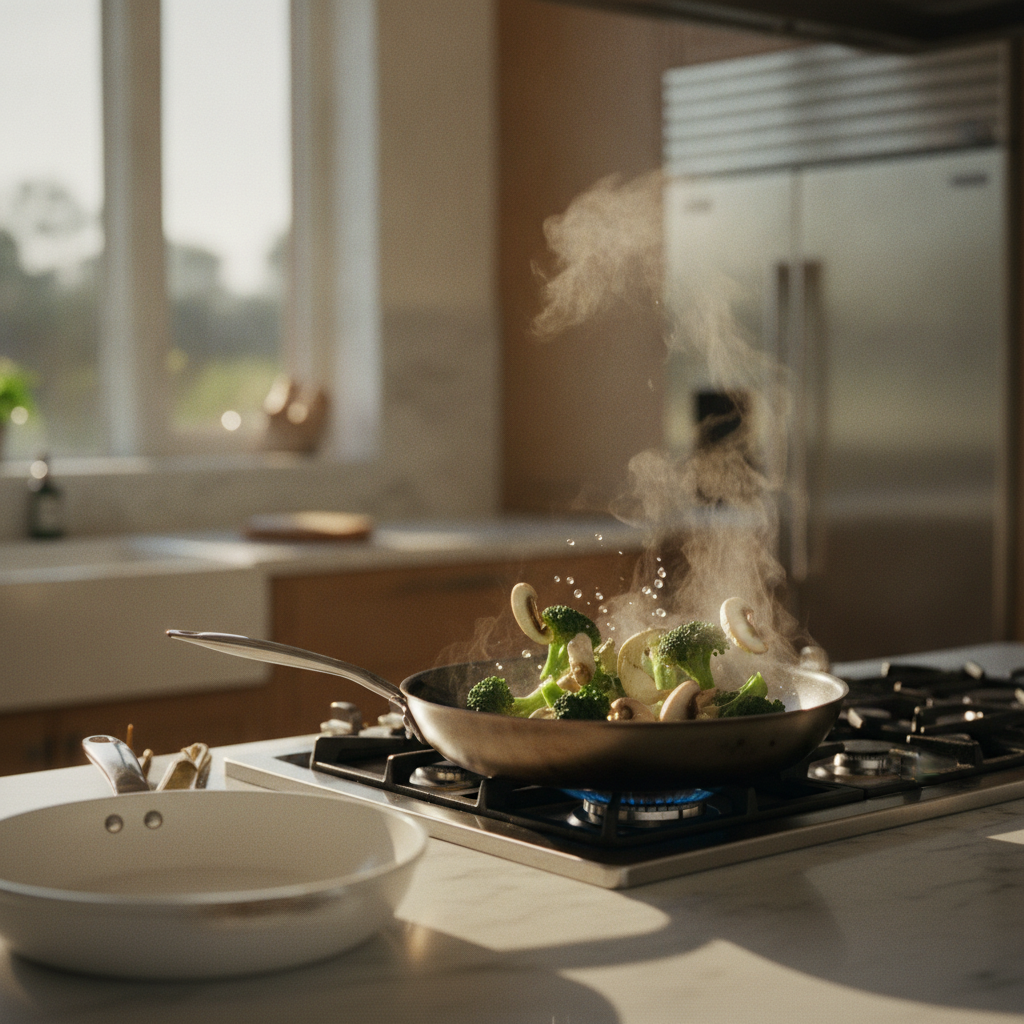
Nonstick pans deliver immediate oil-free release through low-friction coatings, while carbon steel builds natural nonstick properties through seasoning over time. Pairing both covers more cooking needs than either alone, with nonstick handling delicate foods and carbon steel excelling at high-heat searing.
Why Pan Choice Matters for Oil-Free Vegan Cooking
Nonstick pans release food without oil because their coating fills microscopic surface gaps, while carbon steel requires a seasoning layer you build over time.
The challenge of cooking without oil: adhesion, heat distribution, and food texture
Oil does more in a pan than add flavor. On a microscopic level, every cooking surface, no matter how polished, is covered in tiny hills, valleys, and even caves. Oil's job is to flood those gaps, and once it's hot enough, it triggers a steam effect: food releases moisture, that moisture vaporizes, and the resulting vapor layer lifts the food just enough to keep it from fusing to the metal [1]. This is the same mechanism behind the Leidenfrost effect, where a water droplet dances across a hot surface instead of boiling flat against it [2]. Pull oil out of the equation and that buffer disappears, so proteins and starches make direct contact with bare metal and bond to it almost immediately, especially if the pan hasn't been properly preheated [2].
Heat distribution complicates things further. A pan with uneven heating develops hot spots and cooler zones, and food dropped onto a cool spot releases moisture that drops the surface temperature even more, encouraging sticking rather than browning [2]. Without oil's insulating layer, these temperature swings translate directly into texture problems: vegetables can turn gummy or steam in their own released liquid instead of developing any sear, and the kind of crisp-outside, tender-inside result that oil helps produce becomes harder to achieve [1]. Getting good results oil-free means the pan itself has to compensate for what the oil would normally be doing.
How nonstick and carbon steel handle oil-free sautéing differently
Nonstick pans deliver oil-free release right out of the box because the coating itself has extraordinarily low surface energy, so food has nowhere to grip even without a fat buffer [3]. The PTFE or ceramic layer already fills in the microscopic surface irregularities that oil would otherwise flood, which is why eggs or thin vegetables slide cleanly off a new nonstick pan with zero added fat [3]. Carbon steel works on the opposite principle.
It has no factory coating, so oil-free performance depends entirely on a seasoning layer you build yourself by repeatedly cooking with fat and letting it polymerize onto the steel [4]. That seasoning essentially becomes the pan's permanent "oil," which is why a well-seasoned carbon steel pan can sauté without added fat in a way a brand-new, unseasoned one simply cannot [4]. Heat handling is where the two diverge most.
Carbon steel retains heat aggressively, which helps make up for the missing insulating buffer and supports better browning on vegetables, while nonstick coatings generally need lower, steadier heat to avoid damaging the surface [3]. In practice, nonstick gives you oil-free sautéing from the first use, while carbon steel asks for an upfront seasoning investment before it can match that same release [4].

Nonstick Pans for Oil-Free Vegan Sautéing: Performance, Safety, and Longevity
Ceramic coatings release food without PFAS chemicals and perform comparably to PTFE for oil-free vegan cooking.
Why nonstick surfaces excel at preventing sticking without added fat
Food sticks to metal because bare steel and aluminum have high surface energy, so proteins and sugars bond to the pan almost instantly once heat is applied [5]. PTFE flips that equation. Its carbon-fluorine bonds are so stable and unreactive that the coating ends up with extremely low surface energy, leaving food with almost nothing to grip, water beads on it, oil spreads in a microscopically thin film, and proteins can't form meaningful bonds [5].
That's why a coated pan already fills in the metal's microscopic crevices before you ever add fat, unlike bare steel, which relies on oil to flood those same gaps [5]. Ceramic coatings work on a similar low-friction principle, giving PTFE-free cooks a comparable oil-free release, though the effect tends to fade faster with regular use [5]. In practice, this means eggs, pancake batter, and delicate vegetables can glide off a new nonstick pan with nothing but a splash of water or broth for moisture, since the coating itself is doing the job oil would otherwise handle [6].
The tradeoff is that this release only holds up within a specific heat range. Push a nonstick pan too hot, and the same coating that makes oil-free cooking possible starts to lose its advantage entirely [5].
Health and safety considerations: what you need to know about nonstick coatings for plant-based cooking
For vegan cooks relying on nonstick pans to skip added fat, the coating's safety matters as much as its performance. Independent testing found that PTFE-coated pans can still contain measurable PFOA and other PFAS chemicals even when labeled PFOA-free, while ceramic-coated pans tested free of all 96 PFAS compounds screened [7]. That's because PFOA can form as a byproduct of other PFAS during the curing process, which makes a 'PFOA-free' claim less reliable than a 'PTFE-free' one [7].
Ceramic coatings are made primarily from silicon dioxide and metal oxides rather than any PFAS compound, which is why a PTFE-free, ceramic-coated pan is generally considered a safer bet for oil-free cooking [7]. Scratched or degraded PTFE coatings raise more concern than pans in good condition, and overheating an empty PTFE pan can release fumes that are dangerous to birds and potentially harmful to humans [7]. To limit exposure with any nonstick pan, avoid metal utensils or steel wool that can abrade the surface, skip preheating it empty, and retire it once the coating visibly wears through [7].
Vegan cooks who want a coating-free option entirely can look to carbon steel, since its nonstick quality comes from a seasoned oil layer built over time rather than a factory-applied chemical coating, carrying essentially no PFAS risk [7].
Carbon Steel Pans for Oil-Free Cooking: Building and Maintaining a Natural Nonstick Surface
Polymerized oil layers build a natural nonstick surface over weeks of cooking, but require prompt drying and light oiling after each use to prevent erosion.
How seasoning creates a nonstick layer that improves with use
Seasoning turns bare carbon steel into a cooking surface that behaves like nonstick, but through physics rather than chemistry. Oil heated on the pan polymerizes, meaning it hardens and bonds to the iron, filling the microscopic pores that would otherwise grab food [8]. Each cooking session adds another thin layer that cross-links with the one beneath it, building toward a coating rather than relying on a single application [9]. This explains why a brand-new carbon steel pan feels sticky and finicky: the surface hasn't built up enough polymerized layers yet to seal off the metal's exposed pores [9].
A few weeks of regular cooking, especially with higher-fat foods like bacon or steak, speeds this along, and food tends to stop sticking almost entirely once that seasoning matures [9]. Unlike a factory coating, this layer isn't a one-time fix. It's a physical film reinforced every time you add fat and heat, not a self-healing chemical layer the way chromium oxide protects stainless steel [8]. That also means it isn't indestructible.
Harsh scrubbing, prolonged acid contact, or letting the pan sit wet can strip those layers back to raw iron and undo weeks of buildup [8]. Drying the pan promptly and wiping on a light coat of oil after cooking protects the barrier instead of letting it erode, and following a seasoning routine built around natural oils instead of synthetic shortcuts keeps that nonstick quality compounding rather than resetting with every wash.
Oil-free cooking techniques that work best with carbon steel's heat retention
Carbon steel's responsiveness comes from how thin and light the metal is compared to cast iron, letting it heat up and cool down quickly instead of lagging behind burner adjustments [10]. That same responsiveness pairs with aggressive heat retention once the pan is fully preheated, a combination that lets vegetables sear and caramelize instead of steaming in their own juices, which is the main risk oil-free cooking faces [11].
The preheating step matters here: heating the pan gradually until a few drops of water bead and skitter across the surface signals it is ready, and only then should vegetables or tofu go in [10]. Carbon steel's sloped sides, a design feature cast iron skips, make it easier to toss vegetables continuously during oil-free sautéing, which keeps food moving across the hottest part of the surface and prevents any single spot from sticking too long [11].
High, steady heat combined with constant motion compensates most directly for the missing oil buffer, which is why carbon steel handles high-heat methods like stir-frying and searing so well even without added fat [12]. Mushrooms, broccoli, and other moisture-heavy vegetables benefit from smaller batches, since overcrowding drops the pan's surface temperature and invites sticking exactly the way it would with any other cookware [11].


Nonstick vs Carbon Steel: Choose the Right Pan for Your Vegan Kitchen
Carbon steel outlasts nonstick coatings over time, while nitrided carbon steel skips seasoning and matches nonstick release performance right away.
Decision framework: comparing durability, maintenance, and cooking performance across 5 key factors
Comparing the two materials across five practical factors makes the trade-offs concrete. Durability favors carbon steel, since a properly seasoned carbon steel pan can last decades with basic care, while nonstick coatings wear down and eventually need replacing [13]. Maintenance runs the opposite direction early on: nonstick needs no seasoning, while carbon steel demands drying, a light oil coat, and avoiding long acidic simmers to protect the seasoning layer [14]. Heat tolerance splits sharply too, carbon steel handles aggressive searing heat without damage, while nonstick coatings can degrade once pushed past their rated temperature range [13]. Food release starts in nonstick's favor since a new coated pan slides food free immediately, but one controlled test on coating-free, nitrided carbon steel pans found they released eggs and pancakes cleanly right out of the box with no seasoning required; real-world cooks report a short adjustment period before results match that consistently [15]. Long-term cost tips toward carbon steel, since nonstick pans are cheaper upfront but need periodic replacement as coatings scratch and lose effectiveness over time [13].
Five factors at a glance:
- Durability: carbon steel lasts decades; nonstick wears out [13]
- Maintenance: nonstick needs none; carbon steel needs drying and oiling [14]
- Heat tolerance: carbon steel handles high heat; nonstick degrades [13]
- Food release: nonstick is instant; nitrided carbon steel matched it in one controlled test, though home cooks may need a short adjustment period [15]
- Long-term cost: carbon steel outlasts repeated nonstick replacements [13]
Misen's recommended approach: why many vegan cooks benefit from having both
Pairing a nonstick skillet with a nitrided carbon steel pan covers the gaps either material leaves on its own. Nitrided carbon steel skips the usual seasoning buildup, since the carbonitriding process already smooths the surface, so a quick wash and dry is enough to start cooking instead of the months a traditional carbon steel pan needs to develop release [16]. That head start still comes with a short learning curve: food can stick for the first two to three weeks until you adjust preheating habits, which is where a reliable nonstick pan fills the gap for eggs, tofu, and other delicate foods while the carbon steel pan breaks in [16]. Regular carbon steel also tends to run narrow with tall walls built for tossing, not surface area, so a wider nonstick pan handles high-volume sautéing that a deep carbon steel skillet makes awkward [17]. Keeping both on hand means reaching for nonstick when you need immediate, no-fuss release and carbon steel when a dish calls for aggressive heat and searing. A practical split looks like this:
- Nonstick: eggs, tofu, batters, high-volume stovetop work
- Carbon steel: searing, stir-frying, dishes needing sustained high heat
- Nitrided carbon steel: a middle option with a shorter break-in period [16]
Neither pan replaces the other outright, since nonstick wears out over time and carbon steel asks for upfront patience, but running them side by side covers more of an oil-free vegan cook's daily needs than either pan alone [17]. Explore our collection to find the nonstick and carbon steel pans that fit the way you cook, and lean on our care & maintenance tips to keep both performing for years. Questions about which pan suits your kitchen? Contact us anytime.
Frequently Asked Questions
-
Is a nonstick pan or a carbon steel pan better for oil-free vegan sautéing?
Nonstick gives oil-free release right out of the box because the coating's low surface energy leaves food nothing to grip, while carbon steel needs a seasoning layer built up through repeated cooking before it performs the same way. The article notes nitrided carbon steel is an exception, releasing eggs and pancakes cleanly in one controlled test without prior seasoning, though home cooks may still need a short adjustment period.
-
Are nonstick coatings safe to use for oil-free cooking?
Independent testing cited in the article found PTFE-coated pans can still contain measurable PFOA and other PFAS even when labeled 'PFOA-free,' while ceramic-coated pans tested free of all 96 PFAS compounds screened. To limit exposure with any nonstick pan, avoid metal utensils, don't preheat it empty, and retire it once the coating visibly wears through.
-
How long does a carbon steel pan take to season before it works oil-free?
A brand-new carbon steel pan is sticky and finicky because it hasn't built up enough polymerized oil layers yet. The article says a few weeks of regular cooking, especially with higher-fat foods like bacon or steak, speeds this along, with sticking dropping off almost entirely once the seasoning matures.
-
How many vegetables should I cook at once to avoid sticking without oil?
The article advises smaller batches for moisture-heavy vegetables like mushrooms and broccoli, since overcrowding drops the pan's surface temperature and invites sticking. Keeping food moving and avoiding a packed pan helps maintain the sear instead of steaming.
-
Is carbon steel cheaper than nonstick in the long run for oil-free cooking?
The article notes long-term cost tips toward carbon steel since a well-cared-for pan can last decades, while nonstick coatings wear down and eventually need replacing. Nonstick is cheaper upfront, so compare your actual usage and replacement needs against carbon steel's higher initial investment rather than assuming one is universally less expensive.
- Oil creates a vapor layer that prevents food from sticking to bare metal. Without it, proteins bond directly to the pan surface almost immediately.
- Nonstick coatings deliver immediate oil-free release because their low surface energy fills microscopic gaps that oil would otherwise flood.
- Carbon steel requires seasoning buildup before it performs oil-free, but once polymerized layers develop, it can match nonstick release without chemical coatings.
- Ceramic coatings tested free of all PFAS compounds, while PTFE-coated pans labeled PFOA-free can still contain measurable PFAS from byproducts.
- Carbon steel handles aggressive searing heat without degradation, while nonstick coatings lose effectiveness when pushed past their rated temperature range.
- Nitrided carbon steel skips traditional seasoning and releases food cleanly from the start, though home cooks may need a short adjustment period.
- Pairing nonstick with carbon steel covers more daily cooking needs: use nonstick for eggs and delicate foods, carbon steel for searing and stir-frying.
- https://www.scienceofcooking.com/why_food_sticks.htm
- https://fns.co.in/blogs/news/why-food-sticks-to-your-stainless-steel-frypan-and-how-to-fix-it
- https://brass-steel.com/blogs/tips-and-guides/best-non-stick-pans-explained-find-the-right-fit
- https://cooksofcrocushill.com/blog/guide-to-pfas-free-cookware/
- https://brass-steel.com/blogs/tips-and-guides/science-behind-non-stick-pans-how-they-really-work
- https://ecolutionhome.com/a/blog/nonstick-cookware-your-secret-weapon-for-oil-free-cooking
- https://www.yahoo.com/news/t-always-trust-claims-non-060011551.html
- https://brass-steel.com/blogs/tips-and-guides/carbon-steel-reactivity-what-chemists-need-to-know
- https://news.ycombinator.com/item?id=38152272
- https://brass-steel.com/blogs/tips-and-guides/best-pan-types-for-restaurant-kitchens-a-chefs-guide
- https://www.imesh-kitchenware.com/resources/pros-and-cons-of-carbon-steel-cookware-662de7a252bc0.html
- https://brass-steel.com/blogs/tips-and-guides/what-is-carbon-steel-cookware-guide
- https://brass-steel.com/blogs/tips-and-guides/understanding-carbon-steel-vs-nonstick-comparison
- https://www.bonappetit.com/story/the-carbon-steel-pans-that-replaced-all-my-nonstick-cookware
- https://www.zelpio.com/blog/nonstick-carbon-steel-pans-comparison/
- https://www.vietworldkitchen.com/blog/2025/12/nitrided-carbon-steel-nonstick-pans-review.html
- https://www.leafscore.com/eco-friendly-kitchen-products/cookware/the-best-carbon-steel-pans-based-on-our-staff-tests/
- Summary
- Why Pan Choice Matters for Oil-Free Vegan Cooking
- Nonstick Pans for Oil-Free Vegan Sautéing: Performance, Safety, and Longevity
- Carbon Steel Pans for Oil-Free Cooking: Building and Maintaining a Natural Nonstick Surface
- Nonstick vs Carbon Steel: Choose the Right Pan for Your Vegan Kitchen
- Key Takeaways
- References