

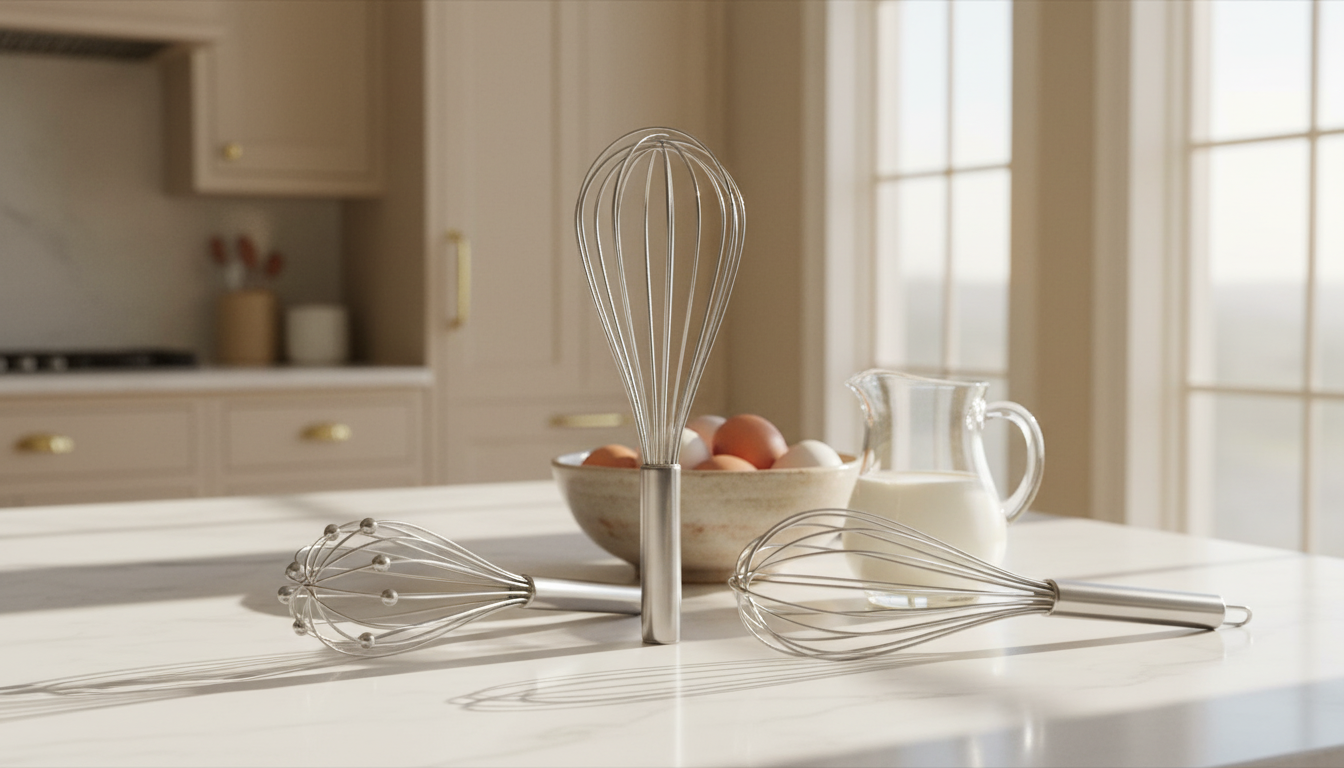
A whisk is far more than a bundle of wires: it is a precision-engineered lever for turning liquid into foam, oil and yolk into silky mayonnaise, and flour into lump-free batters. The article traces the tool's evolution from bundled twigs to specialized shapes--balloon, French, flat, spiral, ball, and Danish dough--that each excel at specific tasks, whether whipping cold cream into stable peaks in under 90 seconds, reaching the tight corners of a saucepan for béarnaise, or cutting through heavy bread dough without clogging. Readers learn the physics behind effective whisking--how vortices trap air, how lecithin in egg yolks binds immiscible liquids, and why side-to-side strokes outperform circles for volume--and get practical guidance on choosing the right whisk for their cookware, matching size to bowl, and maintaining the tool so wires stay aligned and rust-free. Mastering these details translates directly to lighter soufflés, glossier dressings, and faster prep with less arm fatigue, making the humble whisk the quiet hero of both everyday meals and show-stopping desserts.
Understanding the Whisk: A Kitchen Essential
From bundled twigs to coiled-wire marvels, the whisk's 3,000-year journey to your kitchen lets you turn egg whites into clouds and oil into silky dressings by trapping microscopic air bubbles with every flick of your wrist.
Definition and basic structure of a whisk
Think of a whisk as your kitchen's multitasking hero - it's essentially a handle attached to wire loops that work together to blend ingredients and whip air into whatever you're making [1]. Most whisks today feature sturdy metal wires, though you'll also find versions with plastic loops designed to protect your nonstick cookware [2].
It's amazing to think this essential tool started as simple bundles of twigs. Early cooks actually used apple or peach wood branches, which added subtle flavors to their dishes - talk about resourceful cooking [1][2].
The wire whisk we rely on today first appeared before 1841, revolutionizing how we prepare everything from fluffy eggs to perfect pastry cream [2].
Brief history and evolution of whisks
The whisk's journey through history is surprisingly fascinating. Ancient Egyptian, Roman, and Greek cooks started with basic bundles of twigs to mix their ingredients [5].
By the 16th century, European kitchens featured whisks they called "brooms" - bundled twigs held together by wooden or metal frames [4]. Leave it to the French to revolutionize things in the 18th century with the first wire whisk, combining coiled wire with a wooden handle for much more efficient mixing [4].
Those traditional wooden whisks made from birch or silver hazel actually worked brilliantly thanks to their flexible design and multiple contact points [5]. While the wire whisk design gained traction during the Victorian era, American kitchens didn't widely adopt them until much later - proof that even great kitchen innovations take time to catch on [5].
The science behind whisking: Aeration and emulsification
Here's what makes whisking work: it's all about aeration and emulsification. When you whisk, you're essentially creating tiny air bubbles that get smaller and more numerous with each stroke. It's why egg whites transform into fluffy peaks - proteins like ovalbumin and ovomucin work together to trap and stabilize those air bubbles [6].
Emulsification is equally fascinating - it's how whisking helps oil and water play nicely together in dressings and sauces. The key player here is often egg yolk, which contains lecithin that acts like a mediator between these normally incompatible liquids [6]. The effectiveness comes down to physics - your whisk creates turbulence and vortices that distribute ingredients evenly.
That's why the wire spacing and curvature matter so much for getting the job done efficiently [7]. We'll explore these techniques in more detail when we cover specific whisking applications.
Types of Whisks and Their Specific Uses
Master your mixing by matching the task to the whisk: grab a balloon whisk for airy creams and batters, a slim French whisk for dressings and sauces in tight spots, and a ball whisk for scrambling eggs flat in a skillet.
Balloon whisk: The versatile all-rounder
The balloon whisk stands out as the most versatile type, featuring a bulbous shape with multiple thin wires arranged in a balloon-like structure [8]. Its moderate width of 2-3 inches at the widest point provides optimal spacing between wires for effective aeration and emulsification [9].
This design excels at incorporating air into mixtures, making it ideal for whipping cream, beating eggs, and creating smooth batters [8]. A well-designed balloon whisk can transform two cups of heavy cream into soft peaks in under 90 seconds [9].
The wire spacing matters - models with moderately wide balloons and tapered tips work best for both aerating ingredients and reaching bowl corners [9]. For comfortable use, look for whisks with 5-inch handles and good weight balance to reduce hand fatigue during longer mixing tasks [9].
French whisk: For smooth sauces and custards
The French whisk has a narrower, more tapered shape than balloon whisks, perfect for working in smaller pots and containers [10]. Its tightly packed wires make quick work of emulsifying dressings and beating eggs for fluffy omelets, while the tapered design easily reaches into pot corners when making sauces [10].
This whisk shines when preparing salad dressings and just about any sauce you can think of [11]. Keep in mind that the dense wire pattern isn't ideal for thick batters - ingredients can get stuck between the tines [10].
But for creating smooth, perfectly blended mixtures in tight spaces, the French whisk's narrow profile and concentrated wires deliver excellent results [11].
Ball whisk: Reaching corners and tight spaces
Ball whisks feature individual weighted balls at the end of straight tines instead of curved wire loops, making them uniquely suited for specific kitchen tasks. Their design excels at reaching into sharp corners of pots and pans where traditional rounded whisks can't access effectively.
The splayed tines work particularly well for whisking across flat surfaces like wide skillets when making scrambled eggs, and they prove especially useful for mixing ingredients in measuring cups where the tines naturally spread to reach corners. However, ball whisks have limitations - their tines tend to collapse to a single point when working with thick custards or heavy batters, making them less versatile than balloon whisks for general use.
The design also produces notably loud clattering sounds against metal bowls compared to other whisk types.
What Is a Whisk Used For? Unveiling Its Essential Culinary Role
Master your whisk's dual superpowers--spinning thousands of air bubbles into chilled cream or egg whites for lofty peaks and coaxing stubborn oil and yolk into silky emulsions--by adjusting wire thickness, bowl position, and motion to the texture you want.
Incorporating air: Whipping cream and egg whites
A whisk's primary superpower is incorporating air into ingredients. When you're whipping egg whites for fluffy meringues or transforming heavy cream into perfect peaks for your pavlova, your whisk creates thousands of tiny air bubbles that give these ingredients their light, airy texture.
The key to success? Start with properly chilled cream or room-temperature egg whites, then maintain steady, consistent movements - whether you're whisking by hand or using an electric mixer.
While electric mixers work faster, a good balloon whisk gives you better control over texture, preventing overbeating that can turn cream into butter or deflate delicate egg whites. As we explored in the science section, those proteins in egg whites work their magic as you whisk, creating the stable foam structure your recipes need.
Blending and mixing: From batters to dressings
Beyond aeration, whisks are your go-to tool for creating perfectly smooth batters and dressings. When mixing pancake batter or combining ingredients for vinaigrette, your whisk ensures everything comes together evenly - no flour pockets or oil separation. Start from the edges of your bowl and work toward the center using circular motions, adjusting your technique based on what you're making.
For thin dressings, lift the whisk higher to create more mixing action. Working with thicker batters? Keep your whisk low and use quick, tight circles.
The wire configuration matters too - thinner wires handle delicate batters beautifully, while thicker wires power through heavy cookie doughs. You'll find more specific techniques for different recipes in our mastering techniques section below.
Emulsifying: Creating stable mixtures like mayonnaise
Making mayonnaise or hollandaise? Your whisk becomes an emulsification machine, bringing together ingredients that normally don't mix. The secret lies in the egg yolks - nature's perfect emulsifier - combined with patient, steady whisking.
Add your oil drop by drop at first, then in a thin stream, whisking constantly to create that creamy, stable sauce. Keep everything at room temperature for best results, since extreme temperatures can break your emulsion (ever notice how mayo separates on hot food?). While an immersion blender offers a foolproof shortcut, mastering the whisk technique gives you better control and helps you understand when your sauce is coming together perfectly.
Remember the science we covered earlier - those lecithin molecules in egg yolks are doing all the heavy lifting, you're just helping them along with your whisking motion.
Specialized Whisks for Unique Tasks
Master any kitchen challenge by matching your whisk to your task: deploy a Danish dough whisk's stiff, open loops for effortless heavy doughs and a flat whisk's two-dimensional sweep for silky sauces and gravies.
Dough whisk: Mixing heavy batters and doughs
The Danish dough whisk, known as a 'brodpisker' in Denmark, features a unique stiff stainless-steel wire design that resembles an '@' symbol mounted on a wooden handle. Its limited surface area and asymmetrical looped structure allow thick doughs to pass through easily while still providing efficient mixing power. Unlike wooden spoons that lack agitation efficiency or balloon whisks that get clogged with thick mixtures, the dough whisk excels at combining heavy batters and doughs without getting your hands messy.
The tool's rigid wire design and long, sturdy handle let you exert significant force when mixing stiff doughs, while its compact head prevents the flexing common in traditional whisks. For very thick doughs, the whisk's stiff loop can be turned on its edge like a knife to cut and incorporate dry ingredients or mix-ins. The dough whisk proves particularly effective for recipes ranging from bread doughs to muffins and biscuits, gently blending ingredients without overmixing.
Its open design also makes cleanup remarkably simple compared to wooden spoons or traditional whisks, as less batter sticks to the wire loops.
Flat whisk: Ideal for deglazing and making roux
Flat whisks feature a two-dimensional design with wires that loop from the handle in a flat pattern rather than curved shape. This specialized configuration excels at maneuvering in saucepans and pots, making it particularly effective for preparing sauces and gravies.
The flat design proves especially useful for making roux, stirring custards, and preparing dishes that require constant attention like lemon curd. While highly effective for sauce-based tasks, flat whisks have limitations - they don't perform well for aerating ingredients, mixing batters, or combining dry ingredients.
When choosing a flat whisk for your kitchen, look for models with silicone coating if you frequently use nonstick cookware - this prevents scratching and ensures quieter operation. The flat profile also stores more compactly in drawers, making it a practical addition to any well-equipped kitchen.
Spiral whisk: Perfect for small quantities and containers
The spiral whisk features a unique coiled design that makes it particularly effective for mixing small quantities of ingredients in narrow containers. Its tightly wound wire loops create concentrated mixing power while requiring less liquid to function effectively compared to larger whisk styles.
The compact head proves especially useful for whisking in measuring cups, small bowls, or tall containers where traditional balloon or French whisks would be too large or unwieldy. This makes it perfect for single servings of scrambled eggs, small-batch salad dressings, or mixing ingredients directly in their storage containers.
While the spiral whisk excels at quick mixing tasks in confined spaces, it lacks the aeration power of balloon whisks and isn't ideal for whipping large quantities of ingredients. Consider keeping one in your utensil drawer for those times when you need precise mixing in tight spaces - it's an underrated tool that solves specific kitchen challenges.
Mastering Whisking Techniques
Master the side-to-side whisk that slams liquid back and forth to trap extra air, match your circle size to the bowl, and keep cream cold but egg whites at room temperature for the loftiest peaks in half the time.
Proper whisking motions for different tasks
Side-to-side whisking creates maximum shear force and delivers optimal results across most applications. As the whisk moves in one direction, the liquid follows, then encounters resistance when the whisk changes direction - this opposing force incorporates more air than traditional circular stirring [21]. For egg whites specifically, a lifting or beating motion proves most effective since their viscosity allows proteins to cling to the whisk tines and trap additional air.
To enhance efficiency, rotate the mixing bowl with your free hand while whisking to increase agitation and reduce overall whisking time [21]. When working with cream or other ingredients requiring aeration, maintain a 45-degree angle and use consistent speed rather than rushing the motion [20]. The size of your whisking circles should match your bowl - wider circles for large mixing bowls and tighter movements for smaller vessels.
For thin liquids, lift the whisk higher to create more turbulence, while thicker mixtures require lower, faster circular motions [20]. Temperature also impacts technique - cold cream whips more stably than warm, while room temperature egg whites achieve better volume than cold ones [20].
Choosing the right whisk for your recipe
Selecting the right whisk makes all the difference in your cooking results. As covered in our whisk types guide above, each design serves specific purposes - from the versatile balloon whisk for general mixing to specialized tools like the Danish dough whisk for heavy batters.
When choosing, consider both your cookware and the task at hand. Silicone-coated whisks protect nonstick surfaces while operating more quietly than metal alternatives [12].
Match your whisk size to your mixing vessel - a properly sized whisk should move freely without cramping your motion or leaving unmixed areas [23].
Maintenance and care of your whisks
Proper whisk maintenance starts with thorough cleaning after each use. Rinse metal whisks under hot water to remove food particles, avoiding dishwashers which can cause damage [24].
For storage, compress the whisk's wires with rubber bands before placing in drawers to prevent snagging and bending [24]. Alternatively, store whisks upright in utensil holders or consider a
- Balloon whips aerate best; French whips excel in tight pots for dressings and sauces.
- Side-to-side motion beats circles for max air; rotate bowl while whisking to save time.
- Cold cream whips stably; room-temp egg whites give highest foam volume.
- Danish dough whisk's stiff @-shape powers through thick batters without clogging.
- Add oil drop-by-drop when emulsifying; room-temp yolks keep mayo from breaking.
- Match whisk size to bowl and use silicone-coated wires to protect nonstick pans.
- Store whisks upright or band wires to prevent bending and snagging in drawers.