

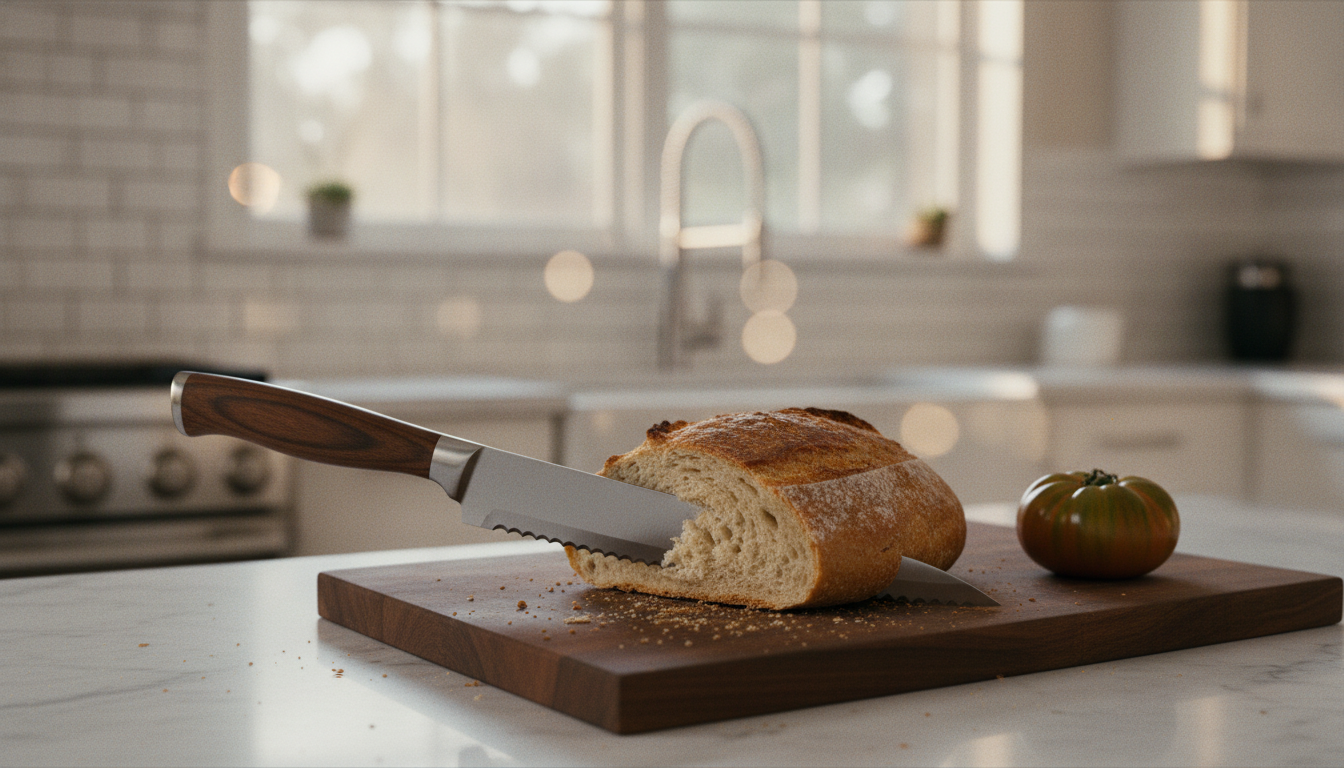
Offset handles clear your knuckles during the sawing motion of serrated blades, while straight handles offer better control for detailed cuts--each excels in different kitchen tasks. Match your handle style to the work: offset for crusty bread and larger cuts, straight for precision with delicate produce.
What Is a Serrated Knife and Why Does Handle Design Matter
Offset handles keep your wrist neutral and knuckles clear during the sawing motion that serrated blades require, making extended prep work more comfortable.
How serrated edges work: teeth that grip instead of slice
A serrated knife works through pointed or wavy teeth spaced along the blade, and each tooth bites into a surface before the sharp edge between the teeth completes the cut. This gripping action is why serrated blades handle tough, slick, or crusty surfaces that would otherwise slide away from a smooth edge, like a crusty loaf or a ripe tomato.
Deeper, sharper points dig into hard crusts on contact, while rounded, scalloped teeth make cleaner cuts through soft foods but require a few passes to break through something tougher [1]. Serration depth matters too: teeth that are too pronounced create a hacking motion instead of a clean saw, and teeth that are too shallow fail to grip at all, so moderate, evenly spaced serrations tend to perform best across both bread and produce [2].
Why handle ergonomics change everything for serrated knives
Handle design determines whether a serrated blade's sawing motion feels natural or fights your wrist. Offset handles drop the grip below the blade's cutting plane, clearing your knuckles from the cutting board so you can saw through a crusty loaf without scraping your fingers against the surface [5].
This geometry also keeps your wrist in a neutral position rather than forcing a downward bend to keep the blade flat, which matters over repeated strokes through a tough crust [4]. Straight handles, by contrast, align your hand directly with the blade, which works fine for single quick cuts but can compound wrist tension during longer sawing sessions [5].
Because serrated blades rely on a back-and-forth motion rather than a rocking chop, the handle you choose directly affects control and comfort during extended prep [5].
Serrated vs Non-Serrated: Performance Comparison Across 5 Common Kitchen Tasks
Serrated blades grip crusty bread and delicate tomato skin without crushing them, while straight edges tend to press and bruise instead of slicing cleanly.
Bread slicing: where serrated edges dominate
Crusty bread is where serrated blades have no real competition, since a straight edge presses down and collapses the soft crumb before it ever gets through the crust [6]. Pointed serrations bite into the crust almost on contact, while blades with rounder, scalloped teeth need a few passes to break through the same crust [1].
A moderate serration pattern, not too deep and not too shallow, cuts the crumb cleanly and keeps the loaf from getting squashed under the blade [2]. (Blade length plays a role here too, and we cover that further down.)
Tomatoes, citrus, and delicate foods: serrated handles the skin without crushing
Tomato skin is slick and thin, and a straight edge tends to press into it before slicing through, bruising the flesh underneath instead of cutting it cleanly [7]. A serrated edge grips that skin on first contact, so the teeth saw through instead of crushing the fruit into a pulpy mess [8].
The same grip advantage extends to citrus: thick, textured rinds catch on the teeth, letting you crack through the peel before switching to a straight edge for cleaner interior slices [6]. Delicate produce like heirloom tomatoes, which turn mealy under pressure, holds together better under a sawing motion than a downward push [7].
Offset Handles vs Straight Handles: Which Grip Style Wins for Serrated Blades
Offset handles give you more knuckle clearance and sawing power for large loaves, while straight handles offer the control and precision you need for delicate cuts.
Offset handles: clearance for knuckles and control during the sawing stroke
An offset handle drops the grip 1 to 2 inches below the blade's spine, which raises your hand and clears your knuckles from the cutting board during the sawing stroke [9]. Taller blade heels amplify this effect, since the higher the blade sits at the heel, the more room your fingers have to curl under the handle without dragging [9].
That extra height also translates into leverage: testers found the raised hand position added power when bearing down through large loaves [9]. The trade-off shows up in control.
Several offset models tested with narrow, short blades flexed and wobbled mid-cut, and one review noted offset shapes offered less control overall compared to a standard straight blade [1][9].
Straight handles: precision and comfort for detailed cutting tasks
A straight handle keeps your hand directly in line with the blade, which suits detailed work like trimming citrus segments or portioning small produce where a downward, controlled cut matters more than sawing power. This alignment gives you clean, precise cuts rather than the gripping action serrations produce, which is why straight edges remain the standard for delicate tasks that need a smooth push through soft material.
A straight-edge utility knife is a good example: it handles fruits, vegetables, and baked goods that fall between paring and chef's knife territory, without the knuckle clearance offset designs add for larger sawing motions [12]. For quick cuts and shorter sessions, a straight handle also stays easier to maneuver and simpler to store alongside the rest of your knife set [10].
Choosing Your Serrated Knife: Handle, Blade Length, and Maintenance Essentials
A 9- or 10-inch serrated blade handles everything from crusty bakery loaves to layer cakes without compromising control on smaller cuts.
Blade length matters: 8-inch vs 10-inch serrated knives for different tasks
A 10-inch serrated blade clears a full-size bakery boule in one stroke, while anything closer to 8 inches often can't cut all the way across without repositioning the loaf [13]. That extra length also helps with cake leveling and large melons, where a single continuous pass keeps the cut flat instead of stepped [13].
An 8-inch blade still handles sandwich loaves, baguettes, and produce like tomatoes or citrus, where the task calls for control over reach [13]. If you're buying one serrated knife for mixed use, a 9- or 10-inch blade gives you more versatility without sacrificing performance on smaller cuts.
A 10-inch serrated knife covers the widest range, from bakery boules to layer cakes [13].
Maintenance and sharpening: why serrated knife care differs from standard blades
Serrated blades hold an edge much longer than straight blades because most of the blade contacts food rather than a cutting board, so a bread knife can go a year or more between sharpenings while a daily-use chef's knife needs attention every month or two [14]. Watch for crumbs piling up when slicing bread or tomato skin tearing instead of parting cleanly under the blade, both signs it's time to sharpen [14]. A standard honing steel won't reach the grooves, so a round honing rod is what works into each scalloped valley, since every tooth functions as its own tiny blade that needs individual attention [14]. The flat back side found on most serrated knives can still be sharpened on a whetstone like a straight edge, but automatic sharpeners that hit both sides at once will ruin the serration pattern [14].
Match the handle to the work in front of you. Reach for an offset serrated knife when you're sawing through crusty loaves and want knuckle clearance, and a straight-handled blade when you need control for detailed cuts. Keep the teeth sharp, store the knife safely, and it'll earn its spot on your counter for years. If sharpening the serrations feels out of reach, our knife sharpening service can handle it for you. Still deciding which blade fits your kitchen? Contact us and we'll point you in the right direction.
- Serrated blades grip crusty surfaces with teeth that bite on contact, preventing collapse of soft interiors.
- Offset handles clear knuckles from the cutting board and reduce wrist strain during extended sawing motions.
- Straight handles provide better control for detailed cuts on delicate produce like heirloom tomatoes.
- A 10-inch blade handles full bakery loaves in one stroke; 8-inch works best for sandwich breads and produce.
- Serrated edges hold their sharpness 2-3x longer than straight blades because less surface contacts the board.
- Round honing rods reach the grooves between serrated teeth; automatic sharpeners damage the serration pattern.
- https://www.nytimes.com/wirecutter/reviews/best-serrated-knife/
- https://www.seriouseats.com/best-bread-serrated-knives-equipment-review
- https://www.dioro.com/blogs/news/offset-vs-straight-blade-high-carbon-stainless-steel-kitchen-scissors?srsltid=AfmBOoq3QlSoBPWK0C5a3NmnWb4Jqrqw8FCLE3S0UqaCiUpxhwSh8Yts
- https://imarku.net/blogs/news/how-to-find-the-best-bread-knife?srsltid=AfmBOoqZRhAoPNMgQHMnUa-h0i3Hd-n8MyaozfCdswX0S2XpuAcWxEHj
- https://fyndamascusknives.com/blogs/knives/bread-knife-guide-uses-sharpening?srsltid=AfmBOop5KXElgRgK0tT1XZdcDCvwFN9zEMDv8KuYEzfCcODQwqfCYLYl
- https://www.opinel-usa.com/blogs/news/serrated-vs-straight-edge-knives-when-each-wins
- https://www.foodrepublic.com/1688346/how-to-cut-tomato-right-way/
- https://www.tastingtable.com/894005/why-thomas-keller-recommends-using-a-bread-knife-to-cut-tomatoes/
- https://www.americastestkitchen.com/equipment_reviews/2497-the-best-serrated-bread-knives
- https://shun.kaiusa.com/shun-cutlery-blog-cutting-edge-of-serration?srsltid=AfmBOop1qf8k3O9HXX73CfHZjQlIX-x_acu1CRwsOyXHVcmU7EWcGTqF
- https://stahlkitchens.com/blogs/news/types-of-knives?srsltid=AfmBOorFa3HBUag2B1McQRj0v-hnQxyIOO_hrfhWiIf8yuqO83W2bYw1
- https://xinzuo.com.au/blogs/news/bread-knife-guide?srsltid=AfmBOorKu_4Uebiu-gaRvLrsOEJ_2XFm1QAm5YhpJZ3DRzLhRj22xQzM
- https://www.foodandwine.com/how-to-sharpen-a-serrated-knife-7152177
- Summary
- What Is a Serrated Knife and Why Does Handle Design Matter
- Serrated vs Non-Serrated: Performance Comparison Across 5 Common Kitchen Tasks
- Offset Handles vs Straight Handles: Which Grip Style Wins for Serrated Blades
- Choosing Your Serrated Knife: Handle, Blade Length, and Maintenance Essentials
- Key Takeaways
- References