

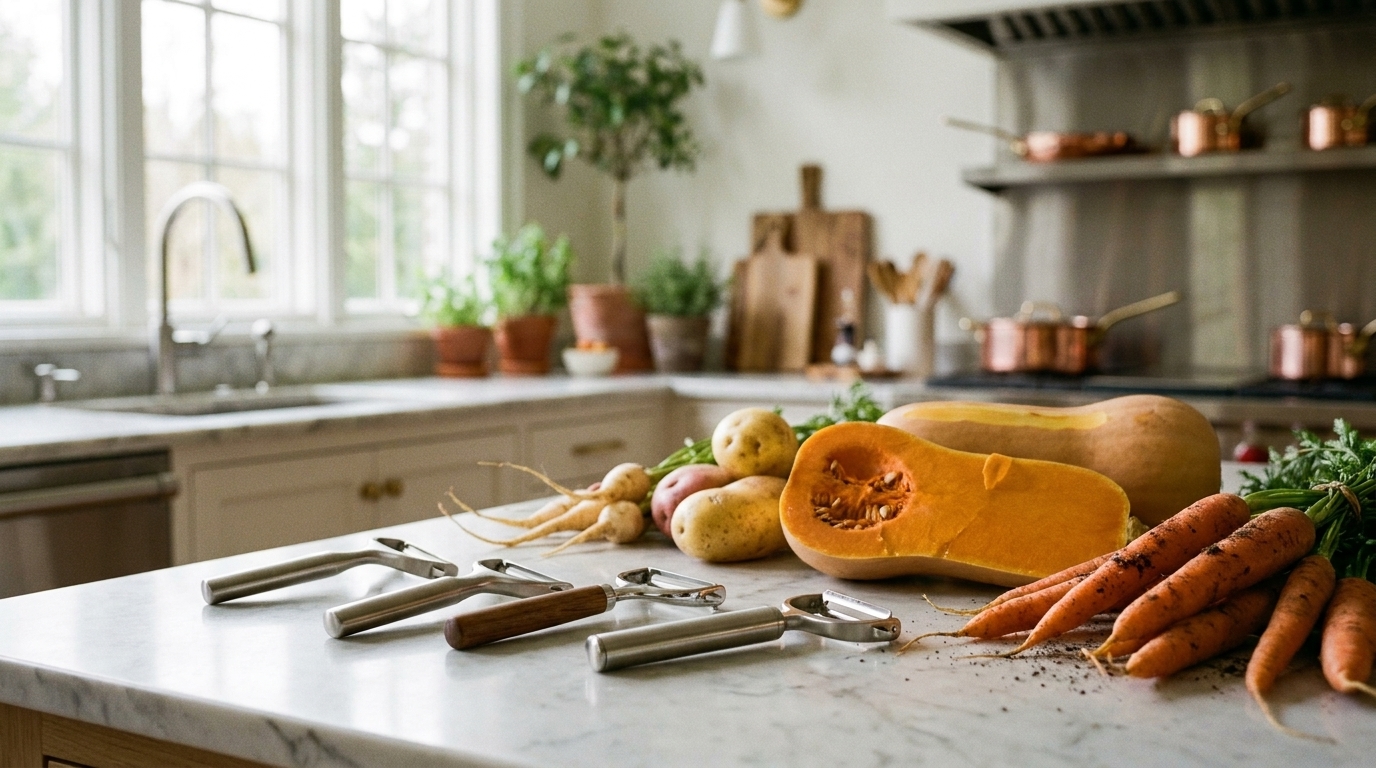
Choosing the right vegetable peeler depends on understanding blade types, handle materials, and which tasks you perform most often. Y-peelers outpace straight swivel models for speed and control, while serrated edges grip tough-skinned produce and multi-tool sets eliminate the need for separate kitchen tools.
Understanding Vegetable Peeler Types
Y-peelers outperform straight swivel models by peeling nearly twice as fast, handling irregular shapes cleanly, and trapping far less skin inside the blade.
Straight (swivel) peelers: Design and functionality
Straight (swivel) peelers have a double blade that runs parallel to the handle, so you push the blade away from you along the produce's surface -- a design sometimes called a "Yorkshire" or "Lancashire" peeler in the UK. [2] The swiveling blade adjusts to the vegetable's contour, and most models include a pointed tip for removing blemishes or potato eyes. [2] Serrated versions grip tougher skins on produce like winter squash and citrus more reliably than a plain edge, making them more versatile than their standard counterparts. [2] In testing, straight swivel peelers tended to skid more on smooth surfaces and struggled around irregular shapes, with skin trapping in the blade more frequently than with Y-peelers. [1]
Y-peelers: Advantages and popular models
The Y-peeler holds its blade perpendicular to the handle, which lets you draw the blade toward you in short, controlled strokes rather than pushing away.
In testing, Y-peelers peeled potatoes nearly twice as fast as straight swivel models, moved more cleanly around irregular shapes, and trapped far less skin inside the blade.[1] The Kuhn Rikon Original Swiss Peeler consistently tops professional kitchen recommendations for its razor-sharp carbon steel blade and sub-$10 price point -- it's the go-to in many professional kitchens -- while the Kuhn Rikon Piranha Y Peeler's serrated edge grips thick-skinned produce like butternut squash on contact without skidding.[3][1] The KitchenAid Classic Y Peeler rounds out the field with a larger non-slip handle that reduces fatigue during longer prep sessions.[1]
Julienne peelers: Specialized uses and benefits
Julienne peelers differ from standard vegetable peelers in one key way: instead of removing skin, they cut produce into thin, uniform strips using a row of small fixed blades. [4] The cutting motion mirrors a Y-peeler -- pull the blade toward you along the produce -- so the technique transfers immediately if you already use one. [5] Carrot ribbons for salads, zucchini strips for stir-fries, and shaved garnishes are where this tool outpaces a knife for speed and consistency. [4] Sets like the Tovolo Magnetic Tri-Peeler include a julienne blade alongside straight and serrated options, so one purchase covers all three common prep tasks. [4]

Key Features to Consider When Choosing a Vegetable Peeler
Blade material, handle comfort, and versatility determine how well a peeler performs across different vegetables and prep tasks.
Blade material and sharpness
Blade material directly affects how long a vegetable peeler stays sharp and how much care it needs.
Carbon steel blades hold an edge longer than stainless steel but rust quickly if left wet, making immediate hand-washing and drying non-negotiable -- the same edge-retention logic that applies to carbon steel knives holds true here. [1] Stainless steel resists corrosion and is generally dishwasher-safe, but may dull faster with frequent use. [1] Serrated edges grip thick-skinned produce like butternut squash and citrus more reliably on contact than plain edges, though they leave visible ridges on smooth-surfaced vegetables like carrots -- making them useful for specific tasks rather than everyday peeling. [1]
Handle ergonomics and grip comfort
Handle material and shape have a direct impact on how long you can peel without discomfort.
Soft rubber or santoprene handles distribute pressure across your palm rather than concentrating it in your fingers -- a meaningful difference when peeling a large batch of produce. [7] Oversized handles, typically around 8 inches long, improve leverage on tough vegetables and work better for cooks with larger hands, arthritis, or reduced grip strength. [8] A non-slip surface matters as much as cushioning: wet hands during vegetable prep are common, and a handle that loses traction forces you to compensate with extra pressure, speeding up fatigue. [6][7]
Versatility and multi-functionality
A vegetable peeler that handles more than one task is worth prioritizing if you prep varied produce regularly.
Sets like the OXO Good Grips 3-Piece cover swivel, serrated, and julienne blades in a single purchase, eliminating the need for separate tools for tomatoes, hard squash, and vegetable ribbons.[9] Beyond peeling, a sharp Y-peeler shaves Parmesan into thin curls, strips lemon rind with minimal pith, and cuts zucchini into long, ribbon-like strips when drawn lengthwise.[9][1] Peelers with bidirectional blades work for both left- and right-handed cooks, while built-in eye scoopers let you switch between peeling and blemish removal without reaching for a paring knife.[9][1]
Top-Rated Vegetable Peelers in the Market
The top-rated peelers balance blade material, cutting depth, and handle comfort--choose based on your preferred peeling motion and maintenance tolerance.
Best overall peelers: OXO Good Grips and Kuhn Rikon models
The Kuhn Rikon Original Swiss Peeler and OXO Good Grips Pro Swivel Peeler consistently top independent testing across multiple sources, but they suit different prep styles. [10][1] The Kuhn Rikon weighs just 13 grams with a carbon steel blade that cuts deeper -- ideal for thick-skinned produce like butternut squash and celery root -- but requires immediate hand-washing and drying to prevent rust. [10][1] The OXO Pro Swivel uses stainless steel, resists corrosion without special care, and makes a shallower cut that handles delicate work like removing citrus rind without digging into the pith. [10][10] Choosing between them is mostly a question of motion: the Kuhn Rikon suits a Y-peeler's pulling stroke, while the OXO fits cooks who favor the back-and-forth wrist motion of a traditional straight swivel peeler. [10]
Budget-friendly options: Mercer Culinary and RSVP Endurance
Mercer Culinary and RSVP Endurance both sit in the under-$15 range where build quality and price align more reliably than at the very lowest price points.
Mercer Culinary's kitchen tools prioritize function over aesthetics -- the brand's lineup consistently delivers professional-grade performance at accessible prices, with comfortable handles and durable construction that hold up to daily prep work. [11] RSVP Endurance takes a comparable approach with its stainless steel line: straightforward, no-fuss designs that resist rust and maintain their shape through regular use, qualities the brand carries across colanders, peelers, and other kitchen essentials. [12] For cooks who want a dependable everyday peeler -- or a backup when the primary one finally wears out -- both brands deliver the same practical durability found across their broader tool ranges without requiring a significant investment. [11][12]
Premium peelers: Rösle Stainless Steel and Suncraft Kaina
Rösle occupies the premium tier through the same German manufacturing standards it applies across its full range of stainless steel kitchen tools.
The brand uses high-quality stainless steel throughout, producing tools that are durable, rust-free, and dishwasher safe -- construction attributes that matter most on tools used daily rather than occasionally. [13] The Suncraft Kaina takes a Japanese approach, pairing a precision blade with an ergonomic handle built for extended prep sessions, making it a practical option for cooks who do heavy vegetable work regularly.
Both models cost significantly more than mid-range options, but the materials and build quality reflect that gap -- particularly in how long each peeler holds its edge before performance noticeably declines. [14]


Peeling Techniques for Different Vegetables
Different vegetables need different peeling approaches--Y-peelers work best for roots, serrated blades for soft produce, and sometimes scrubbing beats peeling entirely.
Efficient peeling methods for root vegetables
For long root vegetables like carrots, parsnips, and celery root, start the peeler at the thicker root end and draw it toward the thin tip in long strokes -- this gives the blade more surface to grip and removes skin in fewer passes. [15] Peeling dry produce is faster than peeling wet: moisture reduces blade grip and increases effort per stroke. [15] For knobby roots like beets and potatoes, a brief boil first loosens the skin enough to pull it off by hand, which reduces waste from blade digging into irregular surfaces. [15] A Y-peeler's bidirectional blade lets you work on both the forward and return stroke, which saves meaningful time when processing a large batch of root vegetables. [9]
Techniques for peeling soft-skinned produce
Soft-skinned produce -- tomatoes, peaches, eggplants, and kiwis -- need a serrated vegetable peeler rather than a plain blade.[16][17] The serrated teeth dig slightly into the skin and cut through it cleanly rather than getting stuck and causing the skin to bunch up, which is what happens when a plain edge meets a delicate surface.[17] For produce with naturally thin, edible skins -- cucumbers, stone fruits, and certain apple varieties -- scrubbing rather than peeling is faster and retains the nutrients concentrated just beneath the surface.[16] If you do need to peel, a partial peel -- removing skin in alternating strips rather than fully -- preserves color and reduces waste on produce like cucumbers.[16]
Tips for peeling challenging vegetables like butternut squash
Butternut squash has two distinct sections with different curves, so a single peeling direction won't cover the whole vegetable cleanly -- cut off both ends first to create flat, stable surfaces before you start.[18][19] Microwaving the uncut squash on high for two minutes after poking it all over with a fork softens the skin enough to reduce the effort per stroke significantly.[20] Use a sharp Y-peeler: peel the bulbous seed end in horizontal strokes around its curve, then switch to downward vertical strokes along the narrower neck section.[18][19] Keep peeling until all white or pale flesh directly under the skin is gone -- that layer can taste fibrous if left behind.[18]
Maintenance and Care of Vegetable Peelers
Hand-wash your peeler immediately after use, sharpen plain-edge blades with a honing rod, and replace it every six months under heavy use to keep it safe and effective.
Proper cleaning and storage practices
Rinse your vegetable peeler under warm water immediately after use -- dried vegetable residue is harder to remove and harbors bacteria in blade crevices. [21] Hand-wash with warm soapy water and use a toothbrush to scrub around swivel joints and blade attachment points where debris collects. [21] Stainless steel peelers are often dishwasher-safe, but -- as with stainless steel pans -- heat and harsh detergents shorten blade life, making hand-washing the better long-term choice. [22] Dry the peeler completely before storing, and keep it away from knives and graters; contact with harder tools chips blade edges and accelerates dulling. [23][22]
Sharpening and replacing peeler blades
Plain-edge carbon and stainless steel blades can be sharpened with a honing rod or metal file -- draw it along the blade at a 15- to 20-degree angle with light pressure, then wipe the blade clean to remove any metal particles. [24] Serrated and ceramic blades won't respond to this method and risk damage from it, so full replacement is the only option when those go dull. [24] Some peelers are designed around this reality with replaceable blades: the Material Forever Peeler and Suncraft Ever Peeler both allow blade swaps at roughly $15 each, letting you keep the handle and replace only the worn part. [1][24] If your peeler has a fixed blade and sharpening hasn't restored its edge, replacing the whole tool is the practical call -- most quality peelers cost well under $20. [1]
Extending the lifespan of your vegetable peeler
How long a vegetable peeler stays functional depends largely on what you peel and how often you use it.
Peelers used daily on dense, knobby vegetables like ginger root or celery root wear down faster than those used occasionally on softer produce -- replacing every six months under heavy use is a practical interval rather than a sign of poor quality. [25] A dull blade is a safety risk beyond just a performance problem: compensating for lost sharpness with extra pressure reduces control and raises the likelihood of the blade skidding off the produce surface. [25] Keeping a spare on hand -- or buying a multi-pack like the Kuhn Rikon Swiss Peeler three-pack -- means you're never stuck finishing prep with a worn tool simply because replacing it feels inconvenient. [25]
- Y-peelers outperform straight swivel peelers by peeling nearly twice as fast with better control around irregular shapes.
- Carbon steel blades hold edges longer but require immediate hand-washing; stainless steel resists rust but dulls faster with frequent use.
- Serrated edges grip thick-skinned produce like butternut squash reliably, but leave visible ridges on smooth vegetables like carrots.
- Soft rubber or santoprene handles with non-slip surfaces reduce fatigue during extended prep work and prevent compensatory pressure injuries.
- A sharp blade is a safety requirement--dull peelers force extra pressure that reduces control and increases skidding risk on produce.
- Peelers with replaceable blades extend tool life affordably; fixed-blade peelers under $20 make full replacement practical when sharpening fails.
- Different vegetables require different techniques: boil knobby roots to loosen skin, microwave squash to soften it, and peel dry produce for faster results.
- https://www.seriouseats.com/best-vegetable-peelers-6892175
- https://www.eatright.org/food/food-preparation/kitchen-tools/peelers-practical-tools-for-paring-produce
- https://www.nytimes.com/wirecutter/reviews/best-vegetable-peeler/
- https://www.goodhousekeeping.com/cooking-tools/g34922659/best-vegetable-peelers/
- https://dalstrong.ca/blogs/news/choosing-the-right-vegetable-peele?srsltid=AfmBOoof6d-W9OWU2BIXLEn7d4MZ8OIZb1lsoB03k12uAYnIycJSO_4p
- https://kitchentoolsadvisor.com/top-rated-ergonomic-vegetable-peelers/
- https://jackscountrystore.com/products/norpro-110-grip-ez-no-slip-peeler
- https://gorillagrip.com/products/peeler?srsltid=AfmBOoo4FYEONqraPpgli3QZ0EdJKK3PPvtOcVURZs0Z_icl9Ez5D3On
- https://www.thespruceeats.com/best-vegetable-peelers-4164913
- https://prudentreviews.com/best-peeler/
- https://www.seriouseats.com/basic-starter-kitchen-equipment
- https://www.seriouseats.com/kitchen-gear-you-should-have-two-of-11696695
- https://www.butch.de/en/roesle-siebe-seiher-trichter.html?srsltid=AfmBOoq1S3DHl_7D3hUgstFRZp3HeRENrFPVwiDDBKE4An_s6qmzLArc
- https://www.butch.de/en/roesle-schneidwaren.html?srsltid=AfmBOopmMhY75Cf4gfNhIKdO6doksUs8AkqpdrvuSScQt10de2RDLP8b
- https://greatist.com/eat/recipe/how-to-peel-stubborn-root-veggies
- https://www.chowhound.com/1573144/peeling-hacks-quick-easy-food-prep/
- https://www.taste.com.au/taste-test-kitchen/articles/little-known-part-vegetable-peeler-you-should-using/h87pmwub
- https://www.seriouseats.com/how-to-cut-butternut-squash-8712492
- https://veggiefunkitchen.com/how-to-peel-and-cube-a-butternut-squash/
- https://www.themountainkitchen.com/how-to-peel-and-cut-butternut-squash/
- https://expedrahome.com/how-to-clean-use-your-vegetable-peeler-properly/
- https://greenchoicelifestyle.com/non-toxic-peelers-for-vegetables/
- https://lifetips.alibaba.com/kitchen-hacks/kitchen-tool-school-the-humble-y-shaped-vegetable-peel
- https://www.foodrepublic.com/1512714/best-way-sharpen-vegetable-peeler/
- https://www.today.com/food/ina-garten-says-replace-your-vegetable-peeler-every-year-t194989