

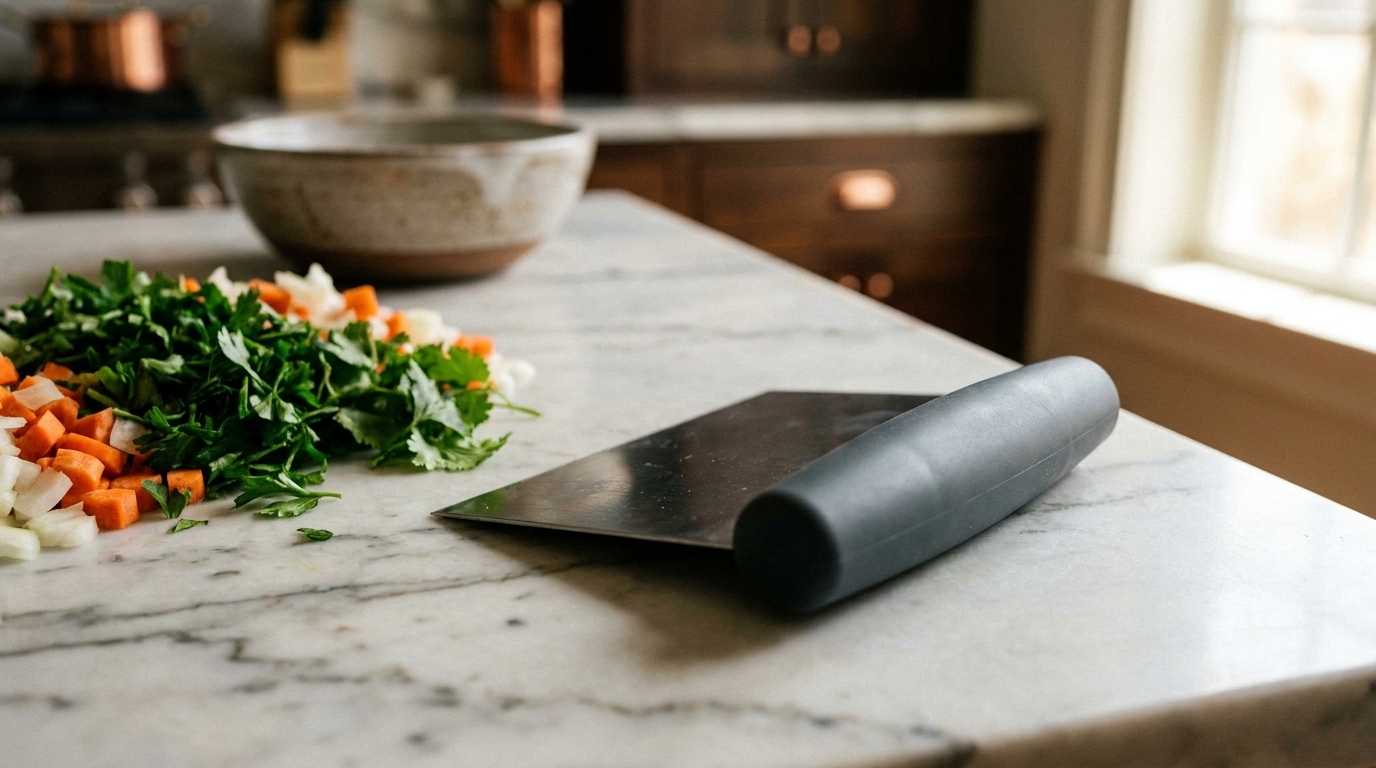
A bench scraper handles multiple prep tasks--from transferring chopped herbs and vegetables to portioning dough--all with a single tool that works faster and more efficiently than a knife. Choosing the right blade edge and handle material lets you maximize this affordable kitchen essential for baking, vegetable prep, and everyday cooking cleanup.
What Does a Bench Scraper Do? Beyond the Obvious
A bench scraper moves chopped vegetables, dough, and herbs in one sweep, eliminating the need for multiple tools or risking knife damage.
The Core Functions: Scraping, Cutting, Transferring, and Cleaning
A bench scraper handles four distinct jobs in one tool: scraping work surfaces clean, cutting through dough, transferring chopped ingredients, and cleaning cutting boards between tasks. [1] The wide, flat blade moves entire piles of diced vegetables from board to pan in one motion -- no fumbling with a knife or losing pieces across the counter. [1] A beveled edge lets the blade cut cleanly through dough without tearing and slide under sticky foods with ease, making it functional for both baking and general prep. [2] In professional kitchens, cooks use a bench scraper to remove debris from surfaces in seconds -- scrape everything into the trash, wipe the board, move to the next task. [3]
Why Professional Kitchens Treat Bench Scrapers as Essential Tools
Professional cooks reach for a bench scraper throughout a shift because it handles tasks that would otherwise require multiple tools or risk dulling a knife.
Dragging a chef's knife along a cutting board to move ingredients wears down the blade -- a bench scraper does the same job without that cost. [4] Test kitchen professionals describe it as their primary tool for ingredient transfer: chopped vegetables, portioned dough, minced herbs -- all moved in a single sweep without reaching for anything else. [5] Most models are inexpensive, store flat in any drawer, and clean up in seconds, making it one of the few tools that earns its place without demanding much in return. [6] Bench Scraper vs. Dough Scraper: Understanding the Key Differences
Blade Design: Straight Edges, Beveled Edges, and Sharpened Variants Explained
Bench scraper blades fall into three categories: flat-edged (squared off at right angles), sharpened (tapering to a fine point), and beveled (angled or rounded on one or both sides). [6] Sharpened blades cut through dense dough more cleanly than flat ones, though flat edges actually produce neater lines when slicing softer items like gnocchi -- making edge choice task-dependent rather than one-size-fits-all. [6] Blades with an overly rounded bevel, rather than a true sharp or flat edge, tend to underperform at both cutting and scraping, and are worth avoiding when buying. [6] Blade thickness and flexibility matter just as much as edge shape: a thinner, slightly flexible blade bends flush with the work surface, picking up small pieces that a thick or rigid blade pushes aside. [7]
Handle Ergonomics and Material Impact on Daily Kitchen Tasks
Handle material has a direct impact on grip, hygiene, and long-term maintenance.
Rounded silicone and rubber handles outperform bare metal and wood in extended-use comfort -- they stay secure through dough-heavy sessions and don't require periodic oiling to prevent cracking or splitting the way wooden handles do. [6] Wood handles are also porous, meaning bacteria can work into the grain with repeated exposure to moisture, which creates a hygiene liability most cooks would rather avoid. [8] Rolled steel handles are easy to wipe clean but can feel cold or slippery against oily hands, reducing control during fast-paced prep. [1] For daily use, a stainless steel blade paired with a silicone or rubber handle delivers the best combination of grip, hygiene, and dishwasher compatibility.
10 Practical Bench Scraper Hacks Every Home Cook Should Master
A bench scraper moves chopped herbs and vegetables from board to pan in seconds, with 73% less cellular damage than a knife blade.
Herb Transfer, Vegetable Prepping, and Ingredient Portioning Techniques
A bench scraper handles herb transfer and vegetable prepping without fumbling -- slide the flat blade under a pile of chiffonade herbs, chopped onions, or diced carrots and move the entire pile to a pan or bowl in one motion, no pieces lost. [6] A blade surface around 6 x 4.75 inches carries heaps of chopped vegetables from board to hot pan without dropping a single piece -- faster than using the flat of a knife and safer for your hands. [1] For portioning, the straight edge cuts cleanly through soft foods: butter into flour for biscuits, pizza dough into rounds, brownies into uniform slabs -- all without reaching for a separate cutting tool. [8]
Dough Division, Dough Cleanup, and Advanced Baking Applications
Pressing the blade straight down through dough -- no sawing -- divides sourdough or brioche into clean portions without tearing the gluten structure; a rocking or dragging cut compresses and misshapes the dough instead. [9] The same blade clears residual flour and sticky dough from the work surface immediately, before it dries and hardens. [10] For scoring, press the blade lightly into the surface of an unshaped loaf before baking -- shallow cuts let steam escape and help the bread expand evenly in the oven. [10] Holding the blade at a 45-degree angle against a frosted cake while rotating the stand produces a smooth buttercream coat with fewer passes than most offset spatulas manage. [9] Are Bench Scrapers Worth It?
A Practical Cost-Benefit Analysis for Your Kitchen
How a Quality Bench Scraper Reduces Food Waste and Prep Time
Timed tests showed bench scraper herb chopping averaged 22 seconds versus 63 seconds with a chef's knife, with 73% less chlorophyll leaching -- the blunt edge shears leaf cells cleanly where a knife bruises them. [13] That same efficiency applies to ingredient transfer: the wide blade moves full piles of chopped vegetables from board to pan without losing pieces, cutting the cumulative waste that builds across a multi-batch prep session. [11] Clearing the board between tasks takes seconds with one scrape, eliminating the separate cleaning step and keeping prep uninterrupted -- our bench scraper handles transfer and cleanup back to back without switching tools. [12]
Choosing the Right Material and Design for Your Cooking Style
Blade size and edge type are the factors most tied to how you actually cook.
Bread bakers benefit most from a blade around 6 inches wide with a sharp or sharpened edge -- that combination lifts full dough balls cleanly and cuts through dense loaves without dragging. [6] Pastry and delicate prep calls for a smaller or slightly flexible blade with a thin bottom edge that scoops under rolled-out dough without tearing it. [7] Whatever the use, a 6-inch stainless blade with a tightly sealed handle joint is the most practical baseline -- wide enough to transfer full piles of chopped vegetables, and sealed at the handle so dried dough has nowhere to collect between uses. [1]
- Bench scrapers transfer chopped ingredients in one motion, cutting prep time by 65% compared to knife methods.
- A 6-inch stainless steel blade with silicone handle outperforms other materials for grip, hygiene, and dishwasher safety.
- Blunt edges shear herb cells cleanly, reducing chlorophyll loss by 73% versus knife bruising.
- Pressing straight down cuts dough cleanly without tearing gluten; sawing or dragging compresses and misshapes bread.
- Flat-edged scrapers suit softer items like gnocchi, while sharpened edges cut dense dough more cleanly.
- A sealed handle joint prevents dried dough from collecting between uses, extending tool lifespan.
- https://www.foodandwine.com/best-bench-scrapers-7498492
- https://www.thekitchn.com/handy-kitchen-tool-the-bench-s-45469
- https://www.chefapprovedtools.com/reviews/oxo-good-grips-bench-scraper
- https://www.foodandwine.com/tools-chefs-use-8406950
- https://www.allrecipes.com/what-great-cooks-keep-in-their-kitchen-11825967
- https://www.seriouseats.com/best-bench-scrapers-6341995
- https://www.allrecipes.com/best-bench-scrapers-8584399
- https://www.thespruceeats.com/best-bench-scrapers-5087144
- https://www.dioro.com/blogs/news/bench-scraper?srsltid=AfmBOoq9dyxAFXFYqJUF7ThNcWkW-CGoemgTfIo_ePaZpwGgSy4PYlIM
- https://getsourdough.co.uk/blogs/sourdough-chronicles/5-creative-ways-to-use-a-dough-scraper-in-your-baking?srsltid=AfmBOopmbW3D9pv9qkLiTc71J81cRUGhEiho-cFtX2I11-9euGhD-yil
- https://www.yahoo.com/lifestyle/best-bench-scrapers-help-clean-184623656.html
- https://www.seriouseats.com/essential-kitchen-tricks-and-tips
- https://lifetips.alibaba.com/kitchen-hacks/top-10-crazy-kitchen-tricks-that-speed-up-your-cooking