

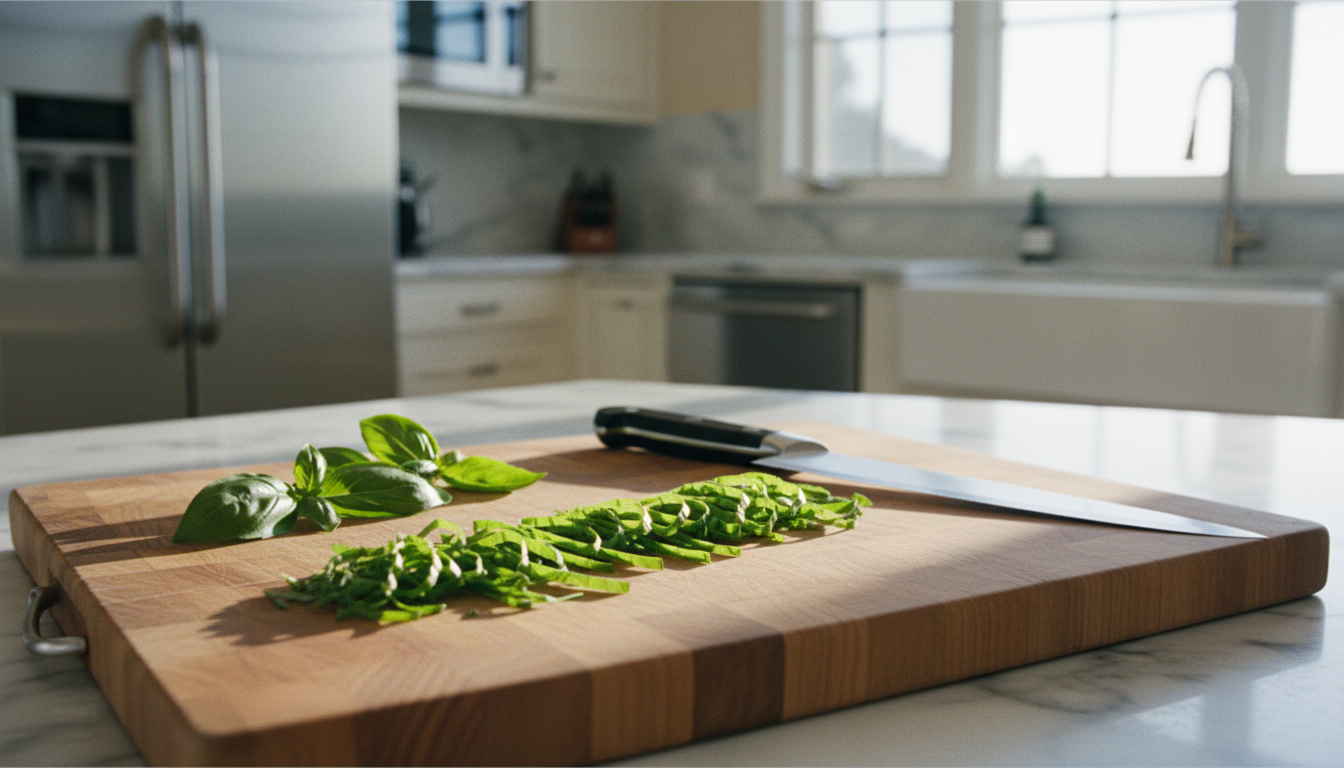
Chiffonade transforms herbs into thin, uniform ribbons that distribute flavor evenly through dishes while preserving color and texture better than mincing or rough chopping. Master the technique by using a sharp knife, rolling leaves tightly, and slicing with a smooth forward motion to achieve consistent results every time.
Understanding the Chiffonade Technique
Chiffonade creates thin, uniform herb strips that distribute evenly through dishes, giving each bite consistent flavor and preserving the herb's bright color and texture.
Defining Chiffonade: 'Little Ribbons' in Modern Cooking
Chiffonade (pronounced shiff-oh-NOD) is a knife technique for cutting leafy herbs and greens into thin, ribbon-like strips -- one of several French knife cuts that remain standard in both professional and home kitchens today. [1] The word comes from the French "chiffon," meaning "rag" or "cloth," though the results look far more like fine ribbons than rags. [2] Originally a garnish technique in classic French cuisine, chiffonade now appears across a range of dishes: threaded through soups, layered into salads, and folded into grain bowls. [1] Finely chiffonading herbs like basil and mint also releases more aromatic compounds than tearing or coarse chopping. [1]
When to Use Chiffonade vs. Other Herb Cutting Methods
Chiffonade is the right choice when you want herbs to remain visible and spread evenly through a dish -- soups, pastas, and composed salads all benefit from this approach. [5] Mincing breaks herbs down to near-paste, which works better in sauces, dressings, and marinades where flavor matters more than texture or appearance. [4] Rough chopping sits between the two: faster than chiffonade but producing uneven pieces that bruise easily and distribute inconsistently. [5] As a general rule, use chiffonade when the herb is part of the presentation, mince when it needs to blend in, and rough chop only when the result won't be seen in the final dish. [4]
The Culinary Benefits of Properly Chiffonaded Herbs
Chiffonade produces thin, uniform strips that distribute evenly through a dish, giving each bite consistent herb flavor instead of uneven pockets. [2] The technique is specifically suited for delicate ingredients because the rolling and slicing motion avoids the bruising that tearing or coarse chopping causes. [2] Preventing bruising preserves the herb's natural color and cellular structure -- keeping basil bright green and mint intact rather than darkened and limp. [2] Those intact cells also mean the herb holds better texture in the finished dish, which is noticeable in salads, pastas, and soups where the herb is part of the eating experience rather than just background flavor. [2]
Tools vs. Technique: What Really Matters for Perfect Results
A sharp knife and a stable cutting board are the only tools required for chiffonade, but sharpness alone doesn't guarantee clean cuts.[6] The real variable is technique: how tightly you roll the leaves, how consistently you space each slice, and whether your stroke is a smooth forward motion rather than a downward press.[7] A dull knife will crush herb cells no matter how precise your hand placement is, while a sharp one can still produce uneven strips if the rolling or slicing motion is inconsistent.[6] Checking your knife's sharpness before starting takes seconds and prevents the bruising and tearing that compromise the whole cut.[8]
Essential Equipment for Perfect Chiffonade
Sharp steel and the right cutting board--wood, bamboo, or quality plastic--preserve your blade's edge and produce clean, consistent ribbons every time.
Selecting the Ideal Knife: Sharpness Over Size
A chef's knife and a Santoku are both well-suited to chiffonade -- their blade profiles support the back-slice motion this cut requires without needing a rocking or chopping stroke. [9] Blade length is a secondary consideration; the size of the knife matters far less than edge geometry and steel quality, both of which determine how cleanly it passes through tightly rolled herb bundles. [9] Harder steel holds its edge angle longer between sharpenings, which is where consistent slice thickness comes from over time.
For more detail on how steel composition affects edge retention, blade hardness and alloy content are the key variables to understand before buying.
Cutting Surface Considerations for Clean Cuts
The cutting surface you use directly affects the quality of your chiffonade.
Hard surfaces -- glass, ceramic, and granite -- cause the blade's edge to roll or chip on contact, accelerating dulling and producing torn ribbons instead of clean cuts. [10] Wood and bamboo boards give slightly under the blade, which preserves edge sharpness while keeping the surface stable; high-quality plastic works as well when hygiene is a priority. [10] Placing a damp cloth under the board prevents it from shifting mid-cut, keeping your slicing motion consistent. [11] If you use a wooden board regularly, keeping it oiled prevents the drying and surface cracks that compromise stability -- a cutting board oiling routine takes about five minutes and extends the board's life considerably.
Optional Tools That Can Improve Consistency
A standard chef's knife handles chiffonade well, but purpose-built knives include structural features that support more consistent cuts.
A gentle curve from handle to tip cups the rolled herb bundle as you slice, keeping leaves from escaping the blade's path -- something a flat blade profile doesn't do as reliably. [12] An offset handle, positioned lower than the blade's center, lets your hand sit closer to the cutting surface for better stability and a more natural rocking motion during each stroke. [12] The blade's reduced thickness from edge to spine also lowers friction through tightly rolled leaves, producing cleaner, more uniform strips with less effort. [12]
Setting Up Your Workspace for Efficiency and Precision
Before cutting a single leaf, set up your workspace using mise en place principles -- keep everything you need within arm's reach and arrange it left to right in the order you'll use it. [13] Place uncut herb bundles on one side, a scrap bowl for stems directly beside the board, and a container for finished ribbons on the other side; this keeps the cutting surface clear throughout the task. [13] When your knife isn't actively slicing, set it flat on the top edge of the board rather than tucked under leaves or hanging off the counter edge. [14] A clear, organized station keeps each slice consistent -- you're not stopping mid-task to move clutter out of the way, which breaks the rhythm that produces uniform cuts. [13]
Mastering the Basic Chiffonade Method
Use a firm pinch grip and consistent forward-downward knife strokes to produce uniform ribbons without crushed or bruised edges.
Preparing Your Herbs: Washing, Drying, and Stem Removal
Wash herbs right before cutting, not in advance -- early washing accelerates wilting and shortens how long they stay usable. [15] Even store-bought bunches carry grit, dust, or bugs, so a quick rinse under cold water followed by a spin in a salad spinner is the standard approach; wet leaves slip under the knife and resist clean slicing rather than producing even ribbons. [15] Herbs like basil, mint, and sage have thick center stems running through each leaf that don't cut cleanly and leave tough, stringy bits in the finished dish -- remove them before stacking. [15] Sort leaves after stripping, setting aside any that are bruised or visibly discolored, since damaged tissue darkens faster once cut and pulls down the appearance of the finished ribbons. [15]
The Stack-and-Roll Technique: Creating the Foundation
Stack leaves largest-to-smallest, face-down, so they naturally curl upward -- this orientation keeps the roll compact and even once you begin slicing. [16] Starting from one of the long ends, roll the stack as tightly as you can while still keeping it manageable, then secure it with your non-dominant hand using a firm pinch grip. [16] The roll doesn't need to be perfect, but it does need to stay together through the full length of the cut -- a loose roll lets leaves shift mid-slice, producing strips of uneven width. [16] Keeping your grip consistent from the first slice to the last is what produces uniform ribbons across the whole bundle. [16]
Executing the Forward Slicing Motion for Clean Cuts
With the roll secured, rest the knife tip on the board and draw the blade forward and slightly down in a single smooth stroke -- this forward-and-down motion keeps cells intact and produces clean ribbons rather than torn, bruised ones. [18] Pressing straight down compresses the roll before the blade passes through it, which is the most common cause of crushed edges in chiffonade. [18] Keep the flat of the blade sliding against your knuckles throughout each stroke, moving your claw hand back in small, even increments to maintain consistent ribbon width. [17] The tip stays in contact with the board the entire time, acting as a pivot point that keeps the cut controlled and repeatable from the first slice to the last. [17]
Visual Guide to Achieving Uniform Thickness
Uniform ribbons fall between 1/16" and 1/8" wide -- thin enough to drape rather than sit flat, but wide enough to hold their shape once plated. [19] After your first two or three slices, check the ribbons: strips that taper at one end or vary noticeably in width indicate that your claw hand is moving in uneven increments rather than steady, measured steps. [19] Keeping the knife perpendicular to the roll -- not angled left or right -- is equally important, since even a slight tilt produces wedge-shaped strips rather than flat ribbons of equal width. [19] If the first few cuts look inconsistent, re-tighten the roll before continuing rather than trying to correct through cutting speed alone. [19]
Advanced Techniques for Different Herb Types
A sharp knife and the two-pass stem-removal method keep delicate herb leaves intact and prevent browning when cutting basil, mint, and sage.
Working with Delicate Herbs Like Basil and Mint
Basil and mint both have high moisture content and thin, flat leaves that bruise and oxidize faster than hardier herbs -- the same chiffonade approach used for delicate greens like spinach applies here, but with less margin for error. [20] A sharp knife is non-negotiable: a dull blade crushes the leaf cells that hold color and flavor, turning cut basil black at the edges within minutes. [21] Stack leaves largest-to-smallest so the roll stays compact, and work quickly -- air exposure after cutting accelerates oxidation regardless of how clean the cut was. [20] Mint's slightly thicker leaves give marginally more working time before browning sets in, but the same rules hold: tight roll, forward slice, and a sharp knife. [21]
Handling Herbs with Tough Center Stems
Mint, sage, and thick-leaved basil varieties all have center stems that resist clean pre-stripping -- folding and tearing the stem out can bruise the leaf before you've even started cutting. [3] A cleaner approach is the two-pass method: stack a few leaves, fold them to hold their shape, then chiffonade from one long edge, stopping just before the center stem. [3] Flip the stack and repeat on the other side, leaving only the bare stem behind to discard. [3] This keeps your slicing motion controlled and your ribbons intact, rather than forcing you to work around torn leaf edges caused by aggressive stem removal. [3]
Adapting Your Technique for Different Leaf Sizes and Textures
Leaf size directly affects how you set up the roll -- larger leaves like spinach, chicory, and sorrel stack naturally with smaller leaves underneath to keep the bundle even, while very small herb leaves need a higher volume per bundle to stay compact through the full length of the cut. [22] The chiffonade herbs technique suits delicate ingredients across a range of sizes, but thicker, sturdier leaves tolerate more roll pressure than thin, fragile ones -- adjust your grip tension accordingly rather than applying the same pressure to every herb. [2] Removing the center rib is also leaf-dependent: large-leafed herbs with pronounced center ribs need them cleared before rolling, while smaller, more uniform leaves can go straight into the stack without that step. [22]
Batch Processing Methods for Cooking in Quantity
When prep volume increases -- cooking for events, meal prepping for the week, or scaling a recipe significantly -- treating chiffonade as a dedicated station task rather than a dish-by-dish step saves meaningful time.
Professional kitchens prep in stages and batches, grouping common ingredients together to reduce setup repetition and improve efficiency. [13] Work through the full stack-and-roll process across multiple herb bundles sequentially, keeping finished ribbons covered with a damp cloth or stored in a sealed container in the refrigerator until service. [13] Prepping roughly 125% of your estimated quantity prevents running short mid-cook without creating unnecessary waste. [13]
Troubleshooting Common Chiffonade Challenges
A sharp knife and tight roll prevent bruising and browning, while proper storage keeps herb ribbons fresh for hours after cutting.
Preventing Oxidation and Discoloration in Cut Herbs
Cut herbs begin oxidizing the moment the blade passes through them -- exposed cells react with oxygen the same way a sliced apple does, turning edges brown within minutes. [23] Cutting right before serving limits this, but when prep-ahead is necessary, two approaches help: cover finished ribbons with a damp cloth to preserve color for a few hours, or lightly coat leaves with oil before rolling and slicing, which seals each cut surface against air exposure. [23] For storage beyond a few hours, place trimmed stems in a shallow amount of cool water in a glass jar, cover loosely, and refrigerate -- this slows the enzymatic decay that drives discoloration. [24] Airtight containers trap ethylene and accelerate browning even under refrigeration, so avoid them. [24]
Solutions for Bruising and Crushing Delicate Leaves
Bruising in delicate herbs comes from three causes: wet leaves, excessive handling, and blades that push rather than slice -- all three compress cells against the board instead of cleanly separating them. [26] A dull edge requires more downward force to pass through leaf tissue, and that extra pressure ruptures more cells than a clean slice would, leaving dark, wet-looking cut surfaces. [26] The fix is direct: dry leaves thoroughly before rolling, handle the bundle as little as possible, and use a smooth forward-and-down stroke rather than a downward press or a dragging motion across the leaf surface. [25] Keeping your knife sharp removes the need for excess force entirely -- and excess force is the root cause of most bruising. [26]
Fixing Uneven or Inconsistent Slices
Inconsistent ribbons usually point to a roll that isn't tight enough or cuts that aren't made in a single deliberate pass.
Rolling the leaves as tightly as possible before slicing keeps the bundle from shifting mid-cut, which is the most direct fix for strips that vary in width. [27] Making each cut in one smooth stroke rather than going back over the same spot preserves cell structure and prevents the tearing that makes ribbons look ragged. [28] Uniform strips require both a compact starting position and consistent spacing between slices -- if either breaks down, pausing to re-roll and reset is faster than trying to compensate through the cutting motion alone. [2]
Practice Exercises to Build Muscle Memory and Consistency
Muscle memory in knife work builds through short, focused sessions rather than extended ones -- fatigue degrades precision and locks in inconsistent habits rather than correcting them. [29] Start with low-resistance ingredients like cucumber or zucchini to isolate grip pressure and slicing motion without fighting tough material; once those movements feel automatic, herbs like basil test whether your technique holds under less forgiving conditions. [29] The same progression applies across other precision cuts -- consistent batonnet work, for example, relies on the same trained muscle memory, so time spent on one cut carries over to others. [30] Running a quick pre-session check -- board secured, knife inspected, station clear -- takes under a minute and keeps each practice block focused on the cut itself rather than correcting setup mid-task. [29]
Creative Applications for Chiffonaded Herbs
Chiffonade ribbons distribute herb flavor evenly through pasta, grains, and salads rather than concentrating it in isolated bites.
Beyond Garnish: Integrating Herb Ribbons Into Dishes
Chiffonade works as more than a last-minute garnish -- the same ribbons can be folded directly into a dish rather than placed on top of it. [31] Stirred into pasta just before serving, herb ribbons coat each strand evenly; the same logic applies to grain bowls and risottos. [31] Fresh herbs added to soups should go in at the end of cooking rather than the start, since prolonged heat eliminates the volatile compounds that carry most of their flavor. [31] Salads that treat chiffonade as a structural ingredient -- not just a topping -- distribute herb flavor through every forkful rather than concentrating it in a few bites. [32]
Pairing Suggestions: Which Herbs Work Best with Different Cuisines
Herb selection follows cuisine logic: sweet Italian basil belongs in Mediterranean dishes -- caprese, pasta sauces, and Neapolitan pizza -- where its mild sweetness pairs naturally with tomatoes, mozzarella, and oregano. [34] Thai basil, with its stronger licorice profile, suits Southeast Asian cooking, where it holds up to heat in stir-fries, curries, and pho without losing texture or flavor. [34] Cilantro is standard in Mexican, Indian, and Middle Eastern dishes; dill pairs well with Scandinavian fish preparations and tzatziki-style sauces; tarragon belongs in French cooking, particularly in béarnaise and egg dishes. [33] Mint works across cuisines -- as a lamb seasoning in Mediterranean cooking, a garnish in Southeast Asian rice paper rolls, and a fresh finish on North African grain dishes. [33]
Presentation Techniques That Showcase Your Knife Skills
Chiffonade ribbons are visible on a finished plate in a way that minced or roughly chopped herbs are not -- their uniform width and curling form communicate deliberate knife work, which is why professional kitchens use the cut as a garnish on pizzas, pastas, and composed salads. [35] Skillful knife cuts aren't purely aesthetic; consistent sizing ensures every element on the plate interacts with the dish the way it was intended, whether that's chiffonade draped across a protein or a brunoise scattered across a sauce. [35] Pairing chiffonade with contrasting cuts on the same plate -- brunoise tomatoes or julienne scallions alongside basil ribbons -- lets each technique read as a distinct visual element rather than blending into undifferentiated green. [5] Cutting ribbons immediately before plating keeps their color sharp, which affects the final appearance as directly as their placement does. [7]
Proper Storage Methods to Preserve Freshness and Appearance
Cut herb ribbons stored in a shallow container lined with a slightly damp paper towel -- covered with a perforated lid rather than a sealed one -- retain color and aromatic intensity for up to 96 hours at 34 degreesF, roughly three times longer than plastic bag storage. [19] For meal prep extending beyond a few days, portion ribbons into silicone ice cube trays, freeze solid, then transfer to vacuum-sealed bags; this method preserves around 94% of volatile aromatics over three months, compared to significant losses in standard freezer bags. [19] Frozen ribbons are best used in cooked applications -- soups, sauces, and grain dishes -- since thawing softens their texture and makes them unsuitable for raw garnish. [25]
- Chiffonade produces uniform, thin ribbons that distribute herb flavor evenly through dishes instead of creating uneven pockets.
- A sharp knife is essential--dull blades crush cells and turn basil black within minutes, regardless of technique.
- Roll leaves tightly and slice with a smooth forward-and-down motion, not a downward press, to keep cells intact.
- Delicate herbs like basil and mint oxidize quickly after cutting; cover with damp cloth or coat with oil to preserve color.
- Stack leaves largest-to-smallest and remove center stems before rolling to maintain a compact bundle throughout slicing.
- Consistent ribbon width (1/16" to 1/8") requires even spacing between slices and a knife perpendicular to the roll.
- Use chiffonade when herbs are part of the presentation; mince when flavor matters more than appearance.
- https://www.forksoverknives.com/how-tos/how-to-chiffonade/
- https://grokipedia.com/page/Chiffonade
- https://www.seriouseats.com/knife-kills-how-to-chiffonade-mint-and-other-leafy-herbs
- https://www.bobsredmill.com/articles/what-are-the-different-types-of-cutting-styles-in-cooking
- https://guide.michelin.com/us/en/article/dining-in/knife-cut-types
- https://www.miascucina.com/how-to-chiffonade-basil/
- https://www.escoffier.edu/blog/culinary-arts/8-knife-cuts-every-professional-cook-should-know/
- https://www.olgasflavorfactory.com/olgastips/basic-knife-skills-for-home-cooks/
- https://fnsharp.com/blogs/fns/fn-sharp-guide-knife-cuts?srsltid=AfmBOooU6PkrG0eYM8YmN7o5F7JcWO8YolZ0hVEwkVZesfeRclReMFGz
- https://trust20.co/blog/mastering-knife-skills
- https://www.tastingtable.com/694985/basic-knife-skills-techniques/
- https://mightygadget.com/how-to-make-the-best-chiffonade-cuts/
- https://www.theculinarypro.com/mise-en-place-savory
- https://www.fabullousfood.com/how-to-organize-your-cutting-board-for-faster-safer-meal-prep/
- https://whatsfordinner.com/kitchen-tips/how-to-prepare-fresh-herbs-video/
- https://www.bowlofdelicious.com/chiffonade/
- https://www.wikihow.com/Chiffonade
- https://fond.kitchen/glossary/chiffonade/
- https://lifetips.alibaba.com/kitchen-hacks/chiffonade-know-how
- https://www.lemon8-app.com/@feastytravels/7429109731932783109?region=us
- https://www.lemon8-app.com/@rachelspamperdkitchen/7425845260254872069?region=us
- https://www.papelonconlimon.it/en/cooking-techniques/chiffonade/
- https://fivelittlechefs.com/recipe/ms-cooking-school/chiffonade-basil.html
- https://lifetips.alibaba.com/kitchen-hacks/knife-kills-how-to-chiffonade-mint-and-other-leafy-herbs
- https://www.jessicagavin.com/how-to-cut-basil/
- https://cursa.app/en/page/chiffonade-and-herb-handling-clean-cuts-without-bruising
- https://whatsfordinner.com/kitchen-tips/culinary-cutting-terms-images/
- https://www.foodandwine.com/knife-cuts-7099945
- https://www.escoffier.edu/blog/value-of-culinary-education/how-to-teach-knife-skills/
- https://lecordonbleusunway.com.my/top-professional-knife-skills-aspiring-chefs-must-know/
- https://fnsharp.com/blogs/fns/cooking-with-fresh-herbs-and-spices?srsltid=AfmBOooAi-VFjs6-T1y-oNGimeQtcwnP6nxs7Ah44q-hhBUWhQ-bqzlI
- https://www.chowhound.com/2188409/creative-ways-use-fresh-basil-this-summer/
- https://fnsharp.com/blogs/fns/cooking-with-fresh-herbs-and-spices?srsltid=AfmBOooaMfHnW3TeNuyu7xdEC5grNjQ-QUoMcWSyM0VcvrUzNB8oDIh4
- https://www.seriouseats.com/thai-basil-vs-italian-basil-8686175
- https://www.webstaurantstore.com/article/796/types-of-knife-cuts.html?srsltid=AfmBOoo1Wbb0Q1PwWnriq_UT6alZlfmvAveUMXBGosrC2NkyisCug4jS