

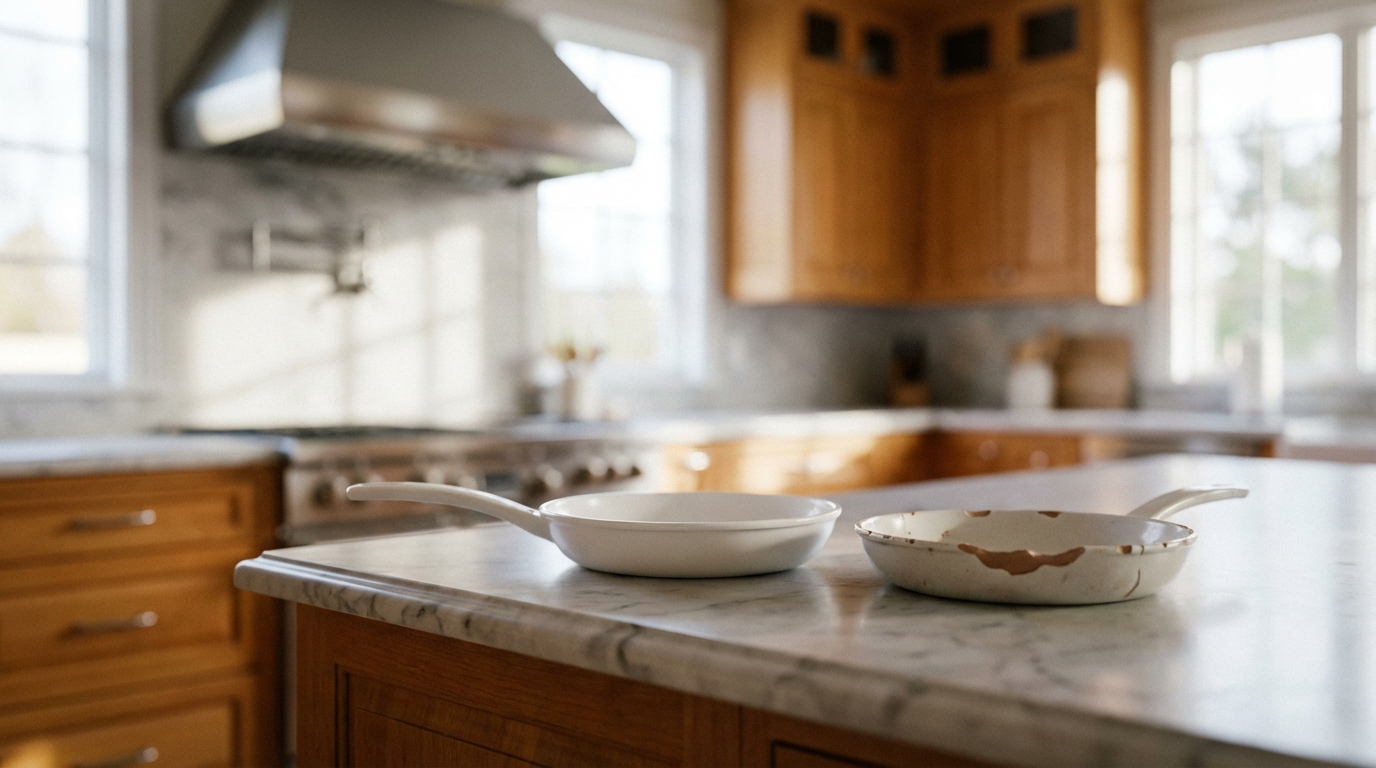
Chipped ceramic cookware rarely poisons you, but it can ruin meals and shorten pan life, so this article shows how to assess the damage, continue cooking safely, and decide when to retire the pot. You'll learn to distinguish cosmetic exterior chips from hazardous cooking-surface damage, remove loose fragments, switch to silicone tools, and adjust heat and oil levels to keep food from sticking. It delivers practical prevention routines--gradual temperature changes, pan protectors, hand-washing, and smart storage--that slash future chipping and extend the life of your investment. Clear replace-or-repair guidelines flag multiple cooking-surface chips, flaking coating, deep cracks, or stubborn sticking as the tipping point, while recommending durable stainless steel upgrades when ceramic is beyond saving. By mastering these care tactics, you save money, reduce waste, and cook with confidence instead of wondering if every chip spells toxins or a new pan.
Ceramic Cookware Chipping Toxic Risk: How Chips Form and What They Mean
Once ceramic cookware chips, its exposed aluminum core can leach into food and trigger heavy-metal exposure, so inspect pans for hairline cracks and stop using them at the first sign of damage.
Impact of chips on cooking performance
A chip doesn't just look bad--it actively works against you the moment heat hits the pan. That glassy ceramic coating is engineered to create a smooth, low-friction surface, but once it's broken, you're left with a rough patch of exposed substrate sitting right in the middle of your nonstick performance. Eggs, cheese, and anything with sugar tend to find that spot, welding themselves to the damaged area while the rest of the pan releases food just fine. It's frustrating precisely because it's inconsistent--you often can't predict when the sticking will happen until it already has.
Heat distribution can take a hit too. Chips disrupt the uniform thermal conductivity ceramic coatings are designed to provide, potentially creating small hot spots or cool pockets around the damaged zone. You may notice uneven browning--one side of your pancake golden, the other pale--or scorching that seems to appear out of nowhere near the chip's edge. Over time, these irregular heating patterns can also stress the surrounding coating, turning a small chip into a spreading crack as repeated expansion and contraction wear at the weakened material.
Then there's the cleanup penalty. Food that sticks to a chipped area tends to burn onto that spot rather than simply resting on top, which means more scrubbing, more soaking, and more temptation to reach for an abrasive sponge or steel wool. That's exactly the wrong move: aggressive scrubbing on a compromised coating accelerates flaking and widens the damage, turning one small chip into several. Ironically, the very act of trying to clean a chipped pan properly can shorten its usable life if you're not careful about which tools you use.
The practical upshot is that chips are a performance problem long before they're a safety problem. You'll likely use more oil, watch the pan more closely, and accept a slightly worse sear or fry than you'd get from an intact surface. That's a reasonable tradeoff for a lightly chipped pan you're not ready to retire, but it's worth naming honestly: a chipped pan is a downgraded pan, and understanding that helps you decide how much extra effort it's actually worth.
The material science behind ceramic chips
Ceramic cookware isn't ceramic all the way through--it's a metal core (usually aluminum, sometimes stainless steel) covered in a glassy, sol-gel coating baked on at high heat. That coating is essentially liquid glass fused to metal, and like any glass-on-metal bond, it's rigid, thin, and unforgiving of flex. Metal expands and contracts with heat, while the ceramic glaze doesn't move nearly as much. Every time you blast a cold pan with high heat or plunge a hot one into cold water, you force two materials with different expansion rates to fight each other at a molecular level. Eventually, the glaze loses.
A chip is what happens when that fight reaches a breaking point. Microscopic stress fractures form first, invisible to the eye, running through the glaze like hairline cracks in a windshield. Repeated thermal shock, a dropped lid, or the scrape of a metal spatula widens these fractures until a visible piece pops loose. Because the coating is only a few microns thick, it doesn't bend or absorb impact the way stainless steel does--it shatters locally, much like a ceramic mug chips rather than dents. That's the core material-science tradeoff: ceramic's nonstick slickness comes from a hard, glassy structure, and hard, glassy structures are inherently more brittle than metal.
What's actually exposed once a chip forms matters more than the chip itself. On many ceramic pans, the metal substrate underneath is plain aluminum, which is soft, reactive, and not meant to touch food directly--hence the coating in the first place. On others, manufacturers use a stainless or anodized base layer specifically so that a chip exposes something food-safe rather than something reactive. This is why two identical-looking chips on two different pans can carry very different risk profiles: one reveals inert stainless steel, while the other reveals bare aluminum that can react with acidic tomatoes or vinegar-based sauces. Knowing your pan's construction--usually listed on the manufacturer's spec sheet--tells you more about a chip's real risk than the size of the chip ever will.
Understanding this layered structure also explains why chip location changes the calculus so much. A chip on the exterior wall or underside of the pan only ever touches heat and air, never food, so it's a durability issue rather than a chemistry one. A chip on the interior cooking surface, by contrast, sits exactly where oil, acid, and high heat repeatedly hit it, accelerating whatever reaction is happening underneath. The physics of how the glaze fractures is the same in both spots; it's the location of the chip relative to your food that decides whether you're dealing with a cosmetic flaw or a genuine safety question.
Health Concerns: Are Chipped Ceramics Actually Toxic?
You can keep cooking on a chipped ceramic pan if the damage is only cosmetic, but switch to gentler utensils, avoid thermal shock, and replace the piece once chips multiply on the cooking surface or food starts sticking.
So your ceramic cookware has a chip or two - now what?
While we've covered whether chips pose health risks, let's talk about how to handle your cookware safely and keep it in the best possible shape.
Immediate Steps for Chipped Cookware
First things first: inspect the damage. Small surface chips on the exterior?
You're probably fine to keep cooking. But chips on the cooking surface require more attention: - Check for loose pieces: Run your finger (carefully) over the chip.
Any rough edges or loose ceramic fragments need to be removed before cooking - Clean thoroughly: Wash the area with warm soapy water to remove any ceramic dust or particles - Avoid metal utensils: Switch to silicone, wood, or plastic tools to prevent further damage
Daily Maintenance Tips
Prevention beats repair every time.
Here's how to minimize future chipping: Temperature management: - Never move ceramic cookware directly from fridge to stovetop - Allow pans to cool before washing - Avoid extreme temperature changes Storage solutions: - Use pan protectors or soft liners between stacked cookware - Hang pots when possible to avoid contact damage - Store lids separately to prevent chips from handle contact Cleaning best practices: - Hand wash when possible (yes, even if it's "dishwasher safe") - Use non-abrasive sponges - Avoid harsh cleaners or scouring powders
When to Repair vs. Replace
Minor exterior chips?
Keep cooking.
But consider replacement when: - Multiple chips appear on the cooking surface - Coating begins peeling or flaking - Deep cracks develop anywhere on the cookware - Food starts sticking despite proper care For cookware that's beyond saving, consider upgrading to more durable options like stainless steel that can handle daily use without the chipping concerns.
Making Chipped Cookware Last
If you're keeping your chipped ceramic pan, adjust your cooking approach: - Use lower heat settings (ceramic retains heat well anyway) - Add extra oil or butter to compensate for any lost nonstick properties - Reserve it for gentler cooking tasks like scrambled eggs or reheating - Monitor the chip area for any changes or deterioration Remember, proper care can extend the life of your cookware significantly - chipped or not.
The key is knowing when minor damage becomes a real concern and adjusting your maintenance routine accordingly.#So your ceramic cookware has a chip or two - now what?
While we've covered whether chips pose health risks, let's talk about how to handle your cookware safely and keep it in the best possible shape.
Immediate Steps for Chipped Cookware
First things first: inspect the damage. Small surface chips on the exterior?
You're probably fine to keep cooking. But chips on the cooking surface require more attention: - Check for loose pieces: Run your finger (carefully) over the chip.
Any rough edges or loose ceramic fragments need to be removed before cooking - Clean thoroughly: Wash the area with warm soapy water to remove any ceramic dust or particles - Avoid metal utensils: Switch to silicone, wood, or plastic tools to prevent further damage
Daily Maintenance Tips
Prevention beats repair every time.
Here's how to minimize future chipping: Temperature management: - Never move ceramic cookware directly from fridge to stovetop - Allow pans to cool before washing - Avoid extreme temperature changes Storage solutions: - Use pan protectors or soft liners between stacked cookware - Hang pots when possible to avoid contact damage - Store lids separately to prevent chips from handle contact Cleaning best practices: - Hand wash when possible (yes, even if it's "dishwasher safe") - Use non-abrasive sponges - Avoid harsh cleaners or scouring powders
When to Repair vs. Replace
Minor exterior chips?
Keep cooking.
But consider replacement when: - Multiple chips appear on the cooking surface - Coating begins peeling or flaking - Deep cracks develop anywhere on the cookware - Food starts sticking despite proper care For cookware that's beyond saving, consider upgrading to more durable options like stainless steel that can handle daily use without the chipping concerns.
Making Chipped Cookware Last
If you're keeping your chipped ceramic pan, adjust your cooking approach: - Use lower heat settings (ceramic retains heat well anyway) - Add extra oil or butter to compensate for any lost nonstick properties - Reserve it for gentler cooking tasks like scrambled eggs or reheating - Monitor the chip area for any changes or deterioration Remember, proper care can extend the life of your cookware significantly - chipped or not.
The key is knowing when minor damage becomes a real concern and adjusting your maintenance routine accordingly.#So your ceramic cookware has a chip or two - now what?
While we've covered whether chips pose health risks, let's talk about how to handle your cookware safely and keep it in the best possible shape.
Immediate Steps for Chipped Cookware
First things first: inspect the damage. Small surface chips on the exterior?
You're probably fine to keep cooking. But chips on the cooking surface require more attention: - Check for loose pieces: Run your finger (carefully) over the chip.
Any rough edges or loose ceramic fragments need to be removed before cooking - Clean thoroughly: Wash the area with warm soapy water to remove any ceramic dust or particles - Avoid metal utensils: Switch to silicone, wood, or plastic tools to prevent further damage
Daily Maintenance Tips
Prevention beats repair every time.
Here's how to minimize future chipping: Temperature management: - Never move ceramic cookware directly from fridge to stovetop - Allow pans to cool before washing - Avoid extreme temperature changes Storage solutions: - Use pan protectors or soft liners between stacked cookware - Hang pots when possible to avoid contact damage - Store lids separately to prevent chips from handle contact Cleaning best practices: - Hand wash when possible (yes, even if it's "dishwasher safe") - Use non-abrasive sponges - Avoid harsh cleaners or scouring powders
When to Repair vs. Replace
Minor exterior chips?
Keep cooking.
But consider replacement when: - Multiple chips appear on the cooking surface - Coating begins peeling or flaking - Deep cracks develop anywhere on the cookware - Food starts sticking despite proper care For cookware that's beyond saving, consider upgrading to more durable options like stainless steel that can handle daily use without the chipping concerns.
Making Chipped Cookware Last
If you're keeping your chipped ceramic pan, adjust your cooking approach: - Use lower heat settings (ceramic retains heat well anyway) - Add extra oil or butter to compensate for any lost nonstick properties - Reserve it for gentler cooking tasks like scrambled eggs or reheating - Monitor the chip area for any changes or deterioration Remember, proper care can extend the life of your cookware significantly - chipped or not. The key is knowing when minor damage becomes a real concern and adjusting your maintenance routine accordingly.
So your ceramic cookware has a chip or two - now what? While we've covered whether chips pose health risks, let's talk about how to handle your cookware safely and keep it in the best possible shape.
Immediate Steps for Chipped Cookware
First things first: inspect the damage. Small surface chips on the exterior?
You're probably fine to keep cooking. But chips on the cooking surface require more attention: - Check for loose pieces: Run your finger (carefully) over the chip.
Any rough edges or loose ceramic fragments need to be removed before cooking - Clean thoroughly: Wash the area with warm soapy water to remove any ceramic dust or particles - Avoid metal utensils: Switch to silicone, wood, or plastic tools to prevent further damage
Daily Maintenance Tips
Prevention beats repair every time.
Here's how to minimize future chipping: Temperature management: - Never move ceramic cookware directly from fridge to stovetop - Allow pans to cool before washing - Avoid extreme temperature changes Storage solutions: - Use pan protectors or soft liners between stacked cookware - Hang pots when possible to avoid contact damage - Store lids separately to prevent chips from handle contact Cleaning best practices: - Hand wash when possible (yes, even if it's "dishwasher safe") - Use non-abrasive sponges - Avoid harsh cleaners or scouring powders
When to Repair vs. Replace
Minor exterior chips?
Keep cooking.
But consider replacement when: - Multiple chips appear on the cooking surface - Coating begins peeling or flaking - Deep cracks develop anywhere on the cookware - Food starts sticking despite proper care For cookware that's beyond saving, consider upgrading to more durable options like stainless steel that can handle daily use without the chipping concerns.
Making Chipped Cookware Last
If you're keeping your chipped ceramic pan, adjust your cooking approach: - Use lower heat settings (ceramic retains heat well anyway) - Add extra oil or butter to compensate for any lost nonstick properties - Reserve it for gentler cooking tasks like scrambled eggs or reheating - Monitor the chip area for any changes or deterioration Remember, proper care can extend the life of your cookware significantly - chipped or not.
The key is knowing when minor damage becomes a real concern and adjusting your maintenance routine accordingly.SSo your ceramic cookware has a chip or two - now what?
While we've covered whether chips pose health risks, let's talk about how to handle your cookware safely and keep it in the best possible shape.
Immediate Steps for Chipped Cookware
First things first: inspect the damage. Small surface chips on the exterior?
You're probably fine to keep cooking. But chips on the cooking surface require more attention: - Check for loose pieces: Run your finger (carefully) over the chip.
Any rough edges or loose ceramic fragments need to be removed before cooking - Clean thoroughly: Wash the area with warm soapy water to remove any ceramic dust or particles - Avoid metal utensils: Switch to silicone, wood, or plastic tools to prevent further damage
Daily Maintenance Tips
Prevention beats repair every time.
Here's how to minimize future chipping: Temperature management: - Never move ceramic cookware directly from fridge to stovetop - Allow pans to cool before washing - Avoid extreme temperature changes Storage solutions: - Use pan protectors or soft liners between stacked cookware - Hang pots when possible to avoid contact damage - Store lids separately to prevent chips from handle contact Cleaning best practices: - Hand wash when possible (yes, even if it's "dishwasher safe") - Use non-abrasive sponges - Avoid harsh cleaners or scouring powders
When to Repair vs. Replace
Minor exterior chips?
Keep cooking.
But consider replacement when: - Multiple chips appear on the cooking surface - Coating begins peeling or flaking - Deep cracks develop anywhere on the cookware - Food starts sticking despite proper care For cookware that's beyond saving, consider upgrading to more durable options like stainless steel that can handle daily use without the chipping concerns.
Making Chipped Cookware Last
If you're keeping your chipped ceramic pan, adjust your cooking approach: - Use lower heat settings (ceramic retains heat well anyway) - Add extra oil or butter to compensate for any lost nonstick properties - Reserve it for gentler cooking tasks like scrambled eggs or reheating - Monitor the chip area for any changes or deterioration Remember, proper care can extend the life of your cookware significantly - chipped or not.
The key is knowing when minor damage becomes a real concern and adjusting your maintenance routine accordingly.aSo your ceramic cookware has a chip or two - now what?
While we've covered whether chips pose health risks, let's talk about how to handle your cookware safely and keep it in the best possible shape.
Immediate Steps for Chipped Cookware
First things first: inspect the damage. Small surface chips on the exterior?
You're probably fine to keep cooking. But chips on the cooking surface require more attention: - Check for loose pieces: Run your finger (carefully) over the chip.
Any rough edges or loose ceramic fragments need to be removed before cooking - Clean thoroughly: Wash the area with warm soapy water to remove any ceramic dust or particles - Avoid metal utensils: Switch to silicone, wood, or plastic tools to prevent further damage
Daily Maintenance Tips
Prevention beats repair every time.
Here's how to minimize future chipping: Temperature management: - Never move ceramic cookware directly from fridge to stovetop - Allow pans to cool before washing - Avoid extreme temperature changes Storage solutions: - Use pan protectors or soft liners between stacked cookware - Hang pots when possible to avoid contact damage - Store lids separately to prevent chips from handle contact Cleaning best practices: - Hand wash when possible (yes, even if it's "dishwasher safe") - Use non-abrasive sponges - Avoid harsh cleaners or scouring powders
When to Repair vs. Replace
Minor exterior chips?
Keep cooking.
But consider replacement when: - Multiple chips appear on the cooking surface - Coating begins peeling or flaking - Deep cracks develop anywhere on the cookware - Food starts sticking despite proper care For cookware that's beyond saving, consider upgrading to more durable options like stainless steel that can handle daily use without the chipping concerns.
Making Chipped Cookware Last
If you're keeping your chipped ceramic pan, adjust your cooking approach: - Use lower heat settings (ceramic retains heat well anyway) - Add extra oil or butter to compensate for any lost nonstick properties - Reserve it for gentler cooking tasks like scrambled eggs or reheating - Monitor the chip area for any changes or deterioration Remember, proper care can extend the life of your cookware significantly - chipped or not.
The key is knowing when minor damage becomes a real concern and adjusting your maintenance routine accordingly.fSo your ceramic cookware has a chip or two - now what?
While we've covered whether chips pose health risks, let's talk about how to handle your cookware safely and keep it in the best possible shape.
Immediate Steps for Chipped Cookware
First things first: inspect the damage. Small surface chips on the exterior?
You're probably fine to keep cooking. But chips on the cooking surface require more attention: - Check for loose pieces: Run your finger (carefully) over the chip.
Any rough edges or loose ceramic fragments need to be removed before cooking - Clean thoroughly: Wash the area with warm soapy water to remove any ceramic dust or particles - Avoid metal utensils: Switch to silicone, wood, or plastic tools to prevent further damage
Daily Maintenance Tips
Prevention beats repair every time.
Here's how to minimize future chipping: Temperature management: - Never move ceramic cookware directly from fridge to stovetop - Allow pans to cool before washing - Avoid extreme temperature changes Storage solutions: - Use pan protectors or soft liners between stacked cookware - Hang pots when possible to avoid contact damage - Store lids separately to prevent chips from handle contact Cleaning best practices: - Hand wash when possible (yes, even if it's "dishwasher safe") - Use non-abrasive sponges - Avoid harsh cleaners or scouring powders
When to Repair vs. Replace
Minor exterior chips?
Keep cooking.
But consider replacement when: - Multiple chips appear on the cooking surface - Coating begins peeling or flaking - Deep cracks develop anywhere on the cookware - Food starts sticking despite proper care For cookware that's beyond saving, consider upgrading to more durable options like stainless steel that can handle daily use without the chipping concerns.
Making Chipped Cookware Last
If you're keeping your chipped ceramic pan, adjust your cooking approach: - Use lower heat settings (ceramic retains heat well anyway) - Add extra oil or butter to compensate for any lost nonstick properties - Reserve it for gentler cooking tasks like scrambled eggs or reheating - Monitor the chip area for any changes or deterioration Remember, proper care can extend the life of your cookware significantly - chipped or not.
The key is knowing when minor damage becomes a real concern and adjusting your maintenance routine accordingly.eSo your ceramic cookware has a chip or two - now what?
While we've covered whether chips pose health risks, let's talk about how to handle your cookware safely and keep it in the best possible shape.
Immediate Steps for Chipped Cookware
First things first: inspect the damage. Small surface chips on the exterior?
You're probably fine to keep cooking. But chips on the cooking surface require more attention: - Check for loose pieces: Run your finger (carefully) over the chip.
Any rough edges or loose ceramic fragments need to be removed before cooking - Clean thoroughly: Wash the area with warm soapy water to remove any ceramic dust or particles - Avoid metal utensils: Switch to silicone, wood, or plastic tools to prevent further damage
Daily Maintenance Tips
Prevention beats repair every time.
Here's how to minimize future chipping: Temperature management: - Never move ceramic cookware directly from fridge to stovetop - Allow pans to cool before washing - Avoid extreme temperature changes Storage solutions: - Use pan protectors or soft liners between stacked cookware - Hang pots when possible to avoid contact damage - Store lids separately to prevent chips from handle contact Cleaning best practices: - Hand wash when possible (yes, even if it's "dishwasher safe") - Use non-abrasive sponges - Avoid harsh cleaners or scouring powders
When to Repair vs. Replace
Minor exterior chips?
Keep cooking.
But consider replacement when: - Multiple chips appear on the cooking surface - Coating begins peeling or flaking - Deep cracks develop anywhere on the cookware - Food starts sticking despite proper care For cookware that's beyond saving, consider upgrading to more durable options like stainless steel that can handle daily use without the chipping concerns.
Making Chipped Cookware Last
If you're keeping your chipped ceramic pan, adjust your cooking approach: - Use lower heat settings (ceramic retains heat well anyway) - Add extra oil or butter to compensate for any lost nonstick properties - Reserve it for gentler cooking tasks like scrambled eggs or reheating - Monitor the chip area for any changes or deterioration Remember, proper care can extend the life of your cookware significantly - chipped or not. The key is knowing when minor damage becomes a real concern and adjusting your maintenance routine accordingly.
So your ceramic cookware has a chip or two - now what? While we've covered whether chips pose health risks, let's talk about how to handle your cookware safely and keep it in the best possible shape.
Immediate Steps for Chipped Cookware
First things first: inspect the damage. Small surface chips on the exterior?
You're probably fine to keep cooking. But chips on the cooking surface require more attention: - Check for loose pieces: Run your finger (carefully) over the chip.
Any rough edges or loose ceramic fragments need to be removed before cooking - Clean thoroughly: Wash the area with warm soapy water to remove any ceramic dust or particles - Avoid metal utensils: Switch to silicone, wood, or plastic tools to prevent further damage
Daily Maintenance Tips
Prevention beats repair every time.
Here's how to minimize future chipping: Temperature management: - Never move ceramic cookware directly from fridge to stovetop - Allow pans to cool before washing - Avoid extreme temperature changes Storage solutions: - Use pan protectors or soft liners between stacked cookware - Hang pots when possible to avoid contact damage - Store lids separately to prevent chips from handle contact Cleaning best practices: - Hand wash when possible (yes, even if it's "dishwasher safe") - Use non-abrasive sponges - Avoid harsh cleaners or scouring powders
When to Repair vs. Replace
Minor exterior chips?
Keep cooking.
But consider replacement when: - Multiple chips appear on the cooking surface - Coating begins peeling or flaking - Deep cracks develop anywhere on the cookware - Food starts sticking despite proper care For cookware that's beyond saving, consider upgrading to more durable options like stainless steel that can handle daily use without the chipping concerns.
Making Chipped Cookware Last
If you're keeping your chipped ceramic pan, adjust your cooking approach: - Use lower heat settings (ceramic retains heat well anyway) - Add extra oil or butter to compensate for any lost nonstick properties - Reserve it for gentler cooking tasks like scrambled eggs or reheating - Monitor the chip area for any changes or deterioration Remember, proper care can extend the life of your cookware significantly - chipped or not.
The key is knowing when minor damage becomes a real concern and adjusting your maintenance routine accordingly.USo your ceramic cookware has a chip or two - now what?
While we've covered whether chips pose health risks, let's talk about how to handle your cookware safely and keep it in the best possible shape.
Immediate Steps for Chipped Cookware
First things first: inspect the damage. Small surface chips on the exterior?
You're probably fine to keep cooking. But chips on the cooking surface require more attention: - Check for loose pieces: Run your finger (carefully) over the chip.
Any rough edges or loose ceramic fragments need to be removed before cooking - Clean thoroughly: Wash the area with warm soapy water to remove any ceramic dust or particles - Avoid metal utensils: Switch to silicone, wood, or plastic tools to prevent further damage
Daily Maintenance Tips
Prevention beats repair every time.
Here's how to minimize future chipping: Temperature management: - Never move ceramic cookware directly from fridge to stovetop - Allow pans to cool before washing - Avoid extreme temperature changes Storage solutions: - Use pan protectors or soft liners between stacked cookware - Hang pots when possible to avoid contact damage - Store lids separately to prevent chips from handle contact Cleaning best practices: - Hand wash when possible (yes, even if it's "dishwasher safe") - Use non-abrasive sponges - Avoid harsh cleaners or scouring powders
When to Repair vs. Replace
Minor exterior chips?
Keep cooking.
But consider replacement when: - Multiple chips appear on the cooking surface - Coating begins peeling or flaking - Deep cracks develop anywhere on the cookware - Food starts sticking despite proper care For cookware that's beyond saving, consider upgrading to more durable options like stainless steel that can handle daily use without the chipping concerns.
Making Chipped Cookware Last
If you're keeping your chipped ceramic pan, adjust your cooking approach: - Use lower heat settings (ceramic retains heat well anyway) - Add extra oil or butter to compensate for any lost nonstick properties - Reserve it for gentler cooking tasks like scrambled eggs or reheating - Monitor the chip area for any changes or deterioration Remember, proper care can extend the life of your cookware significantly - chipped or not.
The key is knowing when minor damage becomes a real concern and adjusting your maintenance routine accordingly.sSo your ceramic cookware has a chip or two - now what?
While we've covered whether chips pose health risks, let's talk about how to handle your cookware safely and keep it in the best possible shape.
Immediate Steps for Chipped Cookware
First things first: inspect the damage. Small surface chips on the exterior?
You're probably fine to keep cooking. But chips on the cooking surface require more attention: - Check for loose pieces: Run your finger (carefully) over the chip.
Any rough edges or loose ceramic fragments need to be removed before cooking - Clean thoroughly: Wash the area with warm soapy water to remove any ceramic dust or particles - Avoid metal utensils: Switch to silicone, wood, or plastic tools to prevent further damage
Daily Maintenance Tips
Prevention beats repair every time.
Here's how to minimize future chipping: Temperature management: - Never move ceramic cookware directly from fridge to stovetop - Allow pans to cool before washing - Avoid extreme temperature changes Storage solutions: - Use pan protectors or soft liners between stacked cookware - Hang pots when possible to avoid contact damage - Store lids separately to prevent chips from handle contact Cleaning best practices: - Hand wash when possible (yes, even if it's "dishwasher safe") - Use non-abrasive sponges - Avoid harsh cleaners or scouring powders
When to Repair vs. Replace
Minor exterior chips?
Keep cooking.
But consider replacement when: - Multiple chips appear on the cooking surface - Coating begins peeling or flaking - Deep cracks develop anywhere on the cookware - Food starts sticking despite proper care For cookware that's beyond saving, consider upgrading to more durable options like stainless steel that can handle daily use without the chipping concerns.
Making Chipped Cookware Last
If you're keeping your chipped ceramic pan, adjust your cooking approach: - Use lower heat settings (ceramic retains heat well anyway) - Add extra oil or butter to compensate for any lost nonstick properties - Reserve it for gentler cooking tasks like scrambled eggs or reheating - Monitor the chip area for any changes or deterioration Remember, proper care can extend the life of your cookware significantly - chipped or not.
The key is knowing when minor damage becomes a real concern and adjusting your maintenance routine accordingly.eSo your ceramic cookware has a chip or two - now what?
While we've covered whether chips pose health risks, let's talk about how to handle your cookware safely and keep it in the best possible shape.
Immediate Steps for Chipped Cookware
First things first: inspect the damage. Small surface chips on the exterior?
You're probably fine to keep cooking. But chips on the cooking surface require more attention: - Check for loose pieces: Run your finger (carefully) over the chip.
Any rough edges or loose ceramic fragments need to be removed before cooking - Clean thoroughly: Wash the area with warm soapy water to remove any ceramic dust or particles - Avoid metal utensils: Switch to silicone, wood, or plastic tools to prevent further damage
Daily Maintenance Tips
Prevention beats repair every time.
Here's how to minimize future chipping: Temperature management: - Never move ceramic cookware directly from fridge to stovetop - Allow pans to cool before washing - Avoid extreme temperature changes Storage solutions: - Use pan protectors or soft liners between stacked cookware - Hang pots when possible to avoid contact damage - Store lids separately to prevent chips from handle contact Cleaning best practices: - Hand wash when possible (yes, even if it's "dishwasher safe") - Use non-abrasive sponges - Avoid harsh cleaners or scouring powders
When to Repair vs. Replace
Minor exterior chips?
Keep cooking.
But consider replacement when: - Multiple chips appear on the cooking surface - Coating begins peeling or flaking - Deep cracks develop anywhere on the cookware - Food starts sticking despite proper care For cookware that's beyond saving, consider upgrading to more durable options like stainless steel that can handle daily use without the chipping concerns.
Making Chipped Cookware Last
If you're keeping your chipped ceramic pan, adjust your cooking approach: - Use lower heat settings (ceramic retains heat well anyway) - Add extra oil or butter to compensate for any lost nonstick properties - Reserve it for gentler cooking tasks like scrambled eggs or reheating - Monitor the chip area for any changes or deterioration Remember, proper care can extend the life of your cookware significantly - chipped or not. The key is knowing when minor damage becomes a real concern and adjusting your maintenance routine accordingly.
So your ceramic cookware has a chip or two - now what? While we've covered whether chips pose health risks, let's talk about how to handle your cookware safely and keep it in the best possible shape.
Immediate Steps for Chipped Cookware
First things first: inspect the damage. Small surface chips on the exterior?
You're probably fine to keep cooking. But chips on the cooking surface require more attention: - Check for loose pieces: Run your finger (carefully) over the chip.
Any rough edges or loose ceramic fragments need to be removed before cooking - Clean thoroughly: Wash the area with warm soapy water to remove any ceramic dust or particles - Avoid metal utensils: Switch to silicone, wood, or plastic tools to prevent further damage
Daily Maintenance Tips
Prevention beats repair every time.
Here's how to minimize future chipping: Temperature management: - Never move ceramic cookware directly from fridge to stovetop - Allow pans to cool before washing - Avoid extreme temperature changes Storage solutions: - Use pan protectors or soft liners between stacked cookware - Hang pots when possible to avoid contact damage - Store lids separately to prevent chips from handle contact Cleaning best practices: - Hand wash when possible (yes, even if it's "dishwasher safe") - Use non-abrasive sponges - Avoid harsh cleaners or scouring powders
When to Repair vs. Replace
Minor exterior chips?
Keep cooking.
But consider replacement when: - Multiple chips appear on the cooking surface - Coating begins peeling or flaking - Deep cracks develop anywhere on the cookware - Food starts sticking despite proper care For cookware that's beyond saving, consider upgrading to more durable options like stainless steel that can handle daily use without the chipping concerns.
Making Chipped Cookware Last
If you're keeping your chipped ceramic pan, adjust your cooking approach: - Use lower heat settings (ceramic retains heat well anyway) - Add extra oil or butter to compensate for any lost nonstick properties - Reserve it for gentler cooking tasks like scrambled eggs or reheating - Monitor the chip area for any changes or deterioration Remember, proper care can extend the life of your cookware significantly - chipped or not.
The key is knowing when minor damage becomes a real concern and adjusting your maintenance routine accordingly.aSo your ceramic cookware has a chip or two - now what?
While we've covered whether chips pose health risks, let's talk about how to handle your cookware safely and keep it in the best possible shape.
Immediate Steps for Chipped Cookware
First things first: inspect the damage. Small surface chips on the exterior?
You're probably fine to keep cooking. But chips on the cooking surface require more attention: - Check for loose pieces: Run your finger (carefully) over the chip.
Any rough edges or loose ceramic fragments need to be removed before cooking - Clean thoroughly: Wash the area with warm soapy water to remove any ceramic dust or particles - Avoid metal utensils: Switch to silicone, wood, or plastic tools to prevent further damage
Daily Maintenance Tips
Prevention beats repair every time.
Here's how to minimize future chipping: Temperature management: - Never move ceramic cookware directly from fridge to stovetop - Allow pans to cool before washing - Avoid extreme temperature changes Storage solutions: - Use pan protectors or soft liners between stacked cookware - Hang pots when possible to avoid contact damage - Store lids separately to prevent chips from handle contact Cleaning best practices: - Hand wash when possible (yes, even if it's "dishwasher safe") - Use non-abrasive sponges - Avoid harsh cleaners or scouring powders
When to Repair vs. Replace
Minor exterior chips?
Keep cooking.
But consider replacement when: - Multiple chips appear on the cooking surface - Coating begins peeling or flaking - Deep cracks develop anywhere on the cookware - Food starts sticking despite proper care For cookware that's beyond saving, consider upgrading to more durable options like stainless steel that can handle daily use without the chipping concerns.
Making Chipped Cookware Last
If you're keeping your chipped ceramic pan, adjust your cooking approach: - Use lower heat settings (ceramic retains heat well anyway) - Add extra oil or butter to compensate for any lost nonstick properties - Reserve it for gentler cooking tasks like scrambled eggs or reheating - Monitor the chip area for any changes or deterioration Remember, proper care can extend the life of your cookware significantly - chipped or not.
The key is knowing when minor damage becomes a real concern and adjusting your maintenance routine accordingly.nSo your ceramic cookware has a chip or two - now what?
While we've covered whether chips pose health risks, let's talk about how to handle your cookware safely and keep it in the best possible shape.
Immediate Steps for Chipped Cookware
First things first: inspect the damage. Small surface chips on the exterior?
You're probably fine to keep cooking. But chips on the cooking surface require more attention: - Check for loose pieces: Run your finger (carefully) over the chip.
Any rough edges or loose ceramic fragments need to be removed before cooking - Clean thoroughly: Wash the area with warm soapy water to remove any ceramic dust or particles - Avoid metal utensils: Switch to silicone, wood, or plastic tools to prevent further damage
Daily Maintenance Tips
Prevention beats repair every time.
Here's how to minimize future chipping: Temperature management: - Never move ceramic cookware directly from fridge to stovetop - Allow pans to cool before washing - Avoid extreme temperature changes Storage solutions: - Use pan protectors or soft liners between stacked cookware - Hang pots when possible to avoid contact damage - Store lids separately to prevent chips from handle contact Cleaning best practices: - Hand wash when possible (yes, even if it's "dishwasher safe") - Use non-abrasive sponges - Avoid harsh cleaners or scouring powders
When to Repair vs. Replace
Minor exterior chips?
Keep cooking.
But consider replacement when: - Multiple chips appear on the cooking surface - Coating begins peeling or flaking - Deep cracks develop anywhere on the cookware - Food starts sticking despite proper care For cookware that's beyond saving, consider upgrading to more durable options like stainless steel that can handle daily use without the chipping concerns.
Making Chipped Cookware Last
If you're keeping your chipped ceramic pan, adjust your cooking approach: - Use lower heat settings (ceramic retains heat well anyway) - Add extra oil or butter to compensate for any lost nonstick properties - Reserve it for gentler cooking tasks like scrambled eggs or reheating - Monitor the chip area for any changes or deterioration Remember, proper care can extend the life of your cookware significantly - chipped or not.
The key is knowing when minor damage becomes a real concern and adjusting your maintenance routine accordingly.dSo your ceramic cookware has a chip or two - now what?
While we've covered whether chips pose health risks, let's talk about how to handle your cookware safely and keep it in the best possible shape.
Immediate Steps for Chipped Cookware
First things first: inspect the damage. Small surface chips on the exterior?
You're probably fine to keep cooking. But chips on the cooking surface require more attention: - Check for loose pieces: Run your finger (carefully) over the chip.
Any rough edges or loose ceramic fragments need to be removed before cooking - Clean thoroughly: Wash the area with warm soapy water to remove any ceramic dust or particles - Avoid metal utensils: Switch to silicone, wood, or plastic tools to prevent further damage
Daily Maintenance Tips
Prevention beats repair every time.
Here's how to minimize future chipping: Temperature management: - Never move ceramic cookware directly from fridge to stovetop - Allow pans to cool before washing - Avoid extreme temperature changes Storage solutions: - Use pan protectors or soft liners between stacked cookware - Hang pots when possible to avoid contact damage - Store lids separately to prevent chips from handle contact Cleaning best practices: - Hand wash when possible (yes, even if it's "dishwasher safe") - Use non-abrasive sponges - Avoid harsh cleaners or scouring powders
When to Repair vs. Replace
Minor exterior chips?
Keep cooking.
But consider replacement when: - Multiple chips appear on the cooking surface - Coating begins peeling or flaking - Deep cracks develop anywhere on the cookware - Food starts sticking despite proper care For cookware that's beyond saving, consider upgrading to more durable options like stainless steel that can handle daily use without the chipping concerns.
Making Chipped Cookware Last
If you're keeping your chipped ceramic pan, adjust your cooking approach: - Use lower heat settings (ceramic retains heat well anyway) - Add extra oil or butter to compensate for any lost nonstick properties - Reserve it for gentler cooking tasks like scrambled eggs or reheating - Monitor the chip area for any changes or deterioration Remember, proper care can extend the life of your cookware significantly - chipped or not. The key is knowing when minor damage becomes a real concern and adjusting your maintenance routine accordingly.
So your ceramic cookware has a chip or two - now what? While we've covered whether chips pose health risks, let's talk about how to handle your cookware safely and keep it in the best possible shape.
Immediate Steps for Chipped Cookware
First things first: inspect the damage. Small surface chips on the exterior?
You're probably fine to keep cooking. But chips on the cooking surface require more attention: - Check for loose pieces: Run your finger (carefully) over the chip.
Any rough edges or loose ceramic fragments need to be removed before cooking - Clean thoroughly: Wash the area with warm soapy water to remove any ceramic dust or particles - Avoid metal utensils: Switch to silicone, wood, or plastic tools to prevent further damage
Daily Maintenance Tips
Prevention beats repair every time.
Here's how to minimize future chipping: Temperature management: - Never move ceramic cookware directly from fridge to stovetop - Allow pans to cool before washing - Avoid extreme temperature changes Storage solutions: - Use pan protectors or soft liners between stacked cookware - Hang pots when possible to avoid contact damage - Store lids separately to prevent chips from handle contact Cleaning best practices: - Hand wash when possible (yes, even if it's "dishwasher safe") - Use non-abrasive sponges - Avoid harsh cleaners or scouring powders
When to Repair vs. Replace
Minor exterior chips?
Keep cooking.
But consider replacement when: - Multiple chips appear on the cooking surface - Coating begins peeling or flaking - Deep cracks develop anywhere on the cookware - Food starts sticking despite proper care For cookware that's beyond saving, consider upgrading to more durable options like stainless steel that can handle daily use without the chipping concerns.
Making Chipped Cookware Last
If you're keeping your chipped ceramic pan, adjust your cooking approach: - Use lower heat settings (ceramic retains heat well anyway) - Add extra oil or butter to compensate for any lost nonstick properties - Reserve it for gentler cooking tasks like scrambled eggs or reheating - Monitor the chip area for any changes or deterioration Remember, proper care can extend the life of your cookware significantly - chipped or not.
The key is knowing when minor damage becomes a real concern and adjusting your maintenance routine accordingly.MSo your ceramic cookware has a chip or two - now what?
While we've covered whether chips pose health risks, let's talk about how to handle your cookware safely and keep it in the best possible shape.
Immediate Steps for Chipped Cookware
First things first: inspect the damage. Small surface chips on the exterior?
You're probably fine to keep cooking. But chips on the cooking surface require more attention: - Check for loose pieces: Run your finger (carefully) over the chip.
Any rough edges or loose ceramic fragments need to be removed before cooking - Clean thoroughly: Wash the area with warm soapy water to remove any ceramic dust or particles - Avoid metal utensils: Switch to silicone, wood, or plastic tools to prevent further damage
Daily Maintenance Tips
Prevention beats repair every time.
Here's how to minimize future chipping: Temperature management: - Never move ceramic cookware directly from fridge to stovetop - Allow pans to cool before washing - Avoid extreme temperature changes Storage solutions: - Use pan protectors or soft liners between stacked cookware - Hang pots when possible to avoid contact damage - Store lids separately to prevent chips from handle contact Cleaning best practices: - Hand wash when possible (yes, even if it's "dishwasher safe") - Use non-abrasive sponges - Avoid harsh cleaners or scouring powders
When to Repair vs. Replace
Minor exterior chips?
Keep cooking.
But consider replacement when: - Multiple chips appear on the cooking surface - Coating begins peeling or flaking - Deep cracks develop anywhere on the cookware - Food starts sticking despite proper care For cookware that's beyond saving, consider upgrading to more durable options like stainless steel that can handle daily use without the chipping concerns.
Making Chipped Cookware Last
If you're keeping your chipped ceramic pan, adjust your cooking approach: - Use lower heat settings (ceramic retains heat well anyway) - Add extra oil or butter to compensate for any lost nonstick properties - Reserve it for gentler cooking tasks like scrambled eggs or reheating - Monitor the chip area for any changes or deterioration Remember, proper care can extend the life of your cookware significantly - chipped or not.
The key is knowing when minor damage becomes a real concern and adjusting your maintenance routine accordingly.aSo your ceramic cookware has a chip or two - now what?
While we've covered whether chips pose health risks, let's talk about how to handle your cookware safely and keep it in the best possible shape.
Immediate Steps for Chipped Cookware
First things first: inspect the damage. Small surface chips on the exterior?
You're probably fine to keep cooking. But chips on the cooking surface require more attention: - Check for loose pieces: Run your finger (carefully) over the chip.
Any rough edges or loose ceramic fragments need to be removed before cooking - Clean thoroughly: Wash the area with warm soapy water to remove any ceramic dust or particles - Avoid metal utensils: Switch to silicone, wood, or plastic tools to prevent further damage
Daily Maintenance Tips
Prevention beats repair every time.
Here's how to minimize future chipping: Temperature management: - Never move ceramic cookware directly from fridge to stovetop - Allow pans to cool before washing - Avoid extreme temperature changes Storage solutions: - Use pan protectors or soft liners between stacked cookware - Hang pots when possible to avoid contact damage - Store lids separately to prevent chips from handle contact Cleaning best practices: - Hand wash when possible (yes, even if it's "dishwasher safe") - Use non-abrasive sponges - Avoid harsh cleaners or scouring powders
When to Repair vs. Replace
Minor exterior chips?
Keep cooking.
But consider replacement when: - Multiple chips appear on the cooking surface - Coating begins peeling or flaking - Deep cracks develop anywhere on the cookware - Food starts sticking despite proper care For cookware that's beyond saving, consider upgrading to more durable options like stainless steel that can handle daily use without the chipping concerns.
Making Chipped Cookware Last
If you're keeping your chipped ceramic pan, adjust your cooking approach: - Use lower heat settings (ceramic retains heat well anyway) - Add extra oil or butter to compensate for any lost nonstick properties - Reserve it for gentler cooking tasks like scrambled eggs or reheating - Monitor the chip area for any changes or deterioration Remember, proper care can extend the life of your cookware significantly - chipped or not.
The key is knowing when minor damage becomes a real concern and adjusting your maintenance routine accordingly.iSo your ceramic cookware has a chip or two - now what?
While we've covered whether chips pose health risks, let's talk about how to handle your cookware safely and keep it in the best possible shape.
Immediate Steps for Chipped Cookware
First things first: inspect the damage. Small surface chips on the exterior?
You're probably fine to keep cooking. But chips on the cooking surface require more attention: - Check for loose pieces: Run your finger (carefully) over the chip.
Any rough edges or loose ceramic fragments need to be removed before cooking - Clean thoroughly: Wash the area with warm soapy water to remove any ceramic dust or particles - Avoid metal utensils: Switch to silicone, wood, or plastic tools to prevent further damage
Daily Maintenance Tips
Prevention beats repair every time.
Here's how to minimize future chipping: Temperature management: - Never move ceramic cookware directly from fridge to stovetop - Allow pans to cool before washing - Avoid extreme temperature changes Storage solutions: - Use pan protectors or soft liners between stacked cookware - Hang pots when possible to avoid contact damage - Store lids separately to prevent chips from handle contact Cleaning best practices: - Hand wash when possible (yes, even if it's "dishwasher safe") - Use non-abrasive sponges - Avoid harsh cleaners or scouring powders
When to Repair vs. Replace
Minor exterior chips?
Keep cooking.
But consider replacement when: - Multiple chips appear on the cooking surface - Coating begins peeling or flaking - Deep cracks develop anywhere on the cookware - Food starts sticking despite proper care For cookware that's beyond saving, consider upgrading to more durable options like stainless steel that can handle daily use without the chipping concerns.
Making Chipped Cookware Last
If you're keeping your chipped ceramic pan, adjust your cooking approach: - Use lower heat settings (ceramic retains heat well anyway) - Add extra oil or butter to compensate for any lost nonstick properties - Reserve it for gentler cooking tasks like scrambled eggs or reheating - Monitor the chip area for any changes or deterioration Remember, proper care can extend the life of your cookware significantly - chipped or not.
The key is knowing when minor damage becomes a real concern and adjusting your maintenance routine accordingly.nSo your ceramic cookware has a chip or two - now what?
While we've covered whether chips pose health risks, let's talk about how to handle your cookware safely and keep it in the best possible shape.
Immediate Steps for Chipped Cookware
First things first: inspect the damage. Small surface chips on the exterior?
You're probably fine to keep cooking. But chips on the cooking surface require more attention: - Check for loose pieces: Run your finger (carefully) over the chip.
Any rough edges or loose ceramic fragments need to be removed before cooking - Clean thoroughly: Wash the area with warm soapy water to remove any ceramic dust or particles - Avoid metal utensils: Switch to silicone, wood, or plastic tools to prevent further damage
Daily Maintenance Tips
Prevention beats repair every time.
Here's how to minimize future chipping: Temperature management: - Never move ceramic cookware directly from fridge to stovetop - Allow pans to cool before washing - Avoid extreme temperature changes Storage solutions: - Use pan protectors or soft liners between stacked cookware - Hang pots when possible to avoid contact damage - Store lids separately to prevent chips from handle contact Cleaning best practices: - Hand wash when possible (yes, even if it's "dishwasher safe") - Use non-abrasive sponges - Avoid harsh cleaners or scouring powders
When to Repair vs. Replace
Minor exterior chips?
Keep cooking.
But consider replacement when: - Multiple chips appear on the cooking surface - Coating begins peeling or flaking - Deep cracks develop anywhere on the cookware - Food starts sticking despite proper care For cookware that's beyond saving, consider upgrading to more durable options like stainless steel that can handle daily use without the chipping concerns.
Making Chipped Cookware Last
If you're keeping your chipped ceramic pan, adjust your cooking approach: - Use lower heat settings (ceramic retains heat well anyway) - Add extra oil or butter to compensate for any lost nonstick properties - Reserve it for gentler cooking tasks like scrambled eggs or reheating - Monitor the chip area for any changes or deterioration Remember, proper care can extend the life of your cookware significantly - chipped or not.
The key is knowing when minor damage becomes a real concern and adjusting your maintenance routine accordingly.tSo your ceramic cookware has a chip or two - now what?
While we've covered whether chips pose health risks, let's talk about how to handle your cookware safely and keep it in the best possible shape.
Immediate Steps for Chipped Cookware
First things first: inspect the damage. Small surface chips on the exterior?
You're probably fine to keep cooking. But chips on the cooking surface require more attention: - Check for loose pieces: Run your finger (carefully) over the chip.
Any rough edges or loose ceramic fragments need to be removed before cooking - Clean thoroughly: Wash the area with warm soapy water to remove any ceramic dust or particles - Avoid metal utensils: Switch to silicone, wood, or plastic tools to prevent further damage
Daily Maintenance Tips
Prevention beats repair every time.
Here's how to minimize future chipping: Temperature management: - Never move ceramic cookware directly from fridge to stovetop - Allow pans to cool before washing - Avoid extreme temperature changes Storage solutions: - Use pan protectors or soft liners between stacked cookware - Hang pots when possible to avoid contact damage - Store lids separately to prevent chips from handle contact Cleaning best practices: - Hand wash when possible (yes, even if it's "dishwasher safe") - Use non-abrasive sponges - Avoid harsh cleaners or scouring powders
When to Repair vs. Replace
Minor exterior chips?
Keep cooking.
But consider replacement when: - Multiple chips appear on the cooking surface - Coating begins peeling or flaking - Deep cracks develop anywhere on the cookware - Food starts sticking despite proper care For cookware that's beyond saving, consider upgrading to more durable options like stainless steel that can handle daily use without the chipping concerns.
Making Chipped Cookware Last
If you're keeping your chipped ceramic pan, adjust your cooking approach: - Use lower heat settings (ceramic retains heat well anyway) - Add extra oil or butter to compensate for any lost nonstick properties - Reserve it for gentler cooking tasks like scrambled eggs or reheating - Monitor the chip area for any changes or deterioration Remember, proper care can extend the life of your cookware significantly - chipped or not.
The key is knowing when minor damage becomes a real concern and adjusting your maintenance routine accordingly.eSo your ceramic cookware has a chip or two - now what?
While we've covered whether chips pose health risks, let's talk about how to handle your cookware safely and keep it in the best possible shape.
Immediate Steps for Chipped Cookware
First things first: inspect the damage. Small surface chips on the exterior?
You're probably fine to keep cooking. But chips on the cooking surface require more attention: - Check for loose pieces: Run your finger (carefully) over the chip.
Any rough edges or loose ceramic fragments need to be removed before cooking - Clean thoroughly: Wash the area with warm soapy water to remove any ceramic dust or particles - Avoid metal utensils: Switch to silicone, wood, or plastic tools to prevent further damage
Daily Maintenance Tips
Prevention beats repair every time.
Here's how to minimize future chipping: Temperature management: - Never move ceramic cookware directly from fridge to stovetop - Allow pans to cool before washing - Avoid extreme temperature changes Storage solutions: - Use pan protectors or soft liners between stacked cookware - Hang pots when possible to avoid contact damage - Store lids separately to prevent chips from handle contact Cleaning best practices: - Hand wash when possible (yes, even if it's "dishwasher safe") - Use non-abrasive sponges - Avoid harsh cleaners or scouring powders
When to Repair vs. Replace
Minor exterior chips?
Keep cooking.
But consider replacement when: - Multiple chips appear on the cooking surface - Coating begins peeling or flaking - Deep cracks develop anywhere on the cookware - Food starts sticking despite proper care For cookware that's beyond saving, consider upgrading to more durable options like stainless steel that can handle daily use without the chipping concerns.
Making Chipped Cookware Last
If you're keeping your chipped ceramic pan, adjust your cooking approach: - Use lower heat settings (ceramic retains heat well anyway) - Add extra oil or butter to compensate for any lost nonstick properties - Reserve it for gentler cooking tasks like scrambled eggs or reheating - Monitor the chip area for any changes or deterioration Remember, proper care can extend the life of your cookware significantly - chipped or not.
The key is knowing when minor damage becomes a real concern and adjusting your maintenance routine accordingly.nSo your ceramic cookware has a chip or two - now what?
While we've covered whether chips pose health risks, let's talk about how to handle your cookware safely and keep it in the best possible shape.
Immediate Steps for Chipped Cookware
First things first: inspect the damage. Small surface chips on the exterior?
You're probably fine to keep cooking. But chips on the cooking surface require more attention: - Check for loose pieces: Run your finger (carefully) over the chip.
Any rough edges or loose ceramic fragments need to be removed before cooking - Clean thoroughly: Wash the area with warm soapy water to remove any ceramic dust or particles - Avoid metal utensils: Switch to silicone, wood, or plastic tools to prevent further damage
Daily Maintenance Tips
Prevention beats repair every time.
Here's how to minimize future chipping: Temperature management: - Never move ceramic cookware directly from fridge to stovetop - Allow pans to cool before washing - Avoid extreme temperature changes Storage solutions: - Use pan protectors or soft liners between stacked cookware - Hang pots when possible to avoid contact damage - Store lids separately to prevent chips from handle contact Cleaning best practices: - Hand wash when possible (yes, even if it's "dishwasher safe") - Use non-abrasive sponges - Avoid harsh cleaners or scouring powders
When to Repair vs. Replace
Minor exterior chips?
Keep cooking.
But consider replacement when: - Multiple chips appear on the cooking surface - Coating begins peeling or flaking - Deep cracks develop anywhere on the cookware - Food starts sticking despite proper care For cookware that's beyond saving, consider upgrading to more durable options like stainless steel that can handle daily use without the chipping concerns.
Making Chipped Cookware Last
If you're keeping your chipped ceramic pan, adjust your cooking approach: - Use lower heat settings (ceramic retains heat well anyway) - Add extra oil or butter to compensate for any lost nonstick properties - Reserve it for gentler cooking tasks like scrambled eggs or reheating - Monitor the chip area for any changes or deterioration Remember, proper care can extend the life of your cookware significantly - chipped or not.
The key is knowing when minor damage becomes a real concern and adjusting your maintenance routine accordingly.aSo your ceramic cookware has a chip or two - now what?
While we've covered whether chips pose health risks, let's talk about how to handle your cookware safely and keep it in the best possible shape.
Immediate Steps for Chipped Cookware
First things first: inspect the damage. Small surface chips on the exterior?
You're probably fine to keep cooking. But chips on the cooking surface require more attention: - Check for loose pieces: Run your finger (carefully) over the chip.
Any rough edges or loose ceramic fragments need to be removed before cooking - Clean thoroughly: Wash the area with warm soapy water to remove any ceramic dust or particles - Avoid metal utensils: Switch to silicone, wood, or plastic tools to prevent further damage
Daily Maintenance Tips
Prevention beats repair every time.
Here's how to minimize future chipping: Temperature management: - Never move ceramic cookware directly from fridge to stovetop - Allow pans to cool before washing - Avoid extreme temperature changes Storage solutions: - Use pan protectors or soft liners between stacked cookware - Hang pots when possible to avoid contact damage - Store lids separately to prevent chips from handle contact Cleaning best practices: - Hand wash when possible (yes, even if it's "dishwasher safe") - Use non-abrasive sponges - Avoid harsh cleaners or scouring powders
When to Repair vs. Replace
Minor exterior chips?
Keep cooking.
But consider replacement when: - Multiple chips appear on the cooking surface - Coating begins peeling or flaking - Deep cracks develop anywhere on the cookware - Food starts sticking despite proper care For cookware that's beyond saving, consider upgrading to more durable options like stainless steel that can handle daily use without the chipping concerns.
Making Chipped Cookware Last
If you're keeping your chipped ceramic pan, adjust your cooking approach: - Use lower heat settings (ceramic retains heat well anyway) - Add extra oil or butter to compensate for any lost nonstick properties - Reserve it for gentler cooking tasks like scrambled eggs or reheating - Monitor the chip area for any changes or deterioration Remember, proper care can extend the life of your cookware significantly - chipped or not.
The key is knowing when minor damage becomes a real concern and adjusting your maintenance routine accordingly.nSo your ceramic cookware has a chip or two - now what?
While we've covered whether chips pose health risks, let's talk about how to handle your cookware safely and keep it in the best possible shape.
Immediate Steps for Chipped Cookware
First things first: inspect the damage. Small surface chips on the exterior?
You're probably fine to keep cooking. But chips on the cooking surface require more attention: - Check for loose pieces: Run your finger (carefully) over the chip.
Any rough edges or loose ceramic fragments need to be removed before cooking - Clean thoroughly: Wash the area with warm soapy water to remove any ceramic dust or particles - Avoid metal utensils: Switch to silicone, wood, or plastic tools to prevent further damage
Daily Maintenance Tips
Prevention beats repair every time.
Here's how to minimize future chipping: Temperature management: - Never move ceramic cookware directly from fridge to stovetop - Allow pans to cool before washing - Avoid extreme temperature changes Storage solutions: - Use pan protectors or soft liners between stacked cookware - Hang pots when possible to avoid contact damage - Store lids separately to prevent chips from handle contact Cleaning best practices: - Hand wash when possible (yes, even if it's "dishwasher safe") - Use non-abrasive sponges - Avoid harsh cleaners or scouring powders
When to Repair vs. Replace
Minor exterior chips?
Keep cooking.
But consider replacement when: - Multiple chips appear on the cooking surface - Coating begins peeling or flaking - Deep cracks develop anywhere on the cookware - Food starts sticking despite proper care For cookware that's beyond saving, consider upgrading to more durable options like stainless steel that can handle daily use without the chipping concerns.
Making Chipped Cookware Last
If you're keeping your chipped ceramic pan, adjust your cooking approach: - Use lower heat settings (ceramic retains heat well anyway) - Add extra oil or butter to compensate for any lost nonstick properties - Reserve it for gentler cooking tasks like scrambled eggs or reheating - Monitor the chip area for any changes or deterioration Remember, proper care can extend the life of your cookware significantly - chipped or not.
The key is knowing when minor damage becomes a real concern and adjusting your maintenance routine accordingly.cSo your ceramic cookware has a chip or two - now what?
While we've covered whether chips pose health risks, let's talk about how to handle your cookware safely and keep it in the best possible shape.
Immediate Steps for Chipped Cookware
First things first: inspect the damage. Small surface chips on the exterior?
You're probably fine to keep cooking. But chips on the cooking surface require more attention: - Check for loose pieces: Run your finger (carefully) over the chip.
Any rough edges or loose ceramic fragments need to be removed before cooking - Clean thoroughly: Wash the area with warm soapy water to remove any ceramic dust or particles - Avoid metal utensils: Switch to silicone, wood, or plastic tools to prevent further damage
Daily Maintenance Tips
Prevention beats repair every time.
Here's how to minimize future chipping: Temperature management: - Never move ceramic cookware directly from fridge to stovetop - Allow pans to cool before washing - Avoid extreme temperature changes Storage solutions: - Use pan protectors or soft liners between stacked cookware - Hang pots when possible to avoid contact damage - Store lids separately to prevent chips from handle contact Cleaning best practices: - Hand wash when possible (yes, even if it's "dishwasher safe") - Use non-abrasive sponges - Avoid harsh cleaners or scouring powders
When to Repair vs. Replace
Minor exterior chips?
Keep cooking.
But consider replacement when: - Multiple chips appear on the cooking surface - Coating begins peeling or flaking - Deep cracks develop anywhere on the cookware - Food starts sticking despite proper care For cookware that's beyond saving, consider upgrading to more durable options like stainless steel that can handle daily use without the chipping concerns.
Making Chipped Cookware Last
If you're keeping your chipped ceramic pan, adjust your cooking approach: - Use lower heat settings (ceramic retains heat well anyway) - Add extra oil or butter to compensate for any lost nonstick properties - Reserve it for gentler cooking tasks like scrambled eggs or reheating - Monitor the chip area for any changes or deterioration Remember, proper care can extend the life of your cookware significantly - chipped or not.
The key is knowing when minor damage becomes a real concern and adjusting your maintenance routine accordingly.eSo your ceramic cookware has a chip or two - now what?
While we've covered whether chips pose health risks, let's talk about how to handle your cookware safely and keep it in the best possible shape.
Immediate Steps for Chipped Cookware
First things first: inspect the damage. Small surface chips on the exterior?
You're probably fine to keep cooking. But chips on the cooking surface require more attention: - Check for loose pieces: Run your finger (carefully) over the chip.
Any rough edges or loose ceramic fragments need to be removed before cooking - Clean thoroughly: Wash the area with warm soapy water to remove any ceramic dust or particles - Avoid metal utensils: Switch to silicone, wood, or plastic tools to prevent further damage
Daily Maintenance Tips
Prevention beats repair every time.
Here's how to minimize future chipping: Temperature management: - Never move ceramic cookware directly from fridge to stovetop - Allow pans to cool before washing - Avoid extreme temperature changes Storage solutions: - Use pan protectors or soft liners between stacked cookware - Hang pots when possible to avoid contact damage - Store lids separately to prevent chips from handle contact Cleaning best practices: - Hand wash when possible (yes, even if it's "dishwasher safe") - Use non-abrasive sponges - Avoid harsh cleaners or scouring powders
When to Repair vs. Replace
Minor exterior chips?
Keep cooking.
But consider replacement when: - Multiple chips appear on the cooking surface - Coating begins peeling or flaking - Deep cracks develop anywhere on the cookware - Food starts sticking despite proper care For cookware that's beyond saving, consider upgrading to more durable options like stainless steel that can handle daily use without the chipping concerns.
Making Chipped Cookware Last
If you're keeping your chipped ceramic pan, adjust your cooking approach: - Use lower heat settings (ceramic retains heat well anyway) - Add extra oil or butter to compensate for any lost nonstick properties - Reserve it for gentler cooking tasks like scrambled eggs or reheating - Monitor the chip area for any changes or deterioration Remember, proper care can extend the life of your cookware significantly - chipped or not. The key is knowing when minor damage becomes a real concern and adjusting your maintenance routine accordingly.
So your ceramic cookware has a chip or two - now what? While we've covered whether chips pose health risks, let's talk about how to handle your cookware safely and keep it in the best possible shape.
Immediate Steps for Chipped Cookware
First things first: inspect the damage. Small surface chips on the exterior?
You're probably fine to keep cooking. But chips on the cooking surface require more attention: - Check for loose pieces: Run your finger (carefully) over the chip.
Any rough edges or loose ceramic fragments need to be removed before cooking - Clean thoroughly: Wash the area with warm soapy water to remove any ceramic dust or particles - Avoid metal utensils: Switch to silicone, wood, or plastic tools to prevent further damage
Daily Maintenance Tips
Prevention beats repair every time.
Here's how to minimize future chipping: Temperature management: - Never move ceramic cookware directly from fridge to stovetop - Allow pans to cool before washing - Avoid extreme temperature changes Storage solutions: - Use pan protectors or soft liners between stacked cookware - Hang pots when possible to avoid contact damage - Store lids separately to prevent chips from handle contact Cleaning best practices: - Hand wash when possible (yes, even if it's "dishwasher safe") - Use non-abrasive sponges - Avoid harsh cleaners or scouring powders
When to Repair vs. Replace
Minor exterior chips?
Keep cooking.
But consider replacement when: - Multiple chips appear on the cooking surface - Coating begins peeling or flaking - Deep cracks develop anywhere on the cookware - Food starts sticking despite proper care For cookware that's beyond saving, consider upgrading to more durable options like stainless steel that can handle daily use without the chipping concerns.
Making Chipped Cookware Last
If you're keeping your chipped ceramic pan, adjust your cooking approach: - Use lower heat settings (ceramic retains heat well anyway) - Add extra oil or butter to compensate for any lost nonstick properties - Reserve it for gentler cooking tasks like scrambled eggs or reheating - Monitor the chip area for any changes or deterioration Remember, proper care can extend the life of your cookware significantly - chipped or not.
The key is knowing when minor damage becomes a real concern and adjusting your maintenance routine accordingly.oSo your ceramic cookware has a chip or two - now what?
While we've covered whether chips pose health risks, let's talk about how to handle your cookware safely and keep it in the best possible shape.
Immediate Steps for Chipped Cookware
First things first: inspect the damage. Small surface chips on the exterior?
You're probably fine to keep cooking. But chips on the cooking surface require more attention: - Check for loose pieces: Run your finger (carefully) over the chip.
Any rough edges or loose ceramic fragments need to be removed before cooking - Clean thoroughly: Wash the area with warm soapy water to remove any ceramic dust or particles - Avoid metal utensils: Switch to silicone, wood, or plastic tools to prevent further damage
Daily Maintenance Tips
Prevention beats repair every time.
Here's how to minimize future chipping: Temperature management: - Never move ceramic cookware directly from fridge to stovetop - Allow pans to cool before washing - Avoid extreme temperature changes Storage solutions: - Use pan protectors or soft liners between stacked cookware - Hang pots when possible to avoid contact damage - Store lids separately to prevent chips from handle contact Cleaning best practices: - Hand wash when possible (yes, even if it's "dishwasher safe") - Use non-abrasive sponges - Avoid harsh cleaners or scouring powders
When to Repair vs. Replace
Minor exterior chips?
Keep cooking.
But consider replacement when: - Multiple chips appear on the cooking surface - Coating begins peeling or flaking - Deep cracks develop anywhere on the cookware - Food starts sticking despite proper care For cookware that's beyond saving, consider upgrading to more durable options like stainless steel that can handle daily use without the chipping concerns.
Making Chipped Cookware Last
If you're keeping your chipped ceramic pan, adjust your cooking approach: - Use lower heat settings (ceramic retains heat well anyway) - Add extra oil or butter to compensate for any lost nonstick properties - Reserve it for gentler cooking tasks like scrambled eggs or reheating - Monitor the chip area for any changes or deterioration Remember, proper care can extend the life of your cookware significantly - chipped or not.
The key is knowing when minor damage becomes a real concern and adjusting your maintenance routine accordingly.fSo your ceramic cookware has a chip or two - now what?
While we've covered whether chips pose health risks, let's talk about how to handle your cookware safely and keep it in the best possible shape.
Immediate Steps for Chipped Cookware
First things first: inspect the damage. Small surface chips on the exterior?
You're probably fine to keep cooking. But chips on the cooking surface require more attention: - Check for loose pieces: Run your finger (carefully) over the chip.
Any rough edges or loose ceramic fragments need to be removed before cooking - Clean thoroughly: Wash the area with warm soapy water to remove any ceramic dust or particles - Avoid metal utensils: Switch to silicone, wood, or plastic tools to prevent further damage
Daily Maintenance Tips
Prevention beats repair every time.
Here's how to minimize future chipping: Temperature management: - Never move ceramic cookware directly from fridge to stovetop - Allow pans to cool before washing - Avoid extreme temperature changes Storage solutions: - Use pan protectors or soft liners between stacked cookware - Hang pots when possible to avoid contact damage - Store lids separately to prevent chips from handle contact Cleaning best practices: - Hand wash when possible (yes, even if it's "dishwasher safe") - Use non-abrasive sponges - Avoid harsh cleaners or scouring powders
When to Repair vs. Replace
Minor exterior chips?
Keep cooking.
But consider replacement when: - Multiple chips appear on the cooking surface - Coating begins peeling or flaking - Deep cracks develop anywhere on the cookware - Food starts sticking despite proper care For cookware that's beyond saving, consider upgrading to more durable options like stainless steel that can handle daily use without the chipping concerns.
Making Chipped Cookware Last
If you're keeping your chipped ceramic pan, adjust your cooking approach: - Use lower heat settings (ceramic retains heat well anyway) - Add extra oil or butter to compensate for any lost nonstick properties - Reserve it for gentler cooking tasks like scrambled eggs or reheating - Monitor the chip area for any changes or deterioration Remember, proper care can extend the life of your cookware significantly - chipped or not. The key is knowing when minor damage becomes a real concern and adjusting your maintenance routine accordingly.
So your ceramic cookware has a chip or two - now what? While we've covered whether chips pose health risks, let's talk about how to handle your cookware safely and keep it in the best possible shape.
Immediate Steps for Chipped Cookware
First things first: inspect the damage. Small surface chips on the exterior?
You're probably fine to keep cooking. But chips on the cooking surface require more attention: - Check for loose pieces: Run your finger (carefully) over the chip.
Any rough edges or loose ceramic fragments need to be removed before cooking - Clean thoroughly: Wash the area with warm soapy water to remove any ceramic dust or particles - Avoid metal utensils: Switch to silicone, wood, or plastic tools to prevent further damage
Daily Maintenance Tips
Prevention beats repair every time.
Here's how to minimize future chipping: Temperature management: - Never move ceramic cookware directly from fridge to stovetop - Allow pans to cool before washing - Avoid extreme temperature changes Storage solutions: - Use pan protectors or soft liners between stacked cookware - Hang pots when possible to avoid contact damage - Store lids separately to prevent chips from handle contact Cleaning best practices: - Hand wash when possible (yes, even if it's "dishwasher safe") - Use non-abrasive sponges - Avoid harsh cleaners or scouring powders
When to Repair vs. Replace
Minor exterior chips?
Keep cooking.
But consider replacement when: - Multiple chips appear on the cooking surface - Coating begins peeling or flaking - Deep cracks develop anywhere on the cookware - Food starts sticking despite proper care For cookware that's beyond saving, consider upgrading to more durable options like stainless steel that can handle daily use without the chipping concerns.
Making Chipped Cookware Last
If you're keeping your chipped ceramic pan, adjust your cooking approach: - Use lower heat settings (ceramic retains heat well anyway) - Add extra oil or butter to compensate for any lost nonstick properties - Reserve it for gentler cooking tasks like scrambled eggs or reheating - Monitor the chip area for any changes or deterioration Remember, proper care can extend the life of your cookware significantly - chipped or not.
The key is knowing when minor damage becomes a real concern and adjusting your maintenance routine accordingly.CSo your ceramic cookware has a chip or two - now what?
While we've covered whether chips pose health risks, let's talk about how to handle your cookware safely and keep it in the best possible shape.
Immediate Steps for Chipped Cookware
First things first: inspect the damage. Small surface chips on the exterior?
You're probably fine to keep cooking. But chips on the cooking surface require more attention: - Check for loose pieces: Run your finger (carefully) over the chip.
Any rough edges or loose ceramic fragments need to be removed before cooking - Clean thoroughly: Wash the area with warm soapy water to remove any ceramic dust or particles - Avoid metal utensils: Switch to silicone, wood, or plastic tools to prevent further damage
Daily Maintenance Tips
Prevention beats repair every time.
Here's how to minimize future chipping: Temperature management: - Never move ceramic cookware directly from fridge to stovetop - Allow pans to cool before washing - Avoid extreme temperature changes Storage solutions: - Use pan protectors or soft liners between stacked cookware - Hang pots when possible to avoid contact damage - Store lids separately to prevent chips from handle contact Cleaning best practices: - Hand wash when possible (yes, even if it's "dishwasher safe") - Use non-abrasive sponges - Avoid harsh cleaners or scouring powders
When to Repair vs. Replace
Minor exterior chips?
Keep cooking.
But consider replacement when: - Multiple chips appear on the cooking surface - Coating begins peeling or flaking - Deep cracks develop anywhere on the cookware - Food starts sticking despite proper care For cookware that's beyond saving, consider upgrading to more durable options like stainless steel that can handle daily use without the chipping concerns.
Making Chipped Cookware Last
If you're keeping your chipped ceramic pan, adjust your cooking approach: - Use lower heat settings (ceramic retains heat well anyway) - Add extra oil or butter to compensate for any lost nonstick properties - Reserve it for gentler cooking tasks like scrambled eggs or reheating - Monitor the chip area for any changes or deterioration Remember, proper care can extend the life of your cookware significantly - chipped or not.
The key is knowing when minor damage becomes a real concern and adjusting your maintenance routine accordingly.hSo your ceramic cookware has a chip or two - now what?
While we've covered whether chips pose health risks, let's talk about how to handle your cookware safely and keep it in the best possible shape.
Immediate Steps for Chipped Cookware
First things first: inspect the damage. Small surface chips on the exterior?
You're probably fine to keep cooking. But chips on the cooking surface require more attention: - Check for loose pieces: Run your finger (carefully) over the chip.
Any rough edges or loose ceramic fragments need to be removed before cooking - Clean thoroughly: Wash the area with warm soapy water to remove any ceramic dust or particles - Avoid metal utensils: Switch to silicone, wood, or plastic tools to prevent further damage
Daily Maintenance Tips
Prevention beats repair every time.
Here's how to minimize future chipping: Temperature management: - Never move ceramic cookware directly from fridge to stovetop - Allow pans to cool before washing - Avoid extreme temperature changes Storage solutions: - Use pan protectors or soft liners between stacked cookware - Hang pots when possible to avoid contact damage - Store lids separately to prevent chips from handle contact Cleaning best practices: - Hand wash when possible (yes, even if it's "dishwasher safe") - Use non-abrasive sponges - Avoid harsh cleaners or scouring powders
When to Repair vs. Replace
Minor exterior chips?
Keep cooking.
But consider replacement when: - Multiple chips appear on the cooking surface - Coating begins peeling or flaking - Deep cracks develop anywhere on the cookware - Food starts sticking despite proper care For cookware that's beyond saving, consider upgrading to more durable options like stainless steel that can handle daily use without the chipping concerns.
Making Chipped Cookware Last
If you're keeping your chipped ceramic pan, adjust your cooking approach: - Use lower heat settings (ceramic retains heat well anyway) - Add extra oil or butter to compensate for any lost nonstick properties - Reserve it for gentler cooking tasks like scrambled eggs or reheating - Monitor the chip area for any changes or deterioration Remember, proper care can extend the life of your cookware significantly - chipped or not.
The key is knowing when minor damage becomes a real concern and adjusting your maintenance routine accordingly.iSo your ceramic cookware has a chip or two - now what?
While we've covered whether chips pose health risks, let's talk about how to handle your cookware safely and keep it in the best possible shape.
Immediate Steps for Chipped Cookware
First things first: inspect the damage. Small surface chips on the exterior?
You're probably fine to keep cooking. But chips on the cooking surface require more attention: - Check for loose pieces: Run your finger (carefully) over the chip.
Any rough edges or loose ceramic fragments need to be removed before cooking - Clean thoroughly: Wash the area with warm soapy water to remove any ceramic dust or particles - Avoid metal utensils: Switch to silicone, wood, or plastic tools to prevent further damage
Daily Maintenance Tips
Prevention beats repair every time.
Here's how to minimize future chipping: Temperature management: - Never move ceramic cookware directly from fridge to stovetop - Allow pans to cool before washing - Avoid extreme temperature changes Storage solutions: - Use pan protectors or soft liners between stacked cookware - Hang pots when possible to avoid contact damage - Store lids separately to prevent chips from handle contact Cleaning best practices: - Hand wash when possible (yes, even if it's "dishwasher safe") - Use non-abrasive sponges - Avoid harsh cleaners or scouring powders
When to Repair vs. Replace
Minor exterior chips?
Keep cooking.
But consider replacement when: - Multiple chips appear on the cooking surface - Coating begins peeling or flaking - Deep cracks develop anywhere on the cookware - Food starts sticking despite proper care For cookware that's beyond saving, consider upgrading to more durable options like stainless steel that can handle daily use without the chipping concerns.
Making Chipped Cookware Last
If you're keeping your chipped ceramic pan, adjust your cooking approach: - Use lower heat settings (ceramic retains heat well anyway) - Add extra oil or butter to compensate for any lost nonstick properties - Reserve it for gentler cooking tasks like scrambled eggs or reheating - Monitor the chip area for any changes or deterioration Remember, proper care can extend the life of your cookware significantly - chipped or not.
The key is knowing when minor damage becomes a real concern and adjusting your maintenance routine accordingly.pSo your ceramic cookware has a chip or two - now what?
While we've covered whether chips pose health risks, let's talk about how to handle your cookware safely and keep it in the best possible shape.
Immediate Steps for Chipped Cookware
First things first: inspect the damage. Small surface chips on the exterior?
You're probably fine to keep cooking. But chips on the cooking surface require more attention: - Check for loose pieces: Run your finger (carefully) over the chip.
Any rough edges or loose ceramic fragments need to be removed before cooking - Clean thoroughly: Wash the area with warm soapy water to remove any ceramic dust or particles - Avoid metal utensils: Switch to silicone, wood, or plastic tools to prevent further damage
Daily Maintenance Tips
Prevention beats repair every time.
Here's how to minimize future chipping: Temperature management: - Never move ceramic cookware directly from fridge to stovetop - Allow pans to cool before washing - Avoid extreme temperature changes Storage solutions: - Use pan protectors or soft liners between stacked cookware - Hang pots when possible to avoid contact damage - Store lids separately to prevent chips from handle contact Cleaning best practices: - Hand wash when possible (yes, even if it's "dishwasher safe") - Use non-abrasive sponges - Avoid harsh cleaners or scouring powders
When to Repair vs. Replace
Minor exterior chips?
Keep cooking.
But consider replacement when: - Multiple chips appear on the cooking surface - Coating begins peeling or flaking - Deep cracks develop anywhere on the cookware - Food starts sticking despite proper care For cookware that's beyond saving, consider upgrading to more durable options like stainless steel that can handle daily use without the chipping concerns.
Making Chipped Cookware Last
If you're keeping your chipped ceramic pan, adjust your cooking approach: - Use lower heat settings (ceramic retains heat well anyway) - Add extra oil or butter to compensate for any lost nonstick properties - Reserve it for gentler cooking tasks like scrambled eggs or reheating - Monitor the chip area for any changes or deterioration Remember, proper care can extend the life of your cookware significantly - chipped or not.
The key is knowing when minor damage becomes a real concern and adjusting your maintenance routine accordingly.pSo your ceramic cookware has a chip or two - now what?
While we've covered whether chips pose health risks, let's talk about how to handle your cookware safely and keep it in the best possible shape.
Immediate Steps for Chipped Cookware
First things first: inspect the damage. Small surface chips on the exterior?
You're probably fine to keep cooking. But chips on the cooking surface require more attention: - Check for loose pieces: Run your finger (carefully) over the chip.
Any rough edges or loose ceramic fragments need to be removed before cooking - Clean thoroughly: Wash the area with warm soapy water to remove any ceramic dust or particles - Avoid metal utensils: Switch to silicone, wood, or plastic tools to prevent further damage
Daily Maintenance Tips
Prevention beats repair every time.
Here's how to minimize future chipping: Temperature management: - Never move ceramic cookware directly from fridge to stovetop - Allow pans to cool before washing - Avoid extreme temperature changes Storage solutions: - Use pan protectors or soft liners between stacked cookware - Hang pots when possible to avoid contact damage - Store lids separately to prevent chips from handle contact Cleaning best practices: - Hand wash when possible (yes, even if it's "dishwasher safe") - Use non-abrasive sponges - Avoid harsh cleaners or scouring powders
When to Repair vs. Replace
Minor exterior chips?
Keep cooking.
But consider replacement when: - Multiple chips appear on the cooking surface - Coating begins peeling or flaking - Deep cracks develop anywhere on the cookware - Food starts sticking despite proper care For cookware that's beyond saving, consider upgrading to more durable options like stainless steel that can handle daily use without the chipping concerns.
Making Chipped Cookware Last
If you're keeping your chipped ceramic pan, adjust your cooking approach: - Use lower heat settings (ceramic retains heat well anyway) - Add extra oil or butter to compensate for any lost nonstick properties - Reserve it for gentler cooking tasks like scrambled eggs or reheating - Monitor the chip area for any changes or deterioration Remember, proper care can extend the life of your cookware significantly - chipped or not.
The key is knowing when minor damage becomes a real concern and adjusting your maintenance routine accordingly.eSo your ceramic cookware has a chip or two - now what?
While we've covered whether chips pose health risks, let's talk about how to handle your cookware safely and keep it in the best possible shape.
Immediate Steps for Chipped Cookware
First things first: inspect the damage. Small surface chips on the exterior?
You're probably fine to keep cooking. But chips on the cooking surface require more attention: - Check for loose pieces: Run your finger (carefully) over the chip.
Any rough edges or loose ceramic fragments need to be removed before cooking - Clean thoroughly: Wash the area with warm soapy water to remove any ceramic dust or particles - Avoid metal utensils: Switch to silicone, wood, or plastic tools to prevent further damage
Daily Maintenance Tips
Prevention beats repair every time.
Here's how to minimize future chipping: Temperature management: - Never move ceramic cookware directly from fridge to stovetop - Allow pans to cool before washing - Avoid extreme temperature changes Storage solutions: - Use pan protectors or soft liners between stacked cookware - Hang pots when possible to avoid contact damage - Store lids separately to prevent chips from handle contact Cleaning best practices: - Hand wash when possible (yes, even if it's "dishwasher safe") - Use non-abrasive sponges - Avoid harsh cleaners or scouring powders
When to Repair vs. Replace
Minor exterior chips?
Keep cooking.
But consider replacement when: - Multiple chips appear on the cooking surface - Coating begins peeling or flaking - Deep cracks develop anywhere on the cookware - Food starts sticking despite proper care For cookware that's beyond saving, consider upgrading to more durable options like stainless steel that can handle daily use without the chipping concerns.
Making Chipped Cookware Last
If you're keeping your chipped ceramic pan, adjust your cooking approach: - Use lower heat settings (ceramic retains heat well anyway) - Add extra oil or butter to compensate for any lost nonstick properties - Reserve it for gentler cooking tasks like scrambled eggs or reheating - Monitor the chip area for any changes or deterioration Remember, proper care can extend the life of your cookware significantly - chipped or not.
The key is knowing when minor damage becomes a real concern and adjusting your maintenance routine accordingly.dSo your ceramic cookware has a chip or two - now what?
While we've covered whether chips pose health risks, let's talk about how to handle your cookware safely and keep it in the best possible shape.
Immediate Steps for Chipped Cookware
First things first: inspect the damage. Small surface chips on the exterior?
You're probably fine to keep cooking. But chips on the cooking surface require more attention: - Check for loose pieces: Run your finger (carefully) over the chip.
Any rough edges or loose ceramic fragments need to be removed before cooking - Clean thoroughly: Wash the area with warm soapy water to remove any ceramic dust or particles - Avoid metal utensils: Switch to silicone, wood, or plastic tools to prevent further damage
Daily Maintenance Tips
Prevention beats repair every time.
Here's how to minimize future chipping: Temperature management: - Never move ceramic cookware directly from fridge to stovetop - Allow pans to cool before washing - Avoid extreme temperature changes Storage solutions: - Use pan protectors or soft liners between stacked cookware - Hang pots when possible to avoid contact damage - Store lids separately to prevent chips from handle contact Cleaning best practices: - Hand wash when possible (yes, even if it's "dishwasher safe") - Use non-abrasive sponges - Avoid harsh cleaners or scouring powders
When to Repair vs. Replace
Minor exterior chips?
Keep cooking.
But consider replacement when: - Multiple chips appear on the cooking surface - Coating begins peeling or flaking - Deep cracks develop anywhere on the cookware - Food starts sticking despite proper care For cookware that's beyond saving, consider upgrading to more durable options like stainless steel that can handle daily use without the chipping concerns.
Making Chipped Cookware Last
If you're keeping your chipped ceramic pan, adjust your cooking approach: - Use lower heat settings (ceramic retains heat well anyway) - Add extra oil or butter to compensate for any lost nonstick properties - Reserve it for gentler cooking tasks like scrambled eggs or reheating - Monitor the chip area for any changes or deterioration Remember, proper care can extend the life of your cookware significantly - chipped or not. The key is knowing when minor damage becomes a real concern and adjusting your maintenance routine accordingly.
So your ceramic cookware has a chip or two - now what? While we've covered whether chips pose health risks, let's talk about how to handle your cookware safely and keep it in the best possible shape.
Immediate Steps for Chipped Cookware
First things first: inspect the damage. Small surface chips on the exterior?
You're probably fine to keep cooking. But chips on the cooking surface require more attention: - Check for loose pieces: Run your finger (carefully) over the chip.
Any rough edges or loose ceramic fragments need to be removed before cooking - Clean thoroughly: Wash the area with warm soapy water to remove any ceramic dust or particles - Avoid metal utensils: Switch to silicone, wood, or plastic tools to prevent further damage
Daily Maintenance Tips
Prevention beats repair every time.
Here's how to minimize future chipping: Temperature management: - Never move ceramic cookware directly from fridge to stovetop - Allow pans to cool before washing - Avoid extreme temperature changes Storage solutions: - Use pan protectors or soft liners between stacked cookware - Hang pots when possible to avoid contact damage - Store lids separately to prevent chips from handle contact Cleaning best practices: - Hand wash when possible (yes, even if it's "dishwasher safe") - Use non-abrasive sponges - Avoid harsh cleaners or scouring powders
When to Repair vs. Replace
Minor exterior chips?
Keep cooking.
But consider replacement when: - Multiple chips appear on the cooking surface - Coating begins peeling or flaking - Deep cracks develop anywhere on the cookware - Food starts sticking despite proper care For cookware that's beyond saving, consider upgrading to more durable options like stainless steel that can handle daily use without the chipping concerns.
Making Chipped Cookware Last
If you're keeping your chipped ceramic pan, adjust your cooking approach: - Use lower heat settings (ceramic retains heat well anyway) - Add extra oil or butter to compensate for any lost nonstick properties - Reserve it for gentler cooking tasks like scrambled eggs or reheating - Monitor the chip area for any changes or deterioration Remember, proper care can extend the life of your cookware significantly - chipped or not.
The key is knowing when minor damage becomes a real concern and adjusting your maintenance routine accordingly.CSo your ceramic cookware has a chip or two - now what?
While we've covered whether chips pose health risks, let's talk about how to handle your cookware safely and keep it in the best possible shape.
Immediate Steps for Chipped Cookware
First things first: inspect the damage. Small surface chips on the exterior?
You're probably fine to keep cooking. But chips on the cooking surface require more attention: - Check for loose pieces: Run your finger (carefully) over the chip.
Any rough edges or loose ceramic fragments need to be removed before cooking - Clean thoroughly: Wash the area with warm soapy water to remove any ceramic dust or particles - Avoid metal utensils: Switch to silicone, wood, or plastic tools to prevent further damage
Daily Maintenance Tips
Prevention beats repair every time.
Here's how to minimize future chipping: Temperature management: - Never move ceramic cookware directly from fridge to stovetop - Allow pans to cool before washing - Avoid extreme temperature changes Storage solutions: - Use pan protectors or soft liners between stacked cookware - Hang pots when possible to avoid contact damage - Store lids separately to prevent chips from handle contact Cleaning best practices: - Hand wash when possible (yes, even if it's "dishwasher safe") - Use non-abrasive sponges - Avoid harsh cleaners or scouring powders
When to Repair vs. Replace
Minor exterior chips?
Keep cooking.
But consider replacement when: - Multiple chips appear on the cooking surface - Coating begins peeling or flaking - Deep cracks develop anywhere on the cookware - Food starts sticking despite proper care For cookware that's beyond saving, consider upgrading to more durable options like stainless steel that can handle daily use without the chipping concerns.
Making Chipped Cookware Last
If you're keeping your chipped ceramic pan, adjust your cooking approach: - Use lower heat settings (ceramic retains heat well anyway) - Add extra oil or butter to compensate for any lost nonstick properties - Reserve it for gentler cooking tasks like scrambled eggs or reheating - Monitor the chip area for any changes or deterioration Remember, proper care can extend the life of your cookware significantly - chipped or not.
The key is knowing when minor damage becomes a real concern and adjusting your maintenance routine accordingly.eSo your ceramic cookware has a chip or two - now what?
While we've covered whether chips pose health risks, let's talk about how to handle your cookware safely and keep it in the best possible shape.
Immediate Steps for Chipped Cookware
First things first: inspect the damage. Small surface chips on the exterior?
You're probably fine to keep cooking. But chips on the cooking surface require more attention: - Check for loose pieces: Run your finger (carefully) over the chip.
Any rough edges or loose ceramic fragments need to be removed before cooking - Clean thoroughly: Wash the area with warm soapy water to remove any ceramic dust or particles - Avoid metal utensils: Switch to silicone, wood, or plastic tools to prevent further damage
Daily Maintenance Tips
Prevention beats repair every time.
Here's how to minimize future chipping: Temperature management: - Never move ceramic cookware directly from fridge to stovetop - Allow pans to cool before washing - Avoid extreme temperature changes Storage solutions: - Use pan protectors or soft liners between stacked cookware - Hang pots when possible to avoid contact damage - Store lids separately to prevent chips from handle contact Cleaning best practices: - Hand wash when possible (yes, even if it's "dishwasher safe") - Use non-abrasive sponges - Avoid harsh cleaners or scouring powders
When to Repair vs. Replace
Minor exterior chips?
Keep cooking.
But consider replacement when: - Multiple chips appear on the cooking surface - Coating begins peeling or flaking - Deep cracks develop anywhere on the cookware - Food starts sticking despite proper care For cookware that's beyond saving, consider upgrading to more durable options like stainless steel that can handle daily use without the chipping concerns.
Making Chipped Cookware Last
If you're keeping your chipped ceramic pan, adjust your cooking approach: - Use lower heat settings (ceramic retains heat well anyway) - Add extra oil or butter to compensate for any lost nonstick properties - Reserve it for gentler cooking tasks like scrambled eggs or reheating - Monitor the chip area for any changes or deterioration Remember, proper care can extend the life of your cookware significantly - chipped or not.
The key is knowing when minor damage becomes a real concern and adjusting your maintenance routine accordingly.rSo your ceramic cookware has a chip or two - now what?
While we've covered whether chips pose health risks, let's talk about how to handle your cookware safely and keep it in the best possible shape.
Immediate Steps for Chipped Cookware
First things first: inspect the damage. Small surface chips on the exterior?
You're probably fine to keep cooking. But chips on the cooking surface require more attention: - Check for loose pieces: Run your finger (carefully) over the chip.
Any rough edges or loose ceramic fragments need to be removed before cooking - Clean thoroughly: Wash the area with warm soapy water to remove any ceramic dust or particles - Avoid metal utensils: Switch to silicone, wood, or plastic tools to prevent further damage
Daily Maintenance Tips
Prevention beats repair every time.
Here's how to minimize future chipping: Temperature management: - Never move ceramic cookware directly from fridge to stovetop - Allow pans to cool before washing - Avoid extreme temperature changes Storage solutions: - Use pan protectors or soft liners between stacked cookware - Hang pots when possible to avoid contact damage - Store lids separately to prevent chips from handle contact Cleaning best practices: - Hand wash when possible (yes, even if it's "dishwasher safe") - Use non-abrasive sponges - Avoid harsh cleaners or scouring powders
When to Repair vs. Replace
Minor exterior chips?
Keep cooking.
But consider replacement when: - Multiple chips appear on the cooking surface - Coating begins peeling or flaking - Deep cracks develop anywhere on the cookware - Food starts sticking despite proper care For cookware that's beyond saving, consider upgrading to more durable options like stainless steel that can handle daily use without the chipping concerns.
Making Chipped Cookware Last
If you're keeping your chipped ceramic pan, adjust your cooking approach: - Use lower heat settings (ceramic retains heat well anyway) - Add extra oil or butter to compensate for any lost nonstick properties - Reserve it for gentler cooking tasks like scrambled eggs or reheating - Monitor the chip area for any changes or deterioration Remember, proper care can extend the life of your cookware significantly - chipped or not.
The key is knowing when minor damage becomes a real concern and adjusting your maintenance routine accordingly.aSo your ceramic cookware has a chip or two - now what?
While we've covered whether chips pose health risks, let's talk about how to handle your cookware safely and keep it in the best possible shape.
Immediate Steps for Chipped Cookware
First things first: inspect the damage. Small surface chips on the exterior?
You're probably fine to keep cooking. But chips on the cooking surface require more attention: - Check for loose pieces: Run your finger (carefully) over the chip.
Any rough edges or loose ceramic fragments need to be removed before cooking - Clean thoroughly: Wash the area with warm soapy water to remove any ceramic dust or particles - Avoid metal utensils: Switch to silicone, wood, or plastic tools to prevent further damage
Daily Maintenance Tips
Prevention beats repair every time.
Here's how to minimize future chipping: Temperature management: - Never move ceramic cookware directly from fridge to stovetop - Allow pans to cool before washing - Avoid extreme temperature changes Storage solutions: - Use pan protectors or soft liners between stacked cookware - Hang pots when possible to avoid contact damage - Store lids separately to prevent chips from handle contact Cleaning best practices: - Hand wash when possible (yes, even if it's "dishwasher safe") - Use non-abrasive sponges - Avoid harsh cleaners or scouring powders
When to Repair vs. Replace
Minor exterior chips?
Keep cooking.
But consider replacement when: - Multiple chips appear on the cooking surface - Coating begins peeling or flaking - Deep cracks develop anywhere on the cookware - Food starts sticking despite proper care For cookware that's beyond saving, consider upgrading to more durable options like stainless steel that can handle daily use without the chipping concerns.
Making Chipped Cookware Last
If you're keeping your chipped ceramic pan, adjust your cooking approach: - Use lower heat settings (ceramic retains heat well anyway) - Add extra oil or butter to compensate for any lost nonstick properties - Reserve it for gentler cooking tasks like scrambled eggs or reheating - Monitor the chip area for any changes or deterioration Remember, proper care can extend the life of your cookware significantly - chipped or not.
The key is knowing when minor damage becomes a real concern and adjusting your maintenance routine accordingly.mSo your ceramic cookware has a chip or two - now what?
While we've covered whether chips pose health risks, let's talk about how to handle your cookware safely and keep it in the best possible shape.
Immediate Steps for Chipped Cookware
First things first: inspect the damage. Small surface chips on the exterior?
You're probably fine to keep cooking. But chips on the cooking surface require more attention: - Check for loose pieces: Run your finger (carefully) over the chip.
Any rough edges or loose ceramic fragments need to be removed before cooking - Clean thoroughly: Wash the area with warm soapy water to remove any ceramic dust or particles - Avoid metal utensils: Switch to silicone, wood, or plastic tools to prevent further damage
Daily Maintenance Tips
Prevention beats repair every time.
Here's how to minimize future chipping: Temperature management: - Never move ceramic cookware directly from fridge to stovetop - Allow pans to cool before washing - Avoid extreme temperature changes Storage solutions: - Use pan protectors or soft liners between stacked cookware - Hang pots when possible to avoid contact damage - Store lids separately to prevent chips from handle contact Cleaning best practices: - Hand wash when possible (yes, even if it's "dishwasher safe") - Use non-abrasive sponges - Avoid harsh cleaners or scouring powders
When to Repair vs. Replace
Minor exterior chips?
Keep cooking.
But consider replacement when: - Multiple chips appear on the cooking surface - Coating begins peeling or flaking - Deep cracks develop anywhere on the cookware - Food starts sticking despite proper care For cookware that's beyond saving, consider upgrading to more durable options like stainless steel that can handle daily use without the chipping concerns.
Making Chipped Cookware Last
If you're keeping your chipped ceramic pan, adjust your cooking approach: - Use lower heat settings (ceramic retains heat well anyway) - Add extra oil or butter to compensate for any lost nonstick properties - Reserve it for gentler cooking tasks like scrambled eggs or reheating - Monitor the chip area for any changes or deterioration Remember, proper care can extend the life of your cookware significantly - chipped or not.
The key is knowing when minor damage becomes a real concern and adjusting your maintenance routine accordingly.iSo your ceramic cookware has a chip or two - now what?
While we've covered whether chips pose health risks, let's talk about how to handle your cookware safely and keep it in the best possible shape.
Immediate Steps for Chipped Cookware
First things first: inspect the damage. Small surface chips on the exterior?
You're probably fine to keep cooking. But chips on the cooking surface require more attention: - Check for loose pieces: Run your finger (carefully) over the chip.
Any rough edges or loose ceramic fragments need to be removed before cooking - Clean thoroughly: Wash the area with warm soapy water to remove any ceramic dust or particles - Avoid metal utensils: Switch to silicone, wood, or plastic tools to prevent further damage
Daily Maintenance Tips
Prevention beats repair every time.
Here's how to minimize future chipping: Temperature management: - Never move ceramic cookware directly from fridge to stovetop - Allow pans to cool before washing - Avoid extreme temperature changes Storage solutions: - Use pan protectors or soft liners between stacked cookware - Hang pots when possible to avoid contact damage - Store lids separately to prevent chips from handle contact Cleaning best practices: - Hand wash when possible (yes, even if it's "dishwasher safe") - Use non-abrasive sponges - Avoid harsh cleaners or scouring powders
When to Repair vs. Replace
Minor exterior chips?
Keep cooking.
But consider replacement when: - Multiple chips appear on the cooking surface - Coating begins peeling or flaking - Deep cracks develop anywhere on the cookware - Food starts sticking despite proper care For cookware that's beyond saving, consider upgrading to more durable options like stainless steel that can handle daily use without the chipping concerns.
Making Chipped Cookware Last
If you're keeping your chipped ceramic pan, adjust your cooking approach: - Use lower heat settings (ceramic retains heat well anyway) - Add extra oil or butter to compensate for any lost nonstick properties - Reserve it for gentler cooking tasks like scrambled eggs or reheating - Monitor the chip area for any changes or deterioration Remember, proper care can extend the life of your cookware significantly - chipped or not.
The key is knowing when minor damage becomes a real concern and adjusting your maintenance routine accordingly.cSo your ceramic cookware has a chip or two - now what?
While we've covered whether chips pose health risks, let's talk about how to handle your cookware safely and keep it in the best possible shape.
Immediate Steps for Chipped Cookware
First things first: inspect the damage. Small surface chips on the exterior?
You're probably fine to keep cooking. But chips on the cooking surface require more attention: - Check for loose pieces: Run your finger (carefully) over the chip.
Any rough edges or loose ceramic fragments need to be removed before cooking - Clean thoroughly: Wash the area with warm soapy water to remove any ceramic dust or particles - Avoid metal utensils: Switch to silicone, wood, or plastic tools to prevent further damage
Daily Maintenance Tips
Prevention beats repair every time.
Here's how to minimize future chipping: Temperature management: - Never move ceramic cookware directly from fridge to stovetop - Allow pans to cool before washing - Avoid extreme temperature changes Storage solutions: - Use pan protectors or soft liners between stacked cookware - Hang pots when possible to avoid contact damage - Store lids separately to prevent chips from handle contact Cleaning best practices: - Hand wash when possible (yes, even if it's "dishwasher safe") - Use non-abrasive sponges - Avoid harsh cleaners or scouring powders
When to Repair vs. Replace
Minor exterior chips?
Keep cooking.
But consider replacement when: - Multiple chips appear on the cooking surface - Coating begins peeling or flaking - Deep cracks develop anywhere on the cookware - Food starts sticking despite proper care For cookware that's beyond saving, consider upgrading to more durable options like stainless steel that can handle daily use without the chipping concerns.
Making Chipped Cookware Last
If you're keeping your chipped ceramic pan, adjust your cooking approach: - Use lower heat settings (ceramic retains heat well anyway) - Add extra oil or butter to compensate for any lost nonstick properties - Reserve it for gentler cooking tasks like scrambled eggs or reheating - Monitor the chip area for any changes or deterioration Remember, proper care can extend the life of your cookware significantly - chipped or not. The key is knowing when minor damage becomes a real concern and adjusting your maintenance routine accordingly.
So your ceramic cookware has a chip or two - now what? While we've covered whether chips pose health risks, let's talk about how to handle your cookware safely and keep it in the best possible shape.
Immediate Steps for Chipped Cookware
First things first: inspect the damage. Small surface chips on the exterior?
You're probably fine to keep cooking. But chips on the cooking surface require more attention: - Check for loose pieces: Run your finger (carefully) over the chip.
Any rough edges or loose ceramic fragments need to be removed before cooking - Clean thoroughly: Wash the area with warm soapy water to remove any ceramic dust or particles - Avoid metal utensils: Switch to silicone, wood, or plastic tools to prevent further damage
Daily Maintenance Tips
Prevention beats repair every time.
Here's how to minimize future chipping: Temperature management: - Never move ceramic cookware directly from fridge to stovetop - Allow pans to cool before washing - Avoid extreme temperature changes Storage solutions: - Use pan protectors or soft liners between stacked cookware - Hang pots when possible to avoid contact damage - Store lids separately to prevent chips from handle contact Cleaning best practices: - Hand wash when possible (yes, even if it's "dishwasher safe") - Use non-abrasive sponges - Avoid harsh cleaners or scouring powders
When to Repair vs. Replace
Minor exterior chips?
Keep cooking.
But consider replacement when: - Multiple chips appear on the cooking surface - Coating begins peeling or flaking - Deep cracks develop anywhere on the cookware - Food starts sticking despite proper care For cookware that's beyond saving, consider upgrading to more durable options like stainless steel that can handle daily use without the chipping concerns.
Making Chipped Cookware Last
If you're keeping your chipped ceramic pan, adjust your cooking approach: - Use lower heat settings (ceramic retains heat well anyway) - Add extra oil or butter to compensate for any lost nonstick properties - Reserve it for gentler cooking tasks like scrambled eggs or reheating - Monitor the chip area for any changes or deterioration Remember, proper care can extend the life of your cookware significantly - chipped or not.
The key is knowing when minor damage becomes a real concern and adjusting your maintenance routine accordingly.CSo your ceramic cookware has a chip or two - now what?
While we've covered whether chips pose health risks, let's talk about how to handle your cookware safely and keep it in the best possible shape.
Immediate Steps for Chipped Cookware
First things first: inspect the damage. Small surface chips on the exterior?
You're probably fine to keep cooking. But chips on the cooking surface require more attention: - Check for loose pieces: Run your finger (carefully) over the chip.
Any rough edges or loose ceramic fragments need to be removed before cooking - Clean thoroughly: Wash the area with warm soapy water to remove any ceramic dust or particles - Avoid metal utensils: Switch to silicone, wood, or plastic tools to prevent further damage
Daily Maintenance Tips
Prevention beats repair every time.
Here's how to minimize future chipping: Temperature management: - Never move ceramic cookware directly from fridge to stovetop - Allow pans to cool before washing - Avoid extreme temperature changes Storage solutions: - Use pan protectors or soft liners between stacked cookware - Hang pots when possible to avoid contact damage - Store lids separately to prevent chips from handle contact Cleaning best practices: - Hand wash when possible (yes, even if it's "dishwasher safe") - Use non-abrasive sponges - Avoid harsh cleaners or scouring powders
When to Repair vs. Replace
Minor exterior chips?
Keep cooking.
But consider replacement when: - Multiple chips appear on the cooking surface - Coating begins peeling or flaking - Deep cracks develop anywhere on the cookware - Food starts sticking despite proper care For cookware that's beyond saving, consider upgrading to more durable options like stainless steel that can handle daily use without the chipping concerns.
Making Chipped Cookware Last
If you're keeping your chipped ceramic pan, adjust your cooking approach: - Use lower heat settings (ceramic retains heat well anyway) - Add extra oil or butter to compensate for any lost nonstick properties - Reserve it for gentler cooking tasks like scrambled eggs or reheating - Monitor the chip area for any changes or deterioration Remember, proper care can extend the life of your cookware significantly - chipped or not.
The key is knowing when minor damage becomes a real concern and adjusting your maintenance routine accordingly.oSo your ceramic cookware has a chip or two - now what?
While we've covered whether chips pose health risks, let's talk about how to handle your cookware safely and keep it in the best possible shape.
Immediate Steps for Chipped Cookware
First things first: inspect the damage. Small surface chips on the exterior?
You're probably fine to keep cooking. But chips on the cooking surface require more attention: - Check for loose pieces: Run your finger (carefully) over the chip.
Any rough edges or loose ceramic fragments need to be removed before cooking - Clean thoroughly: Wash the area with warm soapy water to remove any ceramic dust or particles - Avoid metal utensils: Switch to silicone, wood, or plastic tools to prevent further damage
Daily Maintenance Tips
Prevention beats repair every time.
Here's how to minimize future chipping: Temperature management: - Never move ceramic cookware directly from fridge to stovetop - Allow pans to cool before washing - Avoid extreme temperature changes Storage solutions: - Use pan protectors or soft liners between stacked cookware - Hang pots when possible to avoid contact damage - Store lids separately to prevent chips from handle contact Cleaning best practices: - Hand wash when possible (yes, even if it's "dishwasher safe") - Use non-abrasive sponges - Avoid harsh cleaners or scouring powders
When to Repair vs. Replace
Minor exterior chips?
Keep cooking.
But consider replacement when: - Multiple chips appear on the cooking surface - Coating begins peeling or flaking - Deep cracks develop anywhere on the cookware - Food starts sticking despite proper care For cookware that's beyond saving, consider upgrading to more durable options like stainless steel that can handle daily use without the chipping concerns.
Making Chipped Cookware Last
If you're keeping your chipped ceramic pan, adjust your cooking approach: - Use lower heat settings (ceramic retains heat well anyway) - Add extra oil or butter to compensate for any lost nonstick properties - Reserve it for gentler cooking tasks like scrambled eggs or reheating - Monitor the chip area for any changes or deterioration Remember, proper care can extend the life of your cookware significantly - chipped or not.
The key is knowing when minor damage becomes a real concern and adjusting your maintenance routine accordingly.oSo your ceramic cookware has a chip or two - now what?
While we've covered whether chips pose health risks, let's talk about how to handle your cookware safely and keep it in the best possible shape.
Immediate Steps for Chipped Cookware
First things first: inspect the damage. Small surface chips on the exterior?
You're probably fine to keep cooking. But chips on the cooking surface require more attention: - Check for loose pieces: Run your finger (carefully) over the chip.
Any rough edges or loose ceramic fragments need to be removed before cooking - Clean thoroughly: Wash the area with warm soapy water to remove any ceramic dust or particles - Avoid metal utensils: Switch to silicone, wood, or plastic tools to prevent further damage
Daily Maintenance Tips
Prevention beats repair every time.
Here's how to minimize future chipping: Temperature management: - Never move ceramic cookware directly from fridge to stovetop - Allow pans to cool before washing - Avoid extreme temperature changes Storage solutions: - Use pan protectors or soft liners between stacked cookware - Hang pots when possible to avoid contact damage - Store lids separately to prevent chips from handle contact Cleaning best practices: - Hand wash when possible (yes, even if it's "dishwasher safe") - Use non-abrasive sponges - Avoid harsh cleaners or scouring powders
When to Repair vs. Replace
Minor exterior chips?
Keep cooking.
But consider replacement when: - Multiple chips appear on the cooking surface - Coating begins peeling or flaking - Deep cracks develop anywhere on the cookware - Food starts sticking despite proper care For cookware that's beyond saving, consider upgrading to more durable options like stainless steel that can handle daily use without the chipping concerns.
Making Chipped Cookware Last
If you're keeping your chipped ceramic pan, adjust your cooking approach: - Use lower heat settings (ceramic retains heat well anyway) - Add extra oil or butter to compensate for any lost nonstick properties - Reserve it for gentler cooking tasks like scrambled eggs or reheating - Monitor the chip area for any changes or deterioration Remember, proper care can extend the life of your cookware significantly - chipped or not.
The key is knowing when minor damage becomes a real concern and adjusting your maintenance routine accordingly.kSo your ceramic cookware has a chip or two - now what?
While we've covered whether chips pose health risks, let's talk about how to handle your cookware safely and keep it in the best possible shape.
Immediate Steps for Chipped Cookware
First things first: inspect the damage. Small surface chips on the exterior?
You're probably fine to keep cooking. But chips on the cooking surface require more attention: - Check for loose pieces: Run your finger (carefully) over the chip.
Any rough edges or loose ceramic fragments need to be removed before cooking - Clean thoroughly: Wash the area with warm soapy water to remove any ceramic dust or particles - Avoid metal utensils: Switch to silicone, wood, or plastic tools to prevent further damage
Daily Maintenance Tips
Prevention beats repair every time.
Here's how to minimize future chipping: Temperature management: - Never move ceramic cookware directly from fridge to stovetop - Allow pans to cool before washing - Avoid extreme temperature changes Storage solutions: - Use pan protectors or soft liners between stacked cookware - Hang pots when possible to avoid contact damage - Store lids separately to prevent chips from handle contact Cleaning best practices: - Hand wash when possible (yes, even if it's "dishwasher safe") - Use non-abrasive sponges - Avoid harsh cleaners or scouring powders
When to Repair vs. Replace
Minor exterior chips?
Keep cooking.
But consider replacement when: - Multiple chips appear on the cooking surface - Coating begins peeling or flaking - Deep cracks develop anywhere on the cookware - Food starts sticking despite proper care For cookware that's beyond saving, consider upgrading to more durable options like stainless steel that can handle daily use without the chipping concerns.
Making Chipped Cookware Last
If you're keeping your chipped ceramic pan, adjust your cooking approach: - Use lower heat settings (ceramic retains heat well anyway) - Add extra oil or butter to compensate for any lost nonstick properties - Reserve it for gentler cooking tasks like scrambled eggs or reheating - Monitor the chip area for any changes or deterioration Remember, proper care can extend the life of your cookware significantly - chipped or not.
The key is knowing when minor damage becomes a real concern and adjusting your maintenance routine accordingly.wSo your ceramic cookware has a chip or two - now what?
While we've covered whether chips pose health risks, let's talk about how to handle your cookware safely and keep it in the best possible shape.
Immediate Steps for Chipped Cookware
First things first: inspect the damage. Small surface chips on the exterior?
You're probably fine to keep cooking. But chips on the cooking surface require more attention: - Check for loose pieces: Run your finger (carefully) over the chip.
Any rough edges or loose ceramic fragments need to be removed before cooking - Clean thoroughly: Wash the area with warm soapy water to remove any ceramic dust or particles - Avoid metal utensils: Switch to silicone, wood, or plastic tools to prevent further damage
Daily Maintenance Tips
Prevention beats repair every time.
Here's how to minimize future chipping: Temperature management: - Never move ceramic cookware directly from fridge to stovetop - Allow pans to cool before washing - Avoid extreme temperature changes Storage solutions: - Use pan protectors or soft liners between stacked cookware - Hang pots when possible to avoid contact damage - Store lids separately to prevent chips from handle contact Cleaning best practices: - Hand wash when possible (yes, even if it's "dishwasher safe") - Use non-abrasive sponges - Avoid harsh cleaners or scouring powders
When to Repair vs. Replace
Minor exterior chips?
Keep cooking.
But consider replacement when: - Multiple chips appear on the cooking surface - Coating begins peeling or flaking - Deep cracks develop anywhere on the cookware - Food starts sticking despite proper care For cookware that's beyond saving, consider upgrading to more durable options like stainless steel that can handle daily use without the chipping concerns.
Making Chipped Cookware Last
If you're keeping your chipped ceramic pan, adjust your cooking approach: - Use lower heat settings (ceramic retains heat well anyway) - Add extra oil or butter to compensate for any lost nonstick properties - Reserve it for gentler cooking tasks like scrambled eggs or reheating - Monitor the chip area for any changes or deterioration Remember, proper care can extend the life of your cookware significantly - chipped or not.
The key is knowing when minor damage becomes a real concern and adjusting your maintenance routine accordingly.aSo your ceramic cookware has a chip or two - now what?
While we've covered whether chips pose health risks, let's talk about how to handle your cookware safely and keep it in the best possible shape.
Immediate Steps for Chipped Cookware
First things first: inspect the damage. Small surface chips on the exterior?
You're probably fine to keep cooking. But chips on the cooking surface require more attention: - Check for loose pieces: Run your finger (carefully) over the chip.
Any rough edges or loose ceramic fragments need to be removed before cooking - Clean thoroughly: Wash the area with warm soapy water to remove any ceramic dust or particles - Avoid metal utensils: Switch to silicone, wood, or plastic tools to prevent further damage
Daily Maintenance Tips
Prevention beats repair every time.
Here's how to minimize future chipping: Temperature management: - Never move ceramic cookware directly from fridge to stovetop - Allow pans to cool before washing - Avoid extreme temperature changes Storage solutions: - Use pan protectors or soft liners between stacked cookware - Hang pots when possible to avoid contact damage - Store lids separately to prevent chips from handle contact Cleaning best practices: - Hand wash when possible (yes, even if it's "dishwasher safe") - Use non-abrasive sponges - Avoid harsh cleaners or scouring powders
When to Repair vs. Replace
Minor exterior chips?
Keep cooking.
But consider replacement when: - Multiple chips appear on the cooking surface - Coating begins peeling or flaking - Deep cracks develop anywhere on the cookware - Food starts sticking despite proper care For cookware that's beyond saving, consider upgrading to more durable options like stainless steel that can handle daily use without the chipping concerns.
Making Chipped Cookware Last
If you're keeping your chipped ceramic pan, adjust your cooking approach: - Use lower heat settings (ceramic retains heat well anyway) - Add extra oil or butter to compensate for any lost nonstick properties - Reserve it for gentler cooking tasks like scrambled eggs or reheating - Monitor the chip area for any changes or deterioration Remember, proper care can extend the life of your cookware significantly - chipped or not.
The key is knowing when minor damage becomes a real concern and adjusting your maintenance routine accordingly.rSo your ceramic cookware has a chip or two - now what?
While we've covered whether chips pose health risks, let's talk about how to handle your cookware safely and keep it in the best possible shape.
Immediate Steps for Chipped Cookware
First things first: inspect the damage. Small surface chips on the exterior?
You're probably fine to keep cooking. But chips on the cooking surface require more attention: - Check for loose pieces: Run your finger (carefully) over the chip.
Any rough edges or loose ceramic fragments need to be removed before cooking - Clean thoroughly: Wash the area with warm soapy water to remove any ceramic dust or particles - Avoid metal utensils: Switch to silicone, wood, or plastic tools to prevent further damage
Daily Maintenance Tips
Prevention beats repair every time.
Here's how to minimize future chipping: Temperature management: - Never move ceramic cookware directly from fridge to stovetop - Allow pans to cool before washing - Avoid extreme temperature changes Storage solutions: - Use pan protectors or soft liners between stacked cookware - Hang pots when possible to avoid contact damage - Store lids separately to prevent chips from handle contact Cleaning best practices: - Hand wash when possible (yes, even if it's "dishwasher safe") - Use non-abrasive sponges - Avoid harsh cleaners or scouring powders
When to Repair vs. Replace
Minor exterior chips?
Keep cooking.
But consider replacement when: - Multiple chips appear on the cooking surface - Coating begins peeling or flaking - Deep cracks develop anywhere on the cookware - Food starts sticking despite proper care For cookware that's beyond saving, consider upgrading to more durable options like stainless steel that can handle daily use without the chipping concerns.
Making Chipped Cookware Last
If you're keeping your chipped ceramic pan, adjust your cooking approach: - Use lower heat settings (ceramic retains heat well anyway) - Add extra oil or butter to compensate for any lost nonstick properties - Reserve it for gentler cooking tasks like scrambled eggs or reheating - Monitor the chip area for any changes or deterioration Remember, proper care can extend the life of your cookware significantly - chipped or not.
The key is knowing when minor damage becomes a real concern and adjusting your maintenance routine accordingly.eSo your ceramic cookware has a chip or two - now what?
While we've covered whether chips pose health risks, let's talk about how to handle your cookware safely and keep it in the best possible shape.
Immediate Steps for Chipped Cookware
First things first: inspect the damage. Small surface chips on the exterior?
You're probably fine to keep cooking. But chips on the cooking surface require more attention: - Check for loose pieces: Run your finger (carefully) over the chip.
Any rough edges or loose ceramic fragments need to be removed before cooking - Clean thoroughly: Wash the area with warm soapy water to remove any ceramic dust or particles - Avoid metal utensils: Switch to silicone, wood, or plastic tools to prevent further damage
Daily Maintenance Tips
Prevention beats repair every time.
Here's how to minimize future chipping: Temperature management: - Never move ceramic cookware directly from fridge to stovetop - Allow pans to cool before washing - Avoid extreme temperature changes Storage solutions: - Use pan protectors or soft liners between stacked cookware - Hang pots when possible to avoid contact damage - Store lids separately to prevent chips from handle contact Cleaning best practices: - Hand wash when possible (yes, even if it's "dishwasher safe") - Use non-abrasive sponges - Avoid harsh cleaners or scouring powders
When to Repair vs. Replace
Minor exterior chips?
Keep cooking.
But consider replacement when: - Multiple chips appear on the cooking surface - Coating begins peeling or flaking - Deep cracks develop anywhere on the cookware - Food starts sticking despite proper care For cookware that's beyond saving, consider upgrading to more durable options like stainless steel that can handle daily use without the chipping concerns.
Making Chipped Cookware Last
If you're keeping your chipped ceramic pan, adjust your cooking approach: - Use lower heat settings (ceramic retains heat well anyway) - Add extra oil or butter to compensate for any lost nonstick properties - Reserve it for gentler cooking tasks like scrambled eggs or reheating - Monitor the chip area for any changes or deterioration Remember, proper care can extend the life of your cookware significantly - chipped or not. The key is knowing when minor damage becomes a real concern and adjusting your maintenance routine accordingly.
So your ceramic cookware has a chip or two - now what? While we've covered whether chips pose health risks, let's talk about how to handle your cookware safely and keep it in the best possible shape.
Immediate Steps for Chipped Cookware
First things first: inspect the damage. Small surface chips on the exterior?
You're probably fine to keep cooking. But chips on the cooking surface require more attention: - Check for loose pieces: Run your finger (carefully) over the chip.
Any rough edges or loose ceramic fragments need to be removed before cooking - Clean thoroughly: Wash the area with warm soapy water to remove any ceramic dust or particles - Avoid metal utensils: Switch to silicone, wood, or plastic tools to prevent further damage
Daily Maintenance Tips
Prevention beats repair every time.
Here's how to minimize future chipping: Temperature management: - Never move ceramic cookware directly from fridge to stovetop - Allow pans to cool before washing - Avoid extreme temperature changes Storage solutions: - Use pan protectors or soft liners between stacked cookware - Hang pots when possible to avoid contact damage - Store lids separately to prevent chips from handle contact Cleaning best practices: - Hand wash when possible (yes, even if it's "dishwasher safe") - Use non-abrasive sponges - Avoid harsh cleaners or scouring powders
When to Repair vs. Replace
Minor exterior chips?
Keep cooking.
But consider replacement when: - Multiple chips appear on the cooking surface - Coating begins peeling or flaking - Deep cracks develop anywhere on the cookware - Food starts sticking despite proper care For cookware that's beyond saving, consider upgrading to more durable options like stainless steel that can handle daily use without the chipping concerns.
Making Chipped Cookware Last
If you're keeping your chipped ceramic pan, adjust your cooking approach: - Use lower heat settings (ceramic retains heat well anyway) - Add extra oil or butter to compensate for any lost nonstick properties - Reserve it for gentler cooking tasks like scrambled eggs or reheating - Monitor the chip area for any changes or deterioration Remember, proper care can extend the life of your cookware significantly - chipped or not. The key is knowing when minor damage becomes a real concern and adjusting your maintenance routine accordingly.
So your ceramic cookware has a chip or two - now what? While we've covered whether chips pose health risks, let's talk about how to handle your cookware safely and keep it in the best possible shape.
Immediate Steps for Chipped Cookware
First things first: inspect the damage. Small surface chips on the exterior?
You're probably fine to keep cooking. But chips on the cooking surface require more attention: - Check for loose pieces: Run your finger (carefully) over the chip.
Any rough edges or loose ceramic fragments need to be removed before cooking - Clean thoroughly: Wash the area with warm soapy water to remove any ceramic dust or particles - Avoid metal utensils: Switch to silicone, wood, or plastic tools to prevent further damage
Daily Maintenance Tips
Prevention beats repair every time.
Here's how to minimize future chipping: Temperature management: - Never move ceramic cookware directly from fridge to stovetop - Allow pans to cool before washing - Avoid extreme temperature changes Storage solutions: - Use pan protectors or soft liners between stacked cookware - Hang pots when possible to avoid contact damage - Store lids separately to prevent chips from handle contact Cleaning best practices: - Hand wash when possible (yes, even if it's "dishwasher safe") - Use non-abrasive sponges - Avoid harsh cleaners or scouring powders
When to Repair vs. Replace
Minor exterior chips?
Keep cooking.
But consider replacement when: - Multiple chips appear on the cooking surface - Coating begins peeling or flaking - Deep cracks develop anywhere on the cookware - Food starts sticking despite proper care For cookware that's beyond saving, consider upgrading to more durable options like stainless steel that can handle daily use without the chipping concerns.
Making Chipped Cookware Last
If you're keeping your chipped ceramic pan, adjust your cooking approach: - Use lower heat settings (ceramic retains heat well anyway) - Add extra oil or butter to compensate for any lost nonstick properties - Reserve it for gentler cooking tasks like scrambled eggs or reheating - Monitor the chip area for any changes or deterioration Remember, proper care can extend the life of your cookware significantly - chipped or not.
The key is knowing when minor damage becomes a real concern and adjusting your maintenance routine accordingly.
Current research on safety of chipped ceramic
Most of what circulates online about chipped ceramic cookware being a hidden poison risk traces back to older research on traditional glazed pottery, not modern nonstick ceramic cookware. Studies from the FDA and CPSC on lead and cadmium leaching focused on hand-painted or imported ceramic dishware, where glazes sometimes contained heavy metal pigments that could migrate into acidic foods when the glaze cracked. Contemporary ceramic-coated cookware sold in the U.S. and EU is a different animal: it's typically an inorganic sol-gel coating baked onto aluminum or stainless steel, formulated specifically to be free of lead, cadmium, PFOA, and PFAS. Manufacturers test these coatings against ASTM and ISO leaching standards before they ever reach a store shelf, so a chip in this type of surface is far less likely to introduce anything toxic into your food.
That said, the research that does exist on ceramic coating degradation focuses less on toxicity and more on structural breakdown. Material science studies on sol-gel coatings show that once the surface is compromised, oxidation and microscopic pitting accelerate around the damaged area, which is why chipped pans tend to stick and wear unevenly rather than pose a poisoning risk. A handful of consumer safety labs, including third-party testing groups that cookware brands submit products to, have run migration tests on chipped ceramic samples and consistently found metal transfer levels far below FDA action limits, even under repeated high-heat use. The more measurable risk in these studies isn't chemical, it's mechanical: small, hard fragments breaking loose and ending up in food, which is a choking or dental hazard rather than a toxicological one.
It's also worth noting what researchers haven't found: no peer-reviewed studies to date link properly manufactured ceramic-coated cookware, chipped or otherwise, to heavy metal poisoning or long-term toxic exposure under home cooking conditions. The FDA continues to classify compliant ceramic cookware coatings as safe for food contact even with surface damage, provided the base metal isn't actively flaking into meals in visible quantities. Caution is genuinely warranted with unregulated or bargain-bin ceramic cookware manufactured outside standard safety testing frameworks, since those products haven't been vetted the same way and could theoretically use lower-grade glazes. In short, the current body of research supports treating a chip in reputable ceramic cookware as a durability and performance issue first, and only a distant, theoretical safety concern second.
Potential leaching of metals and chemicals
Here's the part that actually keeps people up at night: what's hiding underneath that glossy ceramic glaze? Most ceramic-coated cookware is built on an aluminum or aluminum-alloy base, and that glaze exists specifically to keep the metal underneath from ever touching your food. When a chip breaks through to bare metal, you're no longer looking at a cosmetic issue--you're looking at a potential exposure point. Aluminum itself isn't classified as acutely toxic in small amounts, but repeated leaching into acidic foods (think tomato sauce, citrus marinades, or vinegar-based dressings) can measurably increase the amount that ends up on your plate over time.
The bigger concern isn't the aluminum--it's what else might be lurking in the coating or the substrate. Older or lower-quality ceramic cookware has, in some cases, been found to contain trace heavy metals like lead or cadmium in the glaze pigments, particularly in bright colors or cheaply manufactured imports. When the surface is intact, these elements stay locked in place. Once a chip exposes that layer to heat, moisture, and acidic ingredients, it creates the exact conditions that encourage leaching. This isn't unique to ceramic, either--it's the same reason enamel-coated cast iron and older glazed pottery carry leaching warnings once the surface degrades.
So should you panic over a single hairline chip? Not really. Leaching tends to be a slow, cumulative process rather than an instant contamination event, and the actual quantities involved in a small, well-maintained chip are typically far below established safety thresholds. The real risk climbs when chips multiply, when the coating starts flaking into food, or when you're regularly cooking acidic, high-heat dishes directly over the damaged spot. Treat a single small chip as a signal to adjust your habits--lower heat, less acidic cooking, closer monitoring--rather than an emergency. But treat a spreading, flaking, or multi-chip surface as your cue to retire the pan, because that's when leaching shifts from theoretical to plausible.
Choosing Long-Lasting Cookware: Quality Over Cheap Alternatives
Invest once in triple-ply, fully-clad stainless steel or enameled cast-iron and you'll skip years of warped, scratched pans that leach chemicals and force you to rebuy every season.
Comparing ceramic durability to other affordable options
Ceramic's Achilles' heel is its glaze--a thin glass coating fused to a metal or stoneware base that looks tough but behaves like a wine glass under stress. Compare that to anodized aluminum, where the nonstick surface is chemically bonded into the metal itself rather than sitting on top of it, and you'll see why ceramic chips while anodized aluminum merely scratches. Stainless steel goes a step further: there's no coating to fail at all, so the worst that happens after years of abuse is some discoloration or a warped bottom, not a hazardous flake floating in your soup.
Cast iron and enameled cast iron sit at the other extreme in terms of cost-per-year of use. The upfront price stings, but a well-seasoned cast iron skillet or an enameled Dutch oven can realistically outlive the person who bought it. Even when enamel chips--and it does, especially from dropped lids or metal utensils--the cast iron underneath keeps functioning as raw cast iron, just with a rustic patch where the coating used to be. Ceramic offers no such fallback; once the glaze fails, the porous or metal substrate beneath it is fully exposed and cooking performance degrades quickly.
Budget nonstick pans deserve a mention because they're often cross-shopped with cheap ceramic. Both rely on a coating that eventually wears out, but nonstick tends to degrade gradually through scratching and thinning, while ceramic tends to fail suddenly through impact chipping. That difference matters for your wallet: a scratched nonstick pan still mostly works until you finally replace it, whereas a chipped ceramic pan can become unusable overnight if the crack propagates or a chunk comes loose mid-sear.
The practical takeaway is that price alone doesn't predict how long cookware lasts--construction does. A $40 ceramic skillet and a $40 stainless pan will not age the same way, and if you're prone to hard scrubbing, high heat, or the occasional dropped lid, coating-free options simply have fewer ways to fail. Ceramic still wins on gentle, low-heat cooking and easy cleanup, but if longevity is the priority, stainless steel and cast iron remain the more forgiving investments over a decade of daily use.
Maximizing lifespan to reduce waste and landfill impact
Every ceramic pan that ends up in a landfill represents wasted mining, manufacturing, and shipping resources--so the real sustainability win isn't buying a "greener" pan, it's keeping the one you have out of the trash as long as possible. A cheap ceramic skillet that chips after eight months and gets tossed does more environmental damage than a quality piece that lasts a decade, even if the cheap one claims to be recyclable. The math is simple: fewer pans manufactured and discarded over your lifetime beats any marketing claim about eco-friendly coatings.
Stretching a pan's usable life starts with the habits already covered here--gentle utensils, gradual temperature changes, hand-washing, and smart storage--but it also means being honest about upgrade cycles. If you're replacing ceramic cookware every one to two years because the coating keeps degrading, you're not saving money by buying cheap; you're subsidizing a disposable-cookware habit. Calculate cost-per-use over five years, not just the sticker price, and cheap pans almost always lose. A $150 stainless pan used three times a week for ten years costs about ten cents per use. A $30 ceramic pan replaced annually costs nearly double that per use, while also generating far more waste over the same span.
When a chipped pan does reach the end of its life, don't just toss it in the regular trash if you can help it. Some manufacturers and municipal programs accept metal cookware for scrap recycling, and cast iron or stainless steel can often be repurposed or sold even when scratched or discolored. Ceramic-coated nonstick is trickier to recycle due to its mixed materials, which is one more reason to favor cookware built to be repaired or refurbished rather than replaced. Seasoning cast iron, re-tightening stainless handles, or simply retiring a chipped ceramic pan to lighter-duty tasks (as described earlier) all extend usable life without adding to the waste stream.
Ultimately, the most sustainable pan is the one already in your cabinet, cared for well enough that it never needs a landfill-bound replacement. Buying quality upfront isn't just about performance or safety--it's a quiet but meaningful way to reduce the churn of manufacturing, shipping, and discarding cookware that most kitchens go through far more often than necessary.
Safe Use and Maintenance of Chipped Ceramic Cookware
Cleaning and cooking with chipped pieces
Chipped doesn't have to mean retired--it just means you cook a little differently. Before you preheat, run a fingertip gently across the damaged area to check for any flakes ready to break free, then wipe the surface with a damp cloth to capture ceramic dust rather than letting it end up in your eggs. Wash chipped pans by hand in warm, soapy water instead of in the dishwasher, since the heat, pressure, and harsh detergents of a wash cycle can widen existing cracks and loosen more coating over time. Skip the steel wool and abrasive scrub pads entirely--they can grind away more glaze around the chip and turn a small nick into a larger bare patch after repeated use.
When it's time to cook, treat the chip as the pan's weak point and plan around it. Keep metal spatulas, whisks, and tongs out of rotation permanently in favor of silicone, wood, or nylon tools, since even a light scrape from metal can catch the raised edge of a chip and peel back more coating. Lower your heat setting slightly from what you'd normally use, add a bit more oil or butter than the recipe calls for, and avoid dragging food directly across the damaged area with repeated stirring or flipping motions. Acidic ingredients--tomato sauce, citrus marinades, wine reductions--are worth avoiding on a chipped cooking surface, since acid can accelerate leaching from any exposed material beneath the glaze and may also react poorly with metal if the chip is deep enough to expose the pan's core.
Storage matters just as much as the cooking itself. Stacking chipped ceramic directly under or over other cookware invites more chipping at the same spot, so slide a pan protector, folded towel, or paper plate between pieces before stacking them in a cabinet. If you're using the pan less often because of the damage, store it flat rather than hanging it, since hanging racks can knock pans against each other or the wall each time you reach into the cupboard. None of this turns a chipped pan into a new one, but it can extend its safe use for a while longer before you have to decide on replacement.
Preventing chips: handling, utensils, and storage tips
Most chips aren't accidents--they're the predictable result of small daily habits that stress ceramic's glassy coating until it finally gives way. The biggest culprit is thermal shock: pulling a pan straight from the fridge or freezer and setting it on high heat, or plunging a hot pan into cold water to "clean it faster." Ceramic expands and contracts with temperature, and rapid swings can crack the glaze from the inside out, often before a chip becomes visible. Let cookware come closer to room temperature before it hits the burner, and let it cool on the stove for a few minutes before it meets the sink.
Utensils matter more than most cooks assume. Metal spatulas, whisks, and serving spoons might feel sturdier, but they're exactly what scores and chips a ceramic surface over time--especially at the edges and rim, where the coating is thinnest and most vulnerable. Stick to silicone, wood, or nylon tools, and avoid stacking metal lids or utensils directly on the cooking surface between uses. If you're scraping at stuck food, resist the urge to dig in with anything sharp; soak the pan in warm water instead and let the residue loosen on its own.
Storage is where a lot of otherwise well-cared-for ceramic meets its end. Nesting pans directly inside one another lets rims and bottoms grind against each other every time you pull one out, chipping the coating in spots you won't notice until food starts sticking there. A simple fix: slide a folded kitchen towel, paper towel, or a felt pan protector between stacked pieces. If you have the cabinet space, hanging pans or storing them on their sides in a rack keeps surfaces from touching at all. It's a small habit, but it's one of the cheapest ways to add years to a pan's life.
Finally, treat washing as part of the prevention routine, not just cleanup. Hand-wash ceramic cookware with a soft sponge and mild soap rather than tossing it in the dishwasher, where jostling against other dishes and harsh detergents can accelerate wear on the glaze. Dry it fully before storing, since trapped moisture can degrade the coating over repeated cycles. None of these steps take much extra time, but together they can be the difference between a pan that chips within a year and one that stays smooth and safe to cook on for a decade.
- Small exterior chips are cosmetic; cooking-surface chips need inspection and cleaning.
- Remove loose fragments with your finger, wash away dust, then switch to silicone/wood tools.
- Prevent chipping: avoid fridge-to-stove thermal shock, cool pans before washing, hand-wash gently.
- Replace when multiple cooking-surface chips, deep cracks, peeling, or food sticking occurs.
- If kept, use lower heat, extra oil, gentle tasks, and monitor chip for worsening.