

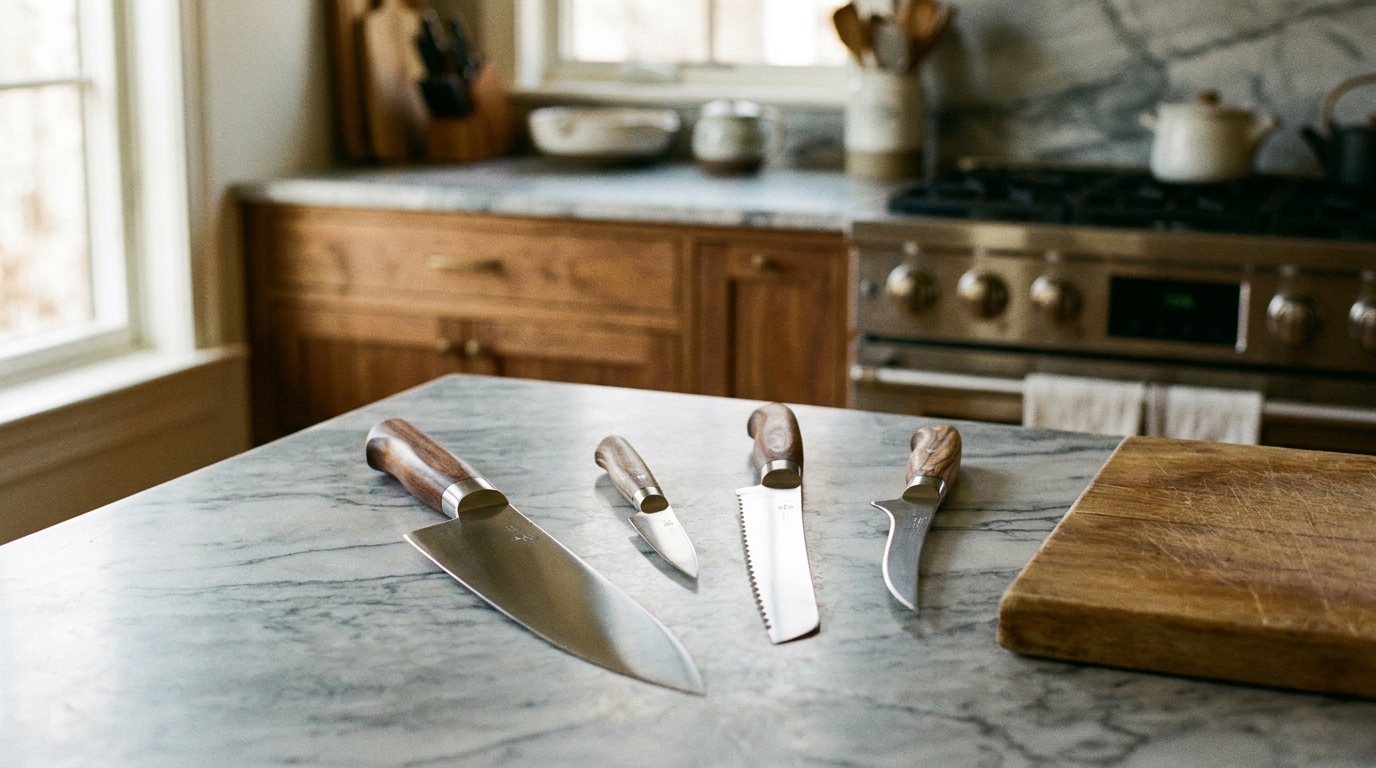
Quality kitchen knives directly affect how safely and precisely you cut, with sharp blades reducing injury risk and enabling even cooking. Building a collection around five essential knives--chef's, paring, serrated bread, boning, and utility--covers virtually every kitchen task while matching blade type to ingredient ensures better results.
What Are the Best Kitchen Knives for Home Cooks and Professionals
A sharp chef's knife handles over 90% of daily prep work, while a paring knife, bread knife, boning knife, and utility knife round out a complete home kitchen.
Why knife quality matters more than you think: durability, safety, and precision
The quality of your cuchillos de cocina affects three things directly: how long they hold an edge, how safe they are to use, and how precisely they cut.
A dull blade requires more applied pressure to move through food, which increases the chance it slips and causes injury -- a sharp knife behaves predictably and cuts where you aim it.[2] Steel composition and blade geometry determine whether your knife stays sharp for months with basic maintenance or dulls quickly and needs frequent resharpening.[1] Clean, uniform cuts also matter beyond safety: consistent sizing means ingredients cook evenly, and finished dishes look better on the plate.[2]
The 5 essential cuchillos de cocina every kitchen needs to function
The five cuchillos de cocina that cover the widest range of kitchen tasks are the chef's knife, paring knife, serrated bread knife, boning knife, and serrated utility knife. [4] A chef's knife (8-10 inches) handles over 90% of daily prep -- chopping, dicing, and slicing -- and is the one worth prioritizing when building a collection from scratch. [4] A paring knife (3-3.5 inches) manages detail work too small for a larger blade, like hulling strawberries or mincing garlic. [1][4] A serrated knife handles crusty loaves and waxy-skinned produce without crushing them, a boning knife navigates around bone and cartilage, and a serrated utility knife fills in for jobs where a bread knife is too long. [4]

Types of Kitchen Knives and What Each One Does Best
Each knife's blade shape determines which cutting motions it handles best, so matching the right knife to your task makes prep work faster and more efficient.
Chef's knife, paring knife, and santoku: matching blade shape to cutting task
Blade shape determines which cutting motion each knife supports.
A chef's knife's curved belly enables a rocking chop -- tip on the board, heel rising and falling -- which makes tasks like mincing herbs and dicing onions faster than any push cut. [5] A santoku's straighter edge and shorter blade (5-7 inches versus 8-10 for a chef's knife) suit push cuts and down-slicing better, and its lighter, thinner spine gives it more agility through dense vegetables. [5] A paring knife's near-flat edge is built to follow curves -- coring tomatoes, segmenting citrus, hulling strawberries -- rather than rocking; a slight belly in the blade helps when you also need to mince with it. [6]
Specialty blades: serrated, boning, and utility knives for specific ingredients
Serrated teeth grip food surfaces rather than push through them, which is why a serrated blade handles ripe tomatoes and soft cakes as cleanly as crusty bread -- a straight edge would crush or drag through both. [1][8] Boning knives split into two practical types: flexible blades trace the curves of poultry and fish, while stiffer blades give you the resistance you need when breaking down denser red meat or separating primal cuts. [7][8] A utility knife -- available in both serrated and straight versions, typically 5-7 inches -- covers the in-between jobs where a bread knife is too long and a chef's knife feels like overkill, from slicing cucumbers to cutting cheese to trimming a sandwich. [7][8] Matching blade type to ingredient, rather than defaulting to one knife for everything, is what makes specialty cuchillos de cocina worth adding to your kit.
German vs. Japanese Kitchen Knives: Steel, Balance, and Cutting Style
German steel construction: heavier, more durable, forgiving on technique
German cuchillos de cocina are built around X50CrMoV15 stainless steel -- an alloy combining chromium for corrosion resistance, molybdenum for structural strength, and vanadium for edge retention -- hardened to 56-58 HRC. [9] That softer hardness range means the edge rolls rather than chips when it meets bone or a hard board, so it recovers quickly on a standard honing steel without specialized equipment. [10] German blades also carry a heavier spine and a more obtuse bevel angle, which shifts weight toward the heel and supports the rocking chop that most cooks use by default. [9] For anyone who doesn't want to manage precise cutting angles or specialty sharpening tools, that combination of toughness and easy maintenance makes German steel the practical choice for daily use. [10]
Japanese blade geometry: sharper edges, lighter weight, precision-focused design
Japanese cuchillos de cocina use higher-carbon steel hardened to 60-64 HRC, producing bevel angles between 9 and 16 degrees -- noticeably sharper than the 14-20 degrees typical of German blades. [11] That harder, thinner edge holds sharpness longer and cuts with less resistance, which is why these knives handle precision tasks like deveining shrimp, slicing raw fish, or cutting thin proteins more effectively than softer steel; stainless options like ACUTO 440 offer similar sharpness with added corrosion resistance. [11][12] Higher carbon content also reduces blade weight -- Japanese knives average roughly 5.8 oz versus 9.4 oz for German models -- giving you more wrist control during longer prep sessions. [12] The practical tradeoff is brittleness: hard steel chips rather than rolls when it contacts bone or a hard board, so Japanese knives require whetstone sharpening rather than a standard honing rod. [11]


How to Choose, Maintain, and Care for Your Kitchen Knives
Handle material, blade length, and steel type each affect how your knife performs and how much maintenance it requires.
Selecting the right knife: handle comfort, blade length, and steel type matter
Three factors determine practical knife fit: handle material, blade length, and steel type.
Composite materials like G10 resist moisture and daily washing without cracking, while wood handles need more upkeep and can weaken where the blade meets the handle with repeated water exposure.[13][15] For blade length, 6- to 8-inch knives see daily use while longer blades come out only for specific tasks -- if you have smaller hands, a shorter blade reduces fatigue and improves control throughout longer prep sessions.[13][14] Stainless steel suits most kitchens because it resists corrosion with minimal care, while high-carbon steel holds a sharper edge longer but stains easily and chips if handled carelessly.[15]
Professional maintenance: sharpening, storage, and cleaning to extend blade life
Honing realigns the blade's microscopic edge without removing metal -- do it weekly or after every few uses -- while sharpening removes material to restore a genuinely dull edge and is typically needed every six to twelve months. [16][17] Hand wash your cuchillos de cocina with mild soap and lukewarm water; dishwashers expose blades to heat and harsh detergents that accelerate dulling and corrosion, so dry immediately with a cloth before storing. [17][18] A knife block, magnetic strip, or in-drawer insert keeps blades separated and protected -- loose storage in a drawer causes nicks and poses a safety risk. [17][18] Wood and plastic cutting boards are easier on edges than glass or stone surfaces, which chip and dull blades quickly. [17]
- Sharp knives cut safely and precisely; dull blades slip and cause injury.
- A chef's knife handles over 90% of daily prep work in most kitchens.
- German steel forgives mistakes and resharpens easily; Japanese steel holds sharper edges longer but chips if mishandled.
- Blade shape determines function: curved for rocking chops, straight for push cuts, serrated for gripping delicate surfaces.
- Hand wash immediately and store in a block or magnetic strip to prevent dulling and nicks.
- Hone weekly to maintain edge alignment; sharpen every 6-12 months when genuinely dull.
- https://www.seriouseats.com/the-best-essential-knives
- https://www.chuboknives.com/blogs/news/the-importance-of-using-a-sharp-knife-in-the-kitchen
- https://www.onceuponachef.com/how-to/7-kitchen-knives-every-cook-needs.html
- https://www.epicurious.com/expert-advice/the-only-3-knives-you-need-article
- https://www.americastestkitchen.com/articles/6273-chefs-knife-vs-santoku
- https://www.seriouseats.com/the-best-paring-knives
- https://www.everythingkitchens.com/knife-education-guide.html?srsltid=AfmBOoqRPS6VlA5SPXfEW_gURFhVOou9SXPsam5mwCRPw7_kBA3s7nqy
- https://home.organizeat.com/blog/types-of-knives-in-the-kitchen/
- https://seriouslyfastsharpening.com/ultimate-guide-german-knives
- https://www.cwchangwen.com/commercial-kitchen-knives-buying-guidesteel-performance/
- https://hexclad.eu/blogs/posts/german-vs-japanese-knives-a-comparison-guide?srsltid=AfmBOopacAyLMWkgUA9CfTIfPaHgWwXJNbZ0PwdTJ9j_-0GUIWBSYSa6
- https://www.womensoutdoornews.com/2024/03/japanese-vs-german-knives-whats-the-best-pick-for-you/
- https://www.montanaknifecompany.com/blogs/news/how-to-choose-a-chef-knife?srsltid=AfmBOoqV1mGSrvH5Gi5Gj_T9b3K_HHSFxrdmi_GljKEbSubNiXvgLRi-
- https://us.seisukeknife.com/pages/knife-style-guide
- https://blog.russellhendrix.com/buying-guides/professional-chef-and-kitchen-knife-buying-guide/
- https://wickedhandy.net/kitchen-knife-care-and-maintenance/
- https://eliteprocutlery.com/extending-the-life-of-your-knives-best-practices/?srsltid=AfmBOooVStNRGWmzcvecM-CYL8amw8On2lmjlMrhd5M36edgduv3ELz0
- https://www.consumerreports.org/kitchen-knives/how-to-care-for-kitchen-knives/
- Summary
-
Types of Kitchen Knives and What Each One Does Best
- Chef's knife, paring knife, and santoku: matching blade shape to cutting task
- Specialty blades: serrated, boning, and utility knives for specific ingredients
- German steel construction: heavier, more durable, forgiving on technique
- Japanese blade geometry: sharper edges, lighter weight, precision-focused design
- Key Takeaways
- References