

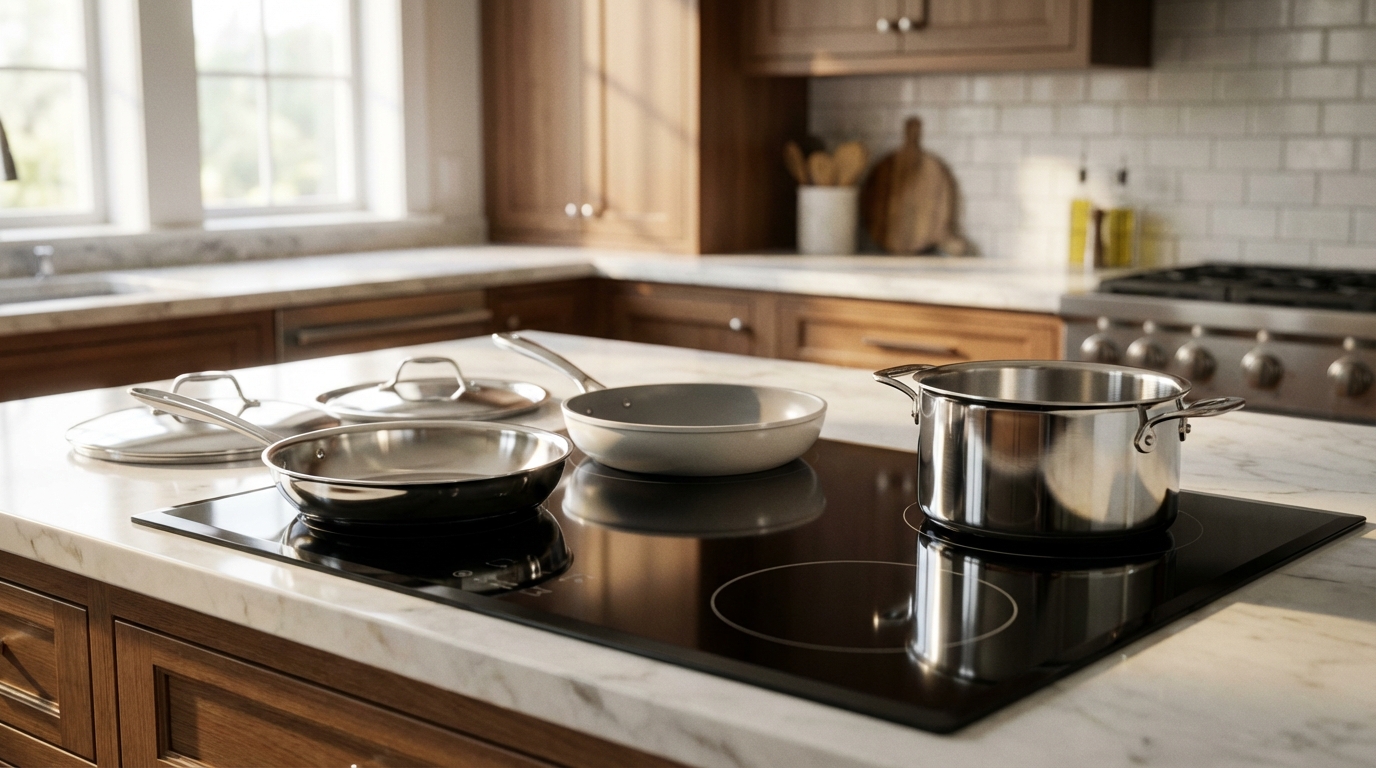
This guide equips glass-top stove owners to choose cookware that heats evenly without scarring the sleek surface, explaining why stainless steel with an aluminum or copper core, lightweight ceramic nonstick, and pans with mirror-flat, polished bases outperform ridged or warped ones, while cast iron's heft and roughness should be skipped or handled with extreme care. Readers learn quick at-home tests--ruler for flatness, water-bubble or flour patterns for hot spots--to verify even heating before buying, plus stove-specific techniques like preheating longer for a steak sear or starting cold nonstick to render fat without splatter. Maintenance chapters detail gentle baking-soda scrubs, razor-blade removal of metal marks, and habits that extend pan life--no cooking spray, no hot-to-cold water shocks, no metal utensils--so both cooktop and cookware stay pristine. Ultimately, the article argues that a small, well-matched set of skillet, saucepan, and stockpot with balanced weight and tri-ply construction delivers more consistent, scratch-free results than bloated, low-quality 12-piece collections, saving money and frustration while making every meal on fragile glass more predictable and enjoyable.
Choosing the Right Materials for Glass-Top Cookware
Pair a stainless-steel pan that has an aluminum or copper core with a flush-bottom ceramic nonstick for glass-top cooking that's scratch-safe, heats evenly, and cleans up in seconds without PTFE fumes.
Stainless Steel: Durable and Scratch‑Resistant
Stainless steel is the most glass-top-friendly material you can own.
It won't scratch the surface easily, handles both electric and induction ranges, and doesn't react with acidic or alkaline foods. [1] The one trade-off: stainless steel conducts heat poorly on its own, so look for pans with an aluminum or copper core in the base.
That combination gives you the scratch resistance of stainless with the fast, even heating of a more conductive metal. [2] A well-built stainless skillet can also move from stovetop to oven without issue -- useful for dishes that need to finish under high heat after a sear. [1]
Nonstick & Ceramic: Easy Clean, Safe on Glass
Ceramic and traditional nonstick pans both work on glass tops, but they behave differently under heat.
Ceramic coatings are free from PTFE and PFOA -- chemicals in conventional nonstick pans that release fumes when overheated -- making them a safer choice if you cook at higher temperatures or in a poorly ventilated kitchen.
Their smooth, flat bases sit flush against the glass surface, distribute heat evenly, and resist scratching, while the nonstick surface means less oil and faster cleanup. [3] Traditional PTFE-based nonstick pans do function on glass tops, but glass cooktops tend to run hotter than coil burners, which speeds up coating degradation -- keep the heat at medium or below to avoid this. [4] Both options are considerably lighter than cast iron, which reduces impact risk if you set a pan down too hard and lowers the chance of cracking the glass surface under sustained weight. [3]

Key Features to Look for in Glass‑Top Friendly Sets
Run your hand across a pan's base--only a mirror-smooth, perfectly flat, medium-weight bottom will give you even heat and keep your glass cooktop scratch-free.
Flat, Polished Bottoms for Even Heat Transfer
The bottom of your pan does two jobs on a glass-top stove: it transfers heat and protects the surface beneath it. Ridges, raised logos, or textured bases interrupt full contact with the glass, creating uneven hot spots and leaving the surface vulnerable to scratches. [5] A completely flat, smooth base maximizes the contact area between pan and burner, so heat moves evenly from the element into the cookware rather than concentrating in patches. [6] This matters more on glass tops than on gas burners because the heat source is a sealed, flat element -- any gap in contact is a gap in heating.
Beyond scratch prevention, a polished base also protects against thermal stress: setting a cold pan straight from the fridge onto a hot burner can crack tempered glass, so letting cookware reach room temperature first is worth the extra minute. [5] When shopping for cookware, check the pan's bottom by running your hand across it -- you want a mirror-smooth finish with no embossed text or raised edges. Even minor surface irregularities that seem cosmetic can act as abrasives over time.
Our stainless steel cookware features completely flat, polished bases designed specifically for optimal contact with glass cooktops.
Weight and Balance: Staying Flush Without Scratching
Pan weight does two opposing things on a glass cooktop: enough heft keeps the pan stable and flush against the burner, but too much creates pressure that accelerates surface wear -- and any sideways drag under that load becomes a scratch. Heavy cookware like cast iron is hard enough to mark glass just from contact alone, let alone sliding it across the surface while cooking.
The practical sweet spot? A pan heavy enough to sit still without repositioning, but light enough to lift cleanly rather than drag.
Balance matters here just as much as total weight -- a well-balanced pan stays secure in your grip during a toss or stir, so you're less likely to let it scrape sideways when setting it back down. [6] Testers consistently flag this as a real-world issue: pans that feel awkward or front-heavy tend to land hard and off-center, which is exactly the kind of contact that leaves marks. [6] Here's a simple test: if a pan feels unwieldy with one hand while empty, it'll be worse when full of food -- and that's when sliding becomes a risk. Look for cookware with a comfortable weight distribution that feels natural to maneuver.
Everyday Performance: How to Test and Use Your Set
Spend five minutes on the pan-flip, water-bubble, or sugar test to spot heat flaws before you cook, then give your steak extra preheat time and a paper-towel pat-down for a glass-top sear that rivals gas.
Heat Distribution Test: The Simple Pan‑Flip Method
Before you commit to a pan, two quick tests tell you whether it will perform evenly on a glass top. The first is the pan-flip check: turn the pan upside down and lay a ruler or any straight edge across the base.
It should contact the surface evenly all the way across -- a very slight concave toward the center is acceptable, but any rocking or gap means the pan will sit unevenly on the burner and concentrate heat in patches rather than spreading it. [8] If a pan passes that check, confirm it with the water bubble test: add about an inch of water, bring it to a boil on high heat, and watch where the bubbles form. Evenly distributed bubbles across the bottom mean even heat transfer; bubbles clustered to one side or bunched in the middle signal a hot spot. [8] For a more visible result, the flour test works the same way -- spread a thin layer across a dry, preheated pan and watch which areas darken first. [9] Sugar dissolved in water gives an even cleaner read: the caramelization pattern shows exactly where heat is concentrating, with darker patches marking the hottest zones. [10] Any of these methods takes under five minutes and tells you more about real-world performance than spec sheets will.
Cooking Common Dishes - From Steaming Broccoli to Searing Steak
For everyday tasks -- sautéed vegetables, scrambled eggs, simmered sauces -- a flat-bottomed nonstick or stainless pan handles glass-top cooking without much adjustment.
Searing steak is where the surface demands more deliberate technique.
The Maillard reaction, responsible for the brown crust on seared meat, kicks off around 300 degreesF and peaks between 350-500 degreesF -- glass-top ranges can reach these temperatures, but they take longer to get there than gas, so budget extra preheat time. [11] Before the steak touches the pan, pat it completely dry with paper towels; surface moisture turns to steam on contact, which suppresses browning and delays crust formation. [12] For well-marbled cuts, one approach that works cleanly on glass tops is placing the steak in a cold nonstick skillet with no added oil -- the fat renders gradually as the pan heats, basting the meat from below and producing a proper crust with far less smoke and splatter than a preheated cast iron method. [13] Regardless of method, don't flip until the crust releases cleanly from the pan surface; forcing it early tears the developing crust and leaves it behind. [12] Once off the heat, rest the steak for roughly as long as it cooked -- carryover heat continues raising the internal temperature a few degrees, and the juices redistribute before cutting. [12]


Maintenance and Longevity Tips for Your Cookware
Guard your cookware's future by swapping metal tools for silicone, skipping cooking spray, and wiping sugar spills while they're still warm--because the difference between years and months of performance is in these small, immediate choices.
Cleaning Glass Tops Without Damage
Your glass cooktop faces two main enemies: harsh cleaners and procrastination. Skip the steel wool, bleach, ammonia, and abrasive scrubbers -- they'll scratch or chemically damage the surface. Instead, reach for a soft cloth, nonabrasive pad, or make a simple baking soda paste. [14] For stubborn burnt-on food, mix half a cup of baking soda with three to four tablespoons of water.
Spread it over the stain, let it work for 20 minutes, then gently scrub with your nonabrasive pad. [15] Those silvery marks from your cookware? They're rarely permanent scratches. A single-edge razor blade held at 45 degrees lifts both metal marks and cooked-on residue -- go any steeper and you risk real damage. [16] Follow up with a thin coat of ceramic-glass cleaner and here's the key: let it dry completely before buffing.
Most people wipe too soon, but that paste needs those five to ten minutes to really lift the stains. [16] One mess you can't ignore: sugar spills. Syrup, candy, jam -- if these cool and harden on your cooktop, they bond like glue and become nearly impossible to remove. Wipe them while the surface is still warm, even if you're exhausted from cooking. [15]
Caring for Nonstick Surfaces and Preventing Warping
Your nonstick pans will last years or months -- the difference comes down to daily habits. Metal utensils remain enemy number one: even gentle contact from tongs, forks, or whisks creates micro-scratches that add up fast. Make the permanent switch to silicone or wooden tools. [17] Skip the cooking spray too. Those aerosols burn at lower temperatures than regular oil, leaving behind a stubborn film that builds up and won't come off.
A quick pour of liquid oil or a refillable mister works better and keeps your coating pristine. [18] Always add oil to a cold pan before heating -- this not only protects the surface but prevents those PTFE fumes nobody wants in their kitchen. [18] The fastest way to ruin a nonstick pan for glass-top cooking? Hot water shock. Plunging a hot pan into cold water warps the base, and as we covered earlier, a warped pan means uneven heating and poor contact with your burner. Let pans cool completely first. [17] Storage matters too: stacking bare pans scratches the coating where they touch.
A simple dish towel between each pan prevents years of gradual damage. [17] When chips appear, food sticks, or the coating starts peeling, it's time for a new pan. Those flakes end up in your food, and no amount of babying brings back a worn coating. Quality nonstick cookware like our nonstick pan is designed to handle daily use when cared for properly -- but even the best pans have a lifespan. [17]


Conclusion: Build a Reliable Glass‑Top Set That Lasts
Prioritize Quality Over Gimmicks
Cookware sets are easy to oversell.
Large piece counts sound impressive until you realize lids and steamer baskets each count toward the total -- a 12-piece set might include only six actual cooking surfaces. [6] The features worth paying for are consistent across every price tier: the smooth, flat base we covered earlier, balanced weight that won't scratch when you lift it, and construction that eliminates hot spots. [6] In testing across 131 sets, the factors that separated reliable cookware from disappointing cookware weren't brand prestige or piece count -- they were whether a pan performed evenly on the burner, how it felt in hand when maneuvering, and how easily it cleaned after a hard cook. [6] Sets that check those boxes at a lower price point routinely outperform premium sets that don't.
Instead of getting distracted by wide color palettes or inflated piece counts, focus on the essentials: a skillet, saucepan, and stockpot with the flat polished bases and core construction your glass cooktop needs. [6]
Invest in Everyday Tools That Pay Off
The value case for quality cookware isn't about brand prestige -- it's about consistency. Different cookware heats and performs differently, but having a matched set helps you stay consistent in the kitchen.
Once you learn how one pan performs, you know how they all will. [19] That predictability matters more than most buyers anticipate: you stop second-guessing heat levels, timing, and technique because your tools behave the same way every time. For most home cooks, a skillet, sauté pan, saucepan, and stockpot -- all with those crucial flat polished bases and tri-ply or clad core construction -- covers daily cooking without redundant pieces collecting dust. [19] Look for sets that combine even heat distribution with lifetime warranties and oven safety to at least 500 degreesF.
Quality
- Stainless steel with aluminum/copper core is best for glass tops.
- Flat, polished pan bottoms prevent scratches and hot spots.
- Use medium or lower heat on PTFE nonstick to slow coating wear.
- Let pans reach room temp before placing on hot glass to avoid cracks.
- Clean glass tops with baking soda paste, never steel wool or bleach.
- Warped pans ruin contact; avoid hot-to-cold water shock.
- Focus on flat base and balance, not piece count or brand prestige.
- https://www.seriouseats.com/best-cookware-glass-stovetops-7506080
- https://lakeappliancerepair.com/blog/the-best-pans-for-glass-cooktops/
- https://www.cupindy.com/blogs/info/ceramic-cookware-benefits?srsltid=AfmBOopdfvII5THcKSTmOlDrUJ2Pzq0YFaZDgCr6az4I6NbIcdIqqEpC
- https://cooking.stackexchange.com/questions/23051/what-kind-of-cookware-is-suitable-for-a-glass-ceramic-stovetop
- https://www.goodhousekeeping.com/cooking-tools/cookware-reviews/g62637899/best-cookware-for-glass-top-stove/
- https://www.thespruceeats.com/best-cookware-for-glass-stoves-4690491
- https://hexclad.ca/fr/blogs/posts/cookware-for-glass-stoves?srsltid=AfmBOoqFXiN84b6Y2VUTZODRUfyJ7sMIE0-o7wwk11iAs6oSePs4l_GY
- https://products.geappliances.com/appliance/gea-support-search-content?contentId=18183
- https://cooking.stackexchange.com/questions/1015/how-can-i-measure-the-performance-of-my-stovetop-pots-and-pans
- https://shouldit.com/electric-skillets/tests/analyzing-heat-distribution/
- https://www.oreateai.com/blog/mastering-the-art-of-cooking-on-glass-top-electric-ranges/467c3274f23fb904ad657643ec913764
- https://www.debuyer-usa.com/blogs/guides/getting-the-perfect-sear-on-a-steak?srsltid=AfmBOoqQ1ptA_cuNqLe8fSyqovh-10yQrAcoyw4fw_AMxA7VW0GlcdbW
- https://www.americastestkitchen.com/articles/3008-how-to-cook-steaks-skillet-without-smoke-mess
- https://www.maytag.com/blog/kitchen/how-to-clean-a-glass-cooktop.html
- https://www.whirlpool.com/blog/kitchen/how-to-clean-a-glass-electric-stovetop.html
- https://www.nytimes.com/wirecutter/reviews/how-to-clean-a-glass-cooktop/
- https://www.consumerreports.org/home-garden/cookware/make-your-nonstick-frying-pan-last-a1106078664/
- https://www.today.com/food/7-ways-you-are-ruining-nonstick-pans-how-save-them-t104329
- https://www.cnn.com/cnn-underscored/reviews/best-cookware-sets