

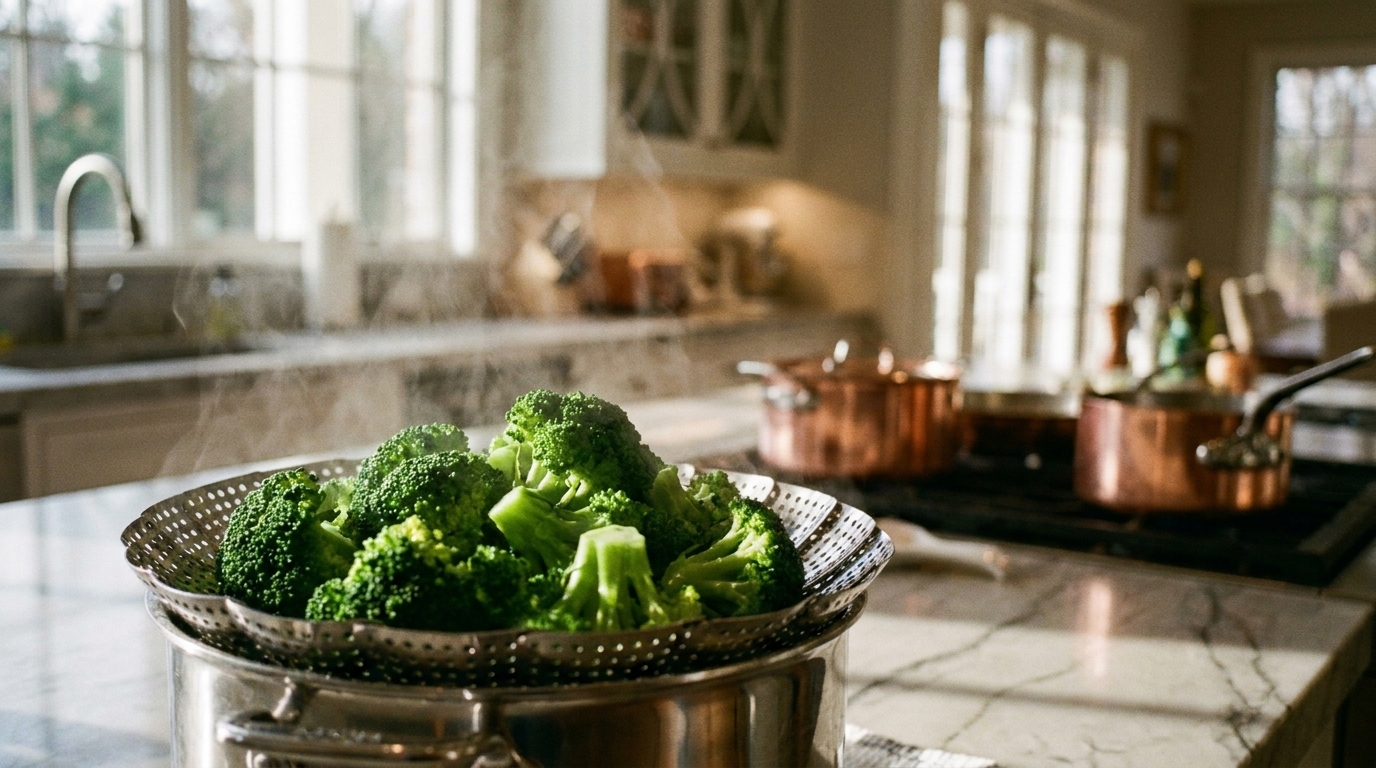
Master the exact steaming times for broccoli based on your preferred texture, from crisp-tender at 3-4 minutes to fully fork-tender at 5-6 minutes. Steaming preserves nutrients and color far better than boiling, keeping broccoli bright green while retaining up to 91% of its vitamin C.
The Direct Answer: Steaming Times for Every Broccoli Texture You Want
Crisp-tender broccoli at 4 to 5 minutes keeps florets firm and bright green, while 5 to 6 minutes yields fully tender stems perfect for mixed dishes.
Crisp-tender broccoli (3-4 minutes): The texture most cooks aim for
Crisp-tender is the point where broccoli yields to a fork but still has some resistance at the stem -- it sits just before full fork-tender, which sources put at 4 to 5 minutes over medium heat. [2] At this stage, florets are firm enough to hold up under dressings or toppings without going limp, and the color stays bright green rather than drab olive, which starts happening at the 7-minute mark. [1] Pulling the broccoli from heat the moment it's fork-pierceable is the most reliable cue -- stovetop heat levels and floret size both affect how fast steam penetrates, so timing alone can vary. [1] For more detail on how the color window works, our guide to steaming broccoli's three-minute window covers what happens to the color in real time.
Tender broccoli (5-6 minutes): Softer but still with structural integrity
At 5 to 6 minutes, broccoli is fully fork-tender -- stems yield without resistance and florets soften enough to press apart easily, though they still hold their shape rather than collapsing. [5] This texture works best for dishes where broccoli integrates into the whole rather than standing alone, such as pasta toss-throughs, grain bowls, or egg frittatas, where a firmer floret would feel out of place.
Steaming keeps structure more intact at this range compared to boiling, which pushes color and texture further toward soft and drab at the same duration. [4] Anything past the 6 to 7-minute mark risks mushy, yellowed florets that lose both flavor and form. [5]
Steaming Broccoli Without a Steamer Basket: Your Best Equipment Options
A dedicated steamer basket keeps steam sealed inside the pot, delivering consistent 3-6 minute cook times instead of the unpredictable results a colander gives you.
How to steam broccoli using a colander or fine-mesh strainer instead of a basket
A metal colander or fine-mesh strainer is the closest substitute for a steamer basket -- set it over a pot with the water level below the strainer's base, cover with a lid, and bring the water to a boil before adding broccoli. [6] The main limitation is lid fit: if the lid doesn't seal tightly over the strainer, steam escapes and cook times run longer than the standard 3-6 minute range. [6] A stockpot works better than a small saucepan here because its wider rim gives most colanders a more stable, near-flush seat that traps steam more effectively. [6] Check florets with a fork rather than relying on timing alone, since steam loss from a loose-fitting lid can extend the cook window unpredictably. [6]
Why a dedicated steamer basket (or steamer insert) delivers the most consistent results
A dedicated steamer basket -- whether a collapsible metal insert or a bamboo steamer -- positions food reliably above the water inside the pot, which lets a standard lid seal flush and keep steam contained around the broccoli. [7] That consistent seal is the difference between predictable 3-6 minute cook times and the variable results you get when a colander or strainer doesn't sit flush enough to trap steam properly. [7] Because the basket sits inside the pot rather than on top of it, you can also monitor the water level more easily and refill before the pot runs dry -- a practical concern the stovetop method requires you to stay on top of. [7] For a full walkthrough of broccoli prep from cutting to plating, our complete guide to perfectly steamed broccoli covers every stage.
Steam vs. Boil: Why Steaming Preserves Nutrition and Texture Better
How steaming retains more potassium and water-soluble vitamins than boiling does
Boiling pulls water-soluble nutrients into the cooking water, where they're lost when that water is discarded -- vitamin C and minerals like potassium, magnesium, and zinc all show lower retention in boiled vegetables compared to raw [10]. Steamed vegetables like broccoli lose just 9-15% of their vitamin C content, compared to roughly 47% lost through boiling, which reduced broccoli's vitamin C retention to around 53% of the raw baseline [10].
A study testing five cooking methods on broccoli found steaming caused no significant vitamin C loss compared to the raw sample, while boiling reduced it by 33% [9]. Reduced water contact is the key variable -- nutrients stay in the food rather than leaching into surrounding liquid [8].
The texture difference: Why steamed broccoli stays firmer and greener than boiled
The mechanism behind steaming's texture advantage is direct water contact -- boiling submerges broccoli in water, which accelerates pectin breakdown in the cell walls and softens stems faster than steam exposure does. [12] Chlorophyll follows the same logic: the pigment converts to olive-brown pheophytin more rapidly in direct contact with boiling water, and the highest pheophytin levels consistently appear in water-boiled samples. [12] Even brief overcooking in boiling water can push broccoli from bright green to dull grayish-green, a color shift that steamed broccoli resists because indirect heat slows that chemical conversion. [11] The absence of an aqueous cooking environment -- which is the core difference when you steam rather than boil on the stove -- is what keeps both cell structure and color closer to the raw baseline. [12]
Steaming Timing & Seasoning Guide: Broccoli Prep to Plate
Season broccoli after steaming with olive oil, lemon, and garlic, or add texture with toasted seeds and nuts for a simple, flavorful finish.
Step-by-step setup: Water level, heat, and broccoli placement for consistent results
Fill the pot with ¾ to 1 inch of water -- enough to generate consistent steam without the water level reaching the basket floor. [1] Bring the water to a boil over high heat, then reduce to a medium simmer before adding the broccoli; the lower, steadier heat is what keeps steam production stable throughout the cook window rather than producing aggressive bursts that vary in intensity. [13] Arrange florets in a single layer so steam can reach each piece without pieces blocking each other -- a crowded basket traps moisture and slows even penetration. [1] Cover with a flush-fitting lid, set a timer when the lid goes on, and confirm doneness with a fork rather than time alone. [13]
Quick flavor additions: Simple seasonings and toppings that complement steamed broccoli
Season steamed broccoli after removing it from the basket -- acid applied during steaming accelerates color loss, and oil in the steamer creates unnecessary mess. [15] The most straightforward finishes are olive oil with kosher salt, black pepper, lemon juice, or garlic powder, which can be combined into a simple pan dressing. [1] [15] For texture contrast, toasted sesame seeds, slivered almonds, or feta crumbles all work well; if using raw red onion, soak it in cold water for a few minutes first to reduce sharpness before adding it to the florets. [14] Seasoned rice vinegar or balsamic vinegar deliver a sharper acid note than lemon when the dish calls for it. [1]
- Crisp-tender broccoli (3-4 minutes) holds firm florets with bright green color; overcooking past 6-7 minutes causes mushiness and color loss.
- Steaming retains 85-91% of vitamin C versus boiling's 53%, because indirect heat prevents nutrient leaching into cooking water.
- Use a dedicated steamer basket inside the pot for predictable 3-6 minute cook times; colanders on top lose steam and extend timing unpredictably.
- Fork-test doneness rather than relying on time alone, since floret size and heat levels affect steam penetration speed.
- Season after steaming--acid applied during cooking accelerates color degradation and oil creates unnecessary mess in the basket.
- Fill pot with ¾ to 1 inch of water, bring to boil, then reduce to medium simmer for stable steam production throughout cooking.
- https://www.simplyrecipes.com/recipes/steamed_broccoli/
- https://www.thefullhelping.com/sheet-pan-smashed-broccoli-florets-crisp-tender/
- https://www.acouplecooks.com/how-to-cook-broccoli/
- https://www.liveeatlearn.com/how-to-cook-broccoli/
- https://fooddoodles.com/how-long-to-boil-broccoli-for-the-best-boiled-broccoli/
- https://www.spendwithpennies.com/how-to-steam-broccoli/
- https://www.kitchenaid.com/pinch-of-help/major-appliances/how-to-steam.html
- https://pmc.ncbi.nlm.nih.gov/articles/PMC6049644/
- https://pmc.ncbi.nlm.nih.gov/articles/PMC2722699/
- https://www.bbc.co.uk/food/articles/healthiest_vegetable_cooking_method
- https://www.epicurious.com/expert-advice/why-an-ice-bath-is-the-key-to-fresher-greener-vegetables
- https://pmc.ncbi.nlm.nih.gov/articles/PMC12840460/
- https://www.loveandlemons.com/steamed-broccoli/
- https://www.acouplecooks.com/easy-steamed-broccoli/
- https://healthyrecipesblogs.com/steamed-broccoli/