

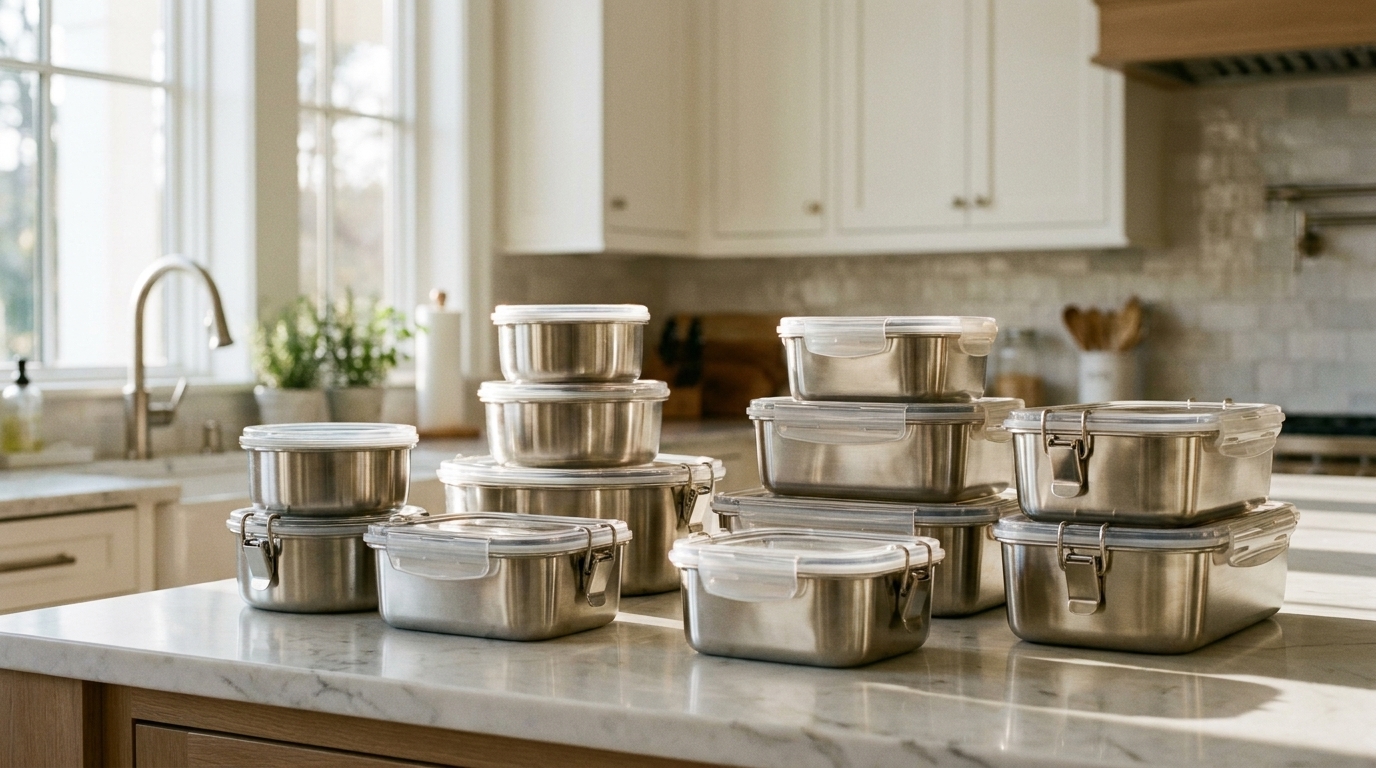
Food-grade stainless steel containers offer a durable, chemical-free alternative to plastic that lasts 5-10 years while cutting household plastic waste by up to 75%. Investing in quality containers costs roughly $2 per year and eliminates odor absorption, staining, and the need for frequent replacements.
Why Stainless Steel Food Storage Matters for Your Kitchen
Stainless steel containers last 5-10 years, cost about $2 annually, and keep 95% of their material recyclable at end of life, unlike plastic.
The health and durability advantage over plastic alternatives
Plastic containers contain chemicals like BPA and phthalates that leach into food, especially under heat -- and BPA-free labels don't guarantee safety, since replacement chemicals can behave in similar ways. [2] Food-grade stainless steel (18/8 or 18/10 grade) is chemically stable, non-porous, and non-reactive with acidic or alkaline foods, so it won't absorb odors, stain, or develop the surface scratches that trap bacteria over time. [1] A quality stainless steel container lasts 5-10 years or longer, while a typical plastic container starts breaking down within a year from warping, cracking, and odor absorption. [2] The higher upfront cost -- roughly $17-$20 per container -- works out to about $2 per year over a decade, which is less than the annual replacement cycle most plastic containers demand. [2]
How stainless steel containers fit into a sustainable kitchen
Stainless steel containers withstand well over 1,000 uses, and one container used just 20 to 115 times already offsets the environmental cost of its production compared to single-use plastics it replaces. [4] At end of life, 95% of stainless steel gets recycled without quality loss -- unlike plastic, where only 5-6% of U.S. plastic was actually recycled in 2021, and even that yields degraded material that can't return as food containers. [4] Producing one ton of plastic releases about 2.5 tons of CO₂, while a reusable container offsets its manufacturing footprint after just 15 uses. [2] Switching to stainless steel food storage containers can cut a household's annual plastic waste by up to 75%, preventing roughly 1,000 pieces of plastic from entering the waste stream over five years. [4]

What Food Is Safe to Store in Stainless Steel Containers
Stainless steel safely stores fresh produce, soups, and leftovers, but acids and salt can damage the container and alter taste over time.
Foods that thrive in stainless steel and why
Food-grade 18/8 and 18/10 stainless steel is chemically stable, which makes it a strong match for the foods that tend to damage or stain plastic: tomatoes, citrus-based dressings, and hot curries can all be stored without triggering any reaction at the container walls. [2] The non-porous surface also means strong flavors don't linger between uses -- garlic, fish, and spiced dishes come out of a stainless container without leaving a trace. [5] Fresh produce, soups, cold leftovers, and hearty stews all hold well in stainless steel, since the material neither absorbs odors nor releases compounds that alter taste. [6] Stainless steel remains fully intact in the freezer too, making it reliable for batch-cooked proteins and grains stored for the week ahead -- unlike plastic, which can become brittle and crack at low temperatures. [2]
Foods to avoid storing in stainless steel and what to use instead
Three categories of food consistently damage stainless steel containers during storage: high-acid foods (tomato-based sauces, citrus juices, and vinegar-based dressings), salty brines (pickles, olives, sauerkraut, feta, and corned beef), and any combination of the two. [7] Organic acids -- citric, acetic, lactic, and tartaric -- pull chromium and nickel out of the steel's protective oxide layer, which alters taste over time and, for anyone with a nickel allergy or contact dermatitis, can trigger symptoms even at sub-toxic exposure levels. [7] Salt accelerates the damage by causing pitting corrosion, creating small surface holes that trap food and bacteria, with the risk increasing sharply in lower-grade or already-damaged containers. [7] Glass is the most practical alternative for all three categories -- it's non-reactive, unaffected by acidity or salt, and lets you visually inspect contents before serving. [7]
Stainless Steel Container Features Comparison: What Actually Matters
Lid design and material thickness matter most--thicker 16-gauge steel and gasket-sealed lids significantly outlast thinner alternatives through years of daily use.
Airtight lids, sizes, and material thickness: A decision table for every kitchen type
Material thickness and lid design are the two specs that most determine whether stainless steel food storage containers hold up over time.
Containers made from 16-gauge steel outlast thinner 18-gauge options -- the extra metal resists denting and warping through repeated washing and stacking, a difference that compounds quickly in kitchens where containers see heavy daily use. [8] For airtight performance, silicone-gasket lids with locking clasps or push-button seals consistently outperform snap lids alone, since the gasket creates a compression seal that holds regardless of how the container is stacked or stored. [9] The 2-10 liter range covers most everyday storage needs, with smaller containers handling portions and prepped ingredients and larger ones suited to batch cooking or bulk dry goods -- and if you're also thinking about how to clean stainless steel pans, the same care principles apply to containers at every size. [8]
Why lid design and seal quality determine container lifespan
The lid is almost always the first component of a stainless steel food storage container to fail -- not the steel body. [11] Repeated dishwasher cycles degrade silicone gaskets faster than hand-washing does, and storing empty containers with lids fully snapped shut stresses the seal mechanism between uses, gradually reducing compression over time -- leaving lids resting on top without locking them is a simple habit that noticeably extends seal life. [11] Heating a sealed container in the microwave creates an internal vacuum that warps the lid and permanently distorts the gasket, so stainless steel containers should always be transferred to a microwave-safe dish before reheating. [11] In lab testing, containers equipped with gaskets and latching mechanisms consistently outperformed simple snap-fit lids on leak resistance, confirming that lid construction is as strong a predictor of long-term performance as any care routine. [10]


Selecting and Maintaining Your Stainless Steel Containers
Start with 4 medium 32-ounce containers per person, then add larger containers for batch-cooked items and small ones for sauces and sides.
How to choose the right container size and quantity for your cooking style
Container size and quantity decisions come down to how many people you're prepping for and how many days of meals you want ready at once.
A practical starting set for one person includes 4 medium containers (32 oz) for weekday lunches, 2 large containers for batch-cooked proteins or grains, and 4-6 small containers for sauces and snacks -- couples and families can double those numbers. [12] If you prep mostly single-serve lunches, containers in the 24-30 oz range cover most meals without wasted fridge or lunch-bag space, while smaller 2-cup containers work well for soups and breakfasts. [13] The simplest rule: if you only buy one size, start with medium (32 oz / 3 cups), since it handles the widest range of single-serve meals and still leaves room for sides. [12]
Cleaning, storage, and care tips to keep containers performing like new
Wash stainless steel food storage containers after every use -- most are dishwasher-safe, though lids may not be, and silicone seals hold up better when hand-washed and air-dried separately each time. [14][10] For odors or stubborn residue, soak with one teaspoon of baking soda in warm water for at least 15 minutes, or shake two tablespoons of distilled white vinegar with warm water inside the container, scrub, and rinse clean. [14] Avoid bleach entirely -- it's not food-safe and damages the steel surface over time. [14] Most containers nest compactly for shelf storage and hold up in the freezer; just leave a gap between the food and lid to allow for expansion. [14]
- Food-grade 18/8 and 18/10 stainless steel won't leach chemicals or absorb odors like plastic containers do.
- A quality stainless steel container costs about $2 per year over a decade, offsetting its environmental footprint after just 15 uses.
- Avoid storing high-acid foods (tomato sauce, citrus), salty brines (pickles, olives), or combinations--they cause corrosion and nickel leaching.
- 16-gauge steel with silicone-gasket lids and locking clasps outperforms thinner options and snap-fit lids for durability and airtight seals.
- Hand-wash silicone gaskets separately and store lids resting on top--never snapped shut--to extend seal life significantly.
- A practical starter set includes 4 medium (32 oz) containers for lunches, 2 large for batch cooking, and 4-6 small for sauces.
- 95% of stainless steel gets recycled without quality loss, while only 5-6% of U.S. plastic was actually recycled in 2021.
- https://www.cupindy.com/blogs/info/stainless-steel-food-containers-guide-benefits-maintenance?srsltid=AfmBOoovucp83NwhBZpkQQVgQcuwCip-DsYfE7APATd35Zs08JuU95Ti
- https://home.organizeat.com/blog/plastic-vs-stainless-steel-food-storage-key-differences/
- https://www.usefull.us/why-stainless-steel/
- https://www.cubep.com/consider-switching-to-reusable-food-storage-containers
- https://www.cupindy.com/blogs/info/stainless-steel-food-containers-guide-benefits-maintenance?srsltid=AfmBOorPrwz0gFr2U1tR4WScFTNtzowU6q30Ye0GA2q3xoIPI9hlr6yE
- https://seedsprout.com.au/blogs/news/5-reasons-why-stainless-steel-is-the-best-for-food-storage?srsltid=AfmBOoqw9biLlJukf78CHb5Wg7nLQ8nxCQopqBsXN0UfyOHzyTfntMdT
- https://www.eatingwell.com/stop-storing-these-foods-in-stainless-steel-containers-11970970
- https://seller.alibaba.com/blogs/2026/southeast-asia/home-storage/stainless-steel-material-guide-alibaba-b2b
- https://kitchen-science.com/blogs/articles/best-dry-food-storage-containers
- https://www.consumerreports.org/home-garden/food-storage/best-food-storage-containers-of-the-year-a7678521903/
- https://www.nytimes.com/wirecutter/reviews/best-food-storage-containers/
- https://fond.kitchen/blog/meal-prep-containers-guide/
- https://www.peanutbutterandfitness.com/how-to-pick-the-perfect-meal-prep-container/
- https://elephantbox.co.uk/blogs/blog/built-to-last-how-to-care-for-your-stainless-steel-products