

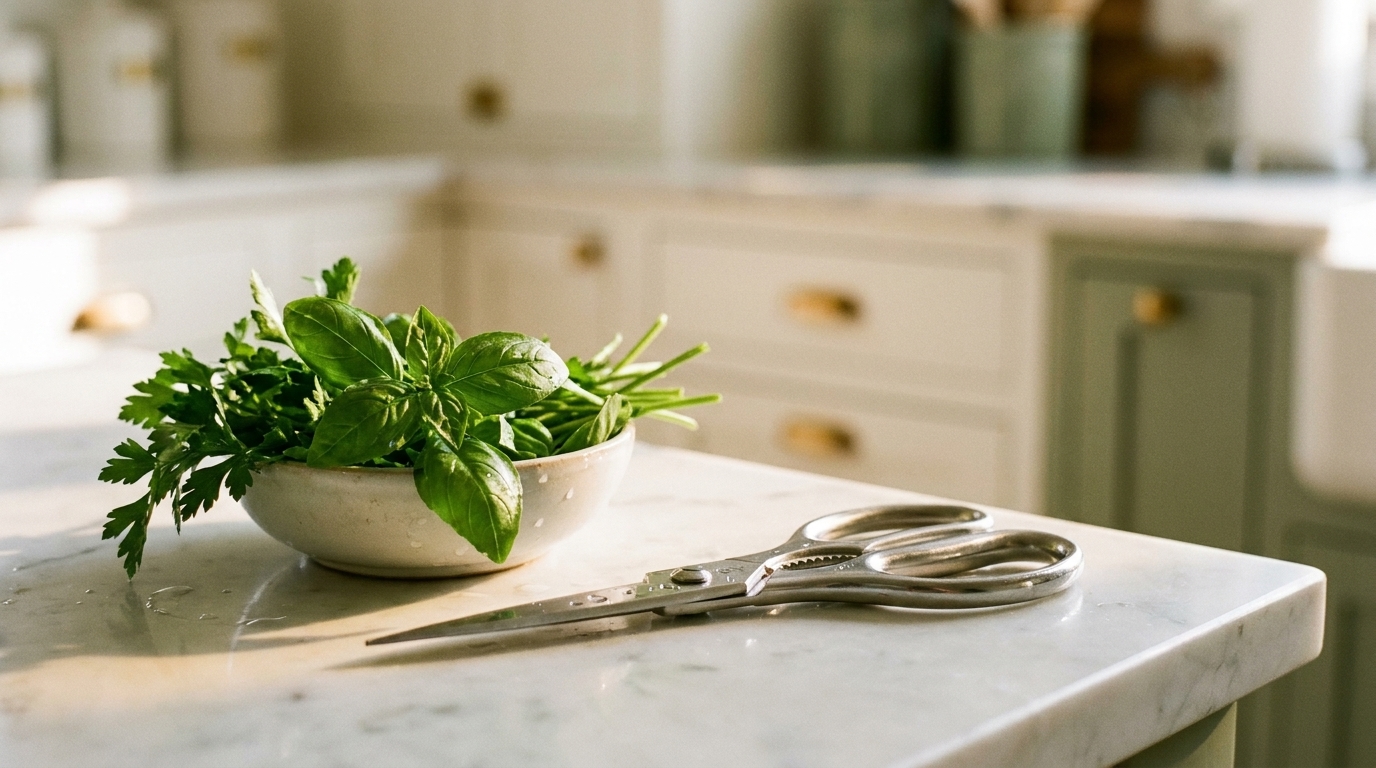
Blade alignment, spring tension, and steel hardness determine whether kitchen shears cleanly cut herbs or crush them, with proper leverage and controlled force preventing bruising and discoloration. Misen's longest-blade shears with nonslip inner lining excel at holding herb bunches steady for consistent cuts across parsley, cilantro, and other delicate greens.
Why Kitchen Shears Beat Kitchen Scissors for Herb Work
Blade alignment and calibrated spring tension let you snip soft herbs cleanly without bruising delicate stems or requiring a crushing grip.
The blade geometry difference: why offset handles matter for precision snipping
Kitchen shears use two blades that slide past each other, with the cut forming at exactly the point where those blades meet -- blade alignment is what separates a clean snip from an herb that bends and bruises instead. [1] The pivot point on kitchen shears sits farther from the handles compared to standard scissors, which creates leverage that lets you apply precise, controlled force without over-gripping. [2] In testing, shears with poor alignment cut cleanly near the base but failed at the tip, meaning soft herbs like chives simply buckled rather than shearing off -- a flaw that becomes most obvious when precision at the blade's end actually matters. [1]
How spring tension affects control when mincing delicate herbs like basil and dill
Spring tension controls how much hand force you need between cuts -- and for soft herbs, that detail matters more than blade sharpness alone.
Shears with stiff springs require full-grip squeezes that compact herb bundles before the blade even engages, which is especially damaging to basil: lateral pressure bruises cell walls and causes discoloration within seconds. [3][4] Spring-loaded action reduces hand fatigue by 38%, but for herb work the real benefit is that lighter spring resistance encourages quick, controlled snips instead of forceful closures that crush soft stems. [3] For dill and parsley, gathering loosely and snipping vertically with minimal compression is the right technique -- well-calibrated spring tension makes that approach natural rather than effortful. [3]

5 Kitchen Shears Tested Head-to-Head: Herb Cutting Performance Comparison
Blade length and edge design directly determine how cleanly you cut herbs--longer blades cover more ground, while serrated edges grip soft stems better than smooth blades.
Comparison table: blade length, material, spring type, and real-world herb performance across all 5 models
Across the five shears tested for herb-cutting performance, overall blade length ranged from 8.72 to 10.7 inches -- a gap that directly affects how much herb you clear per stroke and how easily you maneuver around tight bundles. [5] All five use stainless steel construction, though micro-serrated edges on models like the KitchenAid grip soft stems without slipping, while smooth-bevel blades on the Messermeister and Miyabi depend on edge sharpness alone. [5] None of the five use spring-loaded mechanisms, which testing confirmed suits herb work well -- spring-loaded designs tend to compress bundles before the blade even engages. [5]
| Model | Overall Length | Blade Material | Spring Type | Real-World Herb Performance |
|---|---|---|---|---|
| Messermeister Take-Apart | 8.72 in | Stainless steel | Traditional hinge | Sharp, pointed tip delivers clean snips on soft herbs; testers' top daily-use pick [5] |
| KitchenAid All-Purpose | 8.72 in | Stainless steel | Traditional hinge | Micro-serrations grip herb stems without slipping; consistent cuts across parsley and thyme [5] |
| Miyabi | 10 in | Japanese stainless steel | Traditional hinge | Sharper tip than most; light weight aids precision on delicate herbs, though it can feel less sturdy on heavy bundles [5] |
| Misen Kitchen Scissors | 10.7 in | Stainless steel | Traditional hinge | Longest blade in the test; nonslip inner lining holds herb bunches steady for long, even cuts [5] |
| Material The Good Shears | 10.08 in | Stainless steel | Traditional hinge | Most precise for fine herb work; pointed blades excel on chives and thin stems, though no padding on handle limits extended sessions [5] |
Which shears excelled at chives, parsley, and cilantro--and which ones disappointed
For chives, both the Messermeister and Material Good Shears delivered the cleanest cuts -- their pointed tips engaged the stem directly rather than forcing it to compress first, which is the primary way soft herbs bruise before they're severed. [6] Parsley and cilantro, with denser stem bundles, performed better under the Misen's nonslip inner lining and the KitchenAid's micro-serrated edge, which kept bunches from shifting mid-stroke. [6] The Miyabi cut well on single stems but showed blade flex on full cilantro bunches, making it better suited to lighter, deliberate snips than high-volume prep. [6] For herb prep that moves between shear work and knife cuts, the chiffonade herbs technique covers when a blade outperforms shears for ribbon-cut applications. [6]
What Makes Kitchen Shears Actually Cut Herbs Instead of Crushing Them
High-carbon stainless steel blades retain their edge far longer than standard stainless, keeping herb cuts clean instead of crushed for weeks between sharpenings.
Stainless steel vs. high-carbon blades: edge retention matters more than you thinkThe steel grade in your kitchen shears determines how long they stay sharp between sharpenings -- and for herb prep, that gap shows up fast.
Standard stainless steel (304 grade) sits at HRC 52-55 on the Rockwell Hardness Scale, while high-carbon stainless like 440C reaches HRC 58-62, holding a finer edge through significantly more cutting cycles. [7] In controlled testing, 304-based shears lost 41% of their serration height after 200 herb-cutting cycles, while 440C models retained 94%. [8] That edge retention matters because a harder blade severs herb cell walls cleanly instead of compressing them, reducing the enzymatic browning that discolors basil and cilantro within minutes of a rough cut. [8]
Maintenance and sharpening: why dull shears ruin herbs and how to keep yours cutting clean
Dull shears compress herb stems before severing them -- the same cell-wall damage that sharp edges prevent regardless of steel grade.
For non-serrated edges, a few passes on a coarse whetstone followed by the fine side restores the bevel; micro-serrated blades require a tapered rod or professional re-sharpening instead. [5] Cutting folded aluminum foil repeatedly works as a light touch-up between full sharpenings, since naturally occurring aluminum oxide particles provide mild abrasion without removing significant metal -- expect 3-5 months of performance per session with regular home use. [9] Rinse shears with hot soapy water immediately after use, dry completely before storing to prevent pivot corrosion, and apply a drop of food-grade mineral oil to the hinge periodically to keep blade action smooth. [5][9]


How to Choose Kitchen Shears That Work for Your Cooking Style
Handle opening size and grip comfort determine your control during both delicate herb work and tougher kitchen tasks like spatchcocking.
Beyond herbs: what kitchen shears can cut (and what they shouldn't)
Kitchen shears handle far more than herb prep -- they're the tool of choice for tasks where a cutting board would otherwise get in the way.
Shears cut pizza and soft breads like focaccia or pita directly over a plate, snip bacon into lardons without unrolling the strips, and chop canned whole tomatoes inside the can itself. [10] For proteins, they're the most practical option for spatchcocking poultry, removing backbones, and cracking lobster or crab shells using the notched section between the handles. [11] Where they fall short: any cut requiring consistent thickness or a flat reference surface -- slicing meat against the grain, portioning fish fillets, or thin vegetable cuts -- belongs to a knife instead. [10]
The right shears for your hand size, grip strength, and kitchen workflow
Handle opening size determines how much control you actually have -- openings smaller than 2.5 inches limit most adult hands to three fingers at the knuckle, reducing leverage on tough cuts regardless of blade quality. [1] An opening around 2.75 inches or wider lets three to four fingers seat fully, which distributes grip load and reduces fatigue during longer prep sessions. [1] For lower grip strength, silicone or padded handles prevent mid-stroke shifting without requiring constant re-gripping force -- a detail that shows up most during high-volume herb prep, not during a single spatchcocking session. [2][12] If your workflow spans both fine herb work and heavier kitchen tasks, a blade around 3.5 inches paired with longer handles gives you enough leverage to cover both ends without switching pairs -- our kitchen shears are built around exactly that balance. [1]
- Blade alignment and pivot placement determine whether herbs shear cleanly or bruise and buckle.
- Light spring tension reduces hand fatigue by 38% and prevents crushing soft herb stems before cutting.
- High-carbon stainless steel (440C) retains 94% of edge sharpness after 200 cuts versus 59% for standard stainless.
- Pointed blade tips engage herb stems directly; micro-serrated edges grip denser bundles without slipping mid-stroke.
- A 3.5-inch blade paired with longer handles provides leverage for both delicate herb work and heavier kitchen tasks.
- Dull shears compress herb cell walls, causing enzymatic browning in basil and cilantro within minutes of cutting.
- https://www.seriouseats.com/the-best-kitchen-shears
- https://www.nytimes.com/wirecutter/reviews/best-scissors-kitchen-shears/
- https://lifetips.alibaba.com/kitchen-hacks/eight-smart-ways-to-use-your-kitchen-shears
- https://www.goodhousekeeping.com/food-recipes/a70987329/fresh-herbs-guide/
- https://www.foodandwine.com/best-kitchen-shears-7096434
- https://www.lemon8-app.com/@cosplaytology/7469122084753424938?region=us
- https://www.dioro.com/blogs/news/high-carbon-stainless-steel-offset-kitchen-scissors-vs-regular?srsltid=AfmBOopAYwQE5q8lmN2uDbz_eUE6SUOlOLSKX50mJtd6gwevhL87fNU4
- https://lifetips.alibaba.com/kitchen-hacks/the-best-kitchen-shears
- https://lifetips.alibaba.com/kitchen-hacks/how-to-sharpen-kitchen-shears-with-foil
- https://www.bonappetit.com/story/best-kitchen-shears?srsltid=AfmBOopnz7Y4dpH42VE5IzadT_oZv3hYWSn1JT116h-79S5ClcG8Wta6
- https://www.seriouseats.com/why-you-need-kitchen-shears
- https://www.thespruceeats.com/best-kitchen-shears-4682568