

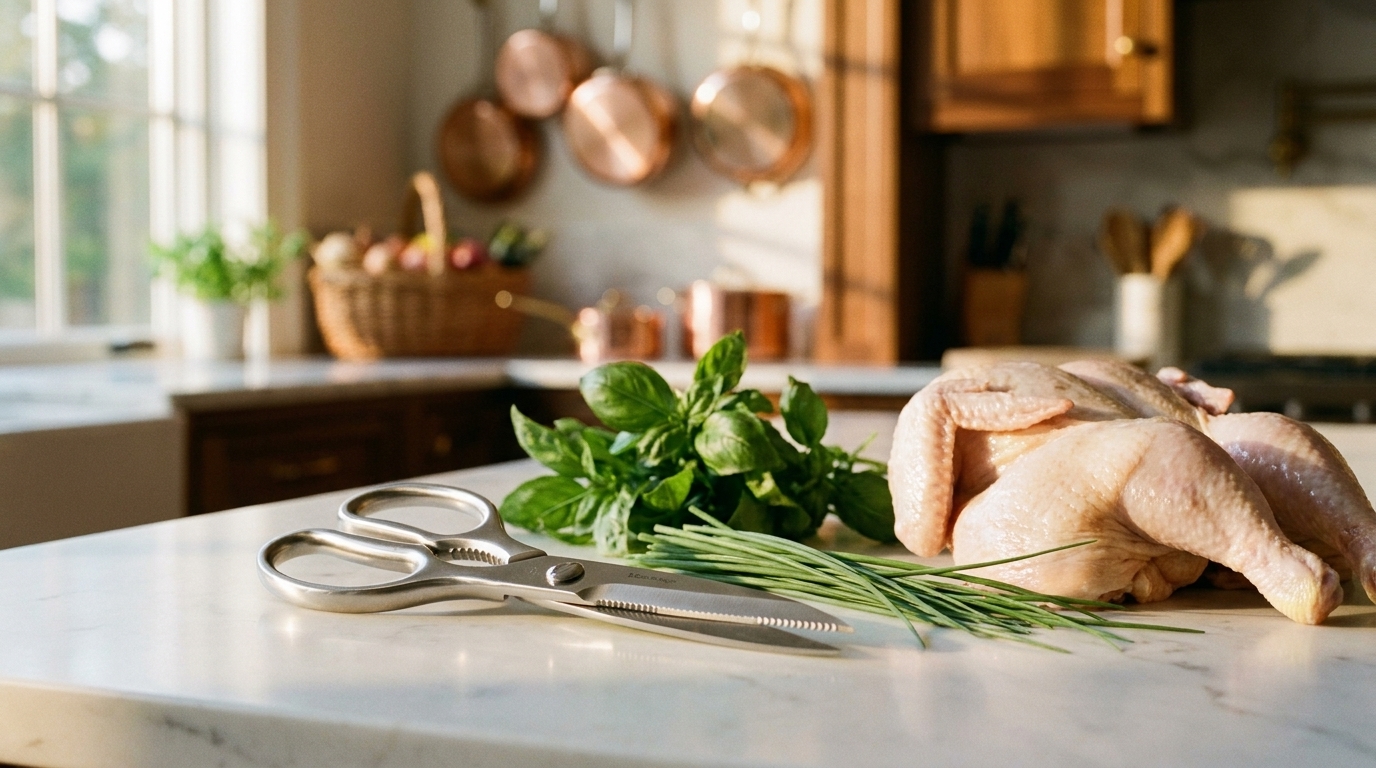
Kitchen scissors are engineered for food prep with micro-serrated blades and proper handle design, making them far superior to regular scissors for cutting poultry, herbs, and delicate proteins. Using dedicated scissors protects your chef's knife from dulling while reducing prep time and keeping your kitchen more hygienic.
Why Kitchen Scissors Belong in Every Cook's Arsenal
Dedicated kitchen scissors protect your chef's knife from dulling while cutting through packaging, frozen items, and herbs--saving prep time without compromising your blade.
The Real Difference Between Kitchen Scissors and Regular Scissors
Kitchen scissors share the same basic structure as regular scissors -- two blades on a central shaft with a pair of handles -- but the functional differences are significant.
Regular scissors are built for paper or fabric; kitchen scissors are engineered for food, with micro-serrated blades that grip slippery proteins, stainless steel construction that resists rust, and handles sized for the torque needed to cut through poultry bones or trim herbs cleanly. [3] Using conventional scissors in the kitchen means uneven cuts and harder-to-clean pivot points that can harbor bacteria. [2] Blade alignment also matters more in food prep: misaligned blades that fold herbs instead of shearing them signal that the tool wasn't designed for kitchen work. [1]
How Kitchen Scissors Save Your Knives (and Your Time)
Every time you use a chef's knife to cut through packaging, pry apart frozen items, or trim herbs directly on a hard surface, you're wearing down the blade faster than cooking alone would. [4] Edge-retention testing shows that knives degrade significantly when used for these incidental tasks -- ones kitchen scissors handle cleanly without blade-to-surface contact. [4] Households that use dedicated kitchen scissors reduce weekly food prep time by an average of 2.1 hours, primarily by eliminating the repositioning and cleanup delays that knife-based cutting adds to routine prep. [4] The practical result: scissors absorb the abusive work, and your knives hold their edge longer.

What to Look For When Choosing Kitchen Scissors
Detachable blades let you separate and thoroughly clean both surfaces and the pivot channel, making them the practical choice for handling raw meat.
Blade Material, Handle Design, and Cutting Performance: A Comparison Table
Detachable vs. Fixed Blades: Which Design Serves Your Kitchen The choice between detachable and fixed-blade kitchen scissors comes down almost entirely to cleaning and hygiene.
Fixed blades are structurally simpler, but food debris collects in the pivot point after cutting raw poultry or sticky foods, where it's difficult to remove with standard washing. [8] Detachable designs let you separate the two blades completely, exposing both blade surfaces and the pivot channel for thorough cleaning. [9] For cooks who regularly handle raw meat or move between multiple proteins in a single prep session, detachable scissors are the more practical choice -- the few extra seconds to reassemble are worth the hygiene benefit. [8]
Detachable vs. Fixed Blades: Which Design Serves Your Kitchen Detachable vs. Fixed Blades: Which Design Serves Your Kitchen
One of the most consequential design decisions you'll make when selecting kitchen scissors is whether to choose a detachable (pull-apart) blade system or a fixed, one-piece construction. Detachable blades are held together by a screw or a simple pivot mechanism that lets the two halves separate completely, usually with a quarter turn or the press of a release button. This design exists almost entirely for cleaning purposes: raw poultry, fish skin, and sticky herb residue have a way of working themselves into the pivot point where regular washing can't reach. Being able to pull the shears apart and scrub each blade individually under hot water is a meaningful advantage if you use your scissors for meat prep on a regular basis, since bacteria can otherwise linger in those hard-to-reach crevices.
Fixed-blade scissors, by contrast, are built as a single continuous unit with a permanent pivot. There's nothing to unscrew, nothing to lose track of, and no risk of the blades loosening or misaligning over time -- a real issue with cheaper detachable models, where the screw can work itself loose after repeated use. Fixed designs also tend to feel sturdier in hand, since the pivot is manufactured to a tighter, more permanent tolerance rather than relying on a screw to hold tension between the blades. This translates to a cleaner, more consistent cut, particularly on tougher tasks like snipping through chicken joints or thick herb stems, where any wobble in the blades shows up as a ragged edge instead of a clean line.
So which one actually serves your kitchen better? If you cook a lot of raw poultry, break down whole chickens, or handle fish regularly, the ease of disassembly for cleaning is worth the minor tradeoff in rigidity -- just make sure the screw mechanism is metal rather than plastic, since plastic threads strip and fail quickly under repeated use. If your kitchen scissors are mostly meant for herbs, packaging, kitchen twine, and the occasional bag of frozen vegetables, a well-made fixed-blade pair will give you a slightly more solid cutting feel and one less thing to maintain. Either way, run your finger along the pivot area before buying (or check reviews closely if shopping online) -- a loose or gritty-feeling joint, detachable or not, is the clearest sign of a pair that won't hold up to real kitchen use.
Essential Uses for Kitchen Scissors Every Cook Should Master
Kitchen scissors outperform knives for poultry joints, delicate herbs, slippery proteins, and tableside tasks like portioning pizza without jostling fillings.
Cutting Meat, Herbs, and Delicate Foods Without a Knife
Kitchen scissors handle three categories of food prep where knives either create more work or risk damage: raw meat, delicate herbs, and soft foods.
For poultry, scissors let you work through joints and remove the backbone for spatchcocking more precisely than a knife -- the blades navigate tight spaces a chef's knife can't reach cleanly. [11] Delicate herbs like basil bruise when cut against a hard surface; scissors shear cleanly without crushing the leaves, and you can snip them directly over the dish using the chiffonade technique without a cutting board. [10] For slippery proteins like raw bacon or soft cheeses like fresh mozzarella and burrata, scissors deliver more control than a blade that skids across the surface. [12]
Beyond the Cutting Board: Parchment, Twine, and Kitchen Tasks
Kitchen scissors earn their keep beyond active cooking: snipping kitchen twine for trussing or tying a roast, opening vacuum-sealed packaging without tearing, and cutting parchment paper to fit a baking pan each take fewer steps than reaching for a knife and board. [13] At the table, they also handle portioning pizza, Korean pancakes, and sandwiches -- the straight-down cut doesn't jostle fillings the way a back-and-forth sawing motion does. [13] Keeping a second pair set aside for cooked food and non-meat tasks is a practical hygiene call: it keeps raw-protein scissors separate without requiring an extra cutting board in the cleanup rotation. [13]


Caring for Kitchen Scissors to Maintain Peak Performance
Dedicate a separate pair of kitchen shears to non-food tasks like cutting tape and cardboard to prevent blade dulling, pivot damage, and adhesive buildup.
Cleaning, Storage, and Sharpening to Extend Blade Life
Even the best pair of kitchen scissors will dull, stiffen, or corrode if you treat it like an afterthought--which is exactly what happens to most kitchen tools that don't get their own dedicated drawer space. The good news is that proper care takes only a few extra seconds per use, and it's the difference between shears that glide through chicken bones for a decade and ones that feel like you're wrestling a rusty gate after eighteen months. Start by cleaning them immediately after use, especially after cutting raw poultry or fish. Food residue and moisture left in the pivot joint are the fastest routes to corrosion and bacterial buildup, so rinse the blades under hot water, work a drop of dish soap into the hinge with an old toothbrush, and dry them thoroughly before putting them away. If your shears are dishwasher-safe, that's a convenient option, but hand-washing is gentler on the pivot screw and any protective coating, and it lets you inspect the blades for nicks or buildup you'd otherwise miss.
Storage matters more than most cooks realize. Tossing kitchen scissors loose into a utensil drawer invites two problems: the blades knock against other metal tools and lose their edge, and the exposed cutting surface becomes a hazard every time you reach in blind. A magnetic knife strip, a dedicated knife block slot, or even a simple blade guard solves both issues at once, protecting the edge and your fingers. If your shears have a detachable design, store the two halves together rather than separated across drawers--this keeps you from hunting for the missing piece and prevents the exposed single blade from becoming an unlabeled cutting hazard.
Sharpening is the maintenance step people skip most often, mainly because kitchen scissors don't announce their dullness the way a knife does--you just start pressing harder and blaming the food. Many kitchen shears hold an edge well, but the micro-serrated design common on these blades isn't something you can touch up with a standard whetstone or honing rod the way you would a chef's knife. Instead, look for a specialty scissor sharpener or a fine-grit sharpening stone designed for serrated edges, and follow the manufacturer's angle recommendations closely--get it wrong and you'll flatten the very serrations that give the blade its grip. For most home cooks, an annual sharpening is plenty, though heavy users who cut through bone and cartilage several times a week may want to check the edge every few months. If diagnosing scissor sharpness yourself feels imprecise, the same paper-slice test used for chef's knives works here too: clean, effortless cuts through a sheet of printer paper mean you're still in good shape.
Finally, don't ignore the pivot screw, the unsung hero of scissor performance. Over time, it loosens from repeated use, causing the blades to wobble and lose the clean shearing action that makes kitchen scissors so effective in the first place. A quarter-turn tightening with a small screwdriver every few months keeps the blades meeting at the correct pressure, and a drop of food-safe mineral oil on the joint prevents squeaking and stiffness. Treat that screw with the same attention you'd give a knife's edge, and your shears will keep performing like new for years past when a lesser pair would have ended up in the donation bin.
Common Mistakes That Damage Kitchen Scissors (and How to Avoid Them)
Using kitchen scissors to cut hard plastic packaging, cardboard, or tape accelerates blade dulling faster than food prep alone -- and can loosen the pivot over time, damage that sharpening won't correct. [16] Forcing blades through cortical bone rather than joints or cartilage risks bending or fracturing them entirely; even cutting small bones regularly will shorten the interval between sharpenings. [16] Adhesive residue from tape is a quieter problem: it builds up between the blades, causing them to bind and separate rather than shear cleanly, and you can clear it with alcohol or a solvent like Goo Gone without harming the steel. [16] Keeping a dedicated pair for non-food tasks removes all three risks before they start.
- Kitchen scissors with micro-serrated blades grip proteins and herbs better than regular scissors, preventing uneven cuts and bacterial buildup.
- Using chef's knives for packaging, frozen items, and herbs dulls blades faster; scissors handle these tasks without edge-to-surface contact.
- Detachable-blade scissors allow complete separation for thorough cleaning, critical for raw meat prep and food safety.
- Scissors excel at poultry spatchcocking, delicate herb chiffonade, and slippery proteins where knives skid or crush.
- Households using dedicated kitchen scissors save 2.1 hours weekly on food prep by eliminating repositioning and cleanup delays.
- Avoid using scissors on hard plastics, cardboard, and tape--adhesive residue binds blades and dulls edges faster than food prep alone.
- https://www.seriouseats.com/the-best-kitchen-shears
- https://www.dioro.com/blogs/news/kitchen-scissors?srsltid=AfmBOopknhZGuDzcbaxnc79nPu5suubca_9UC2pMVSMShefPisZ2iI8T
- https://dalstrong.ca/blogs/news/do-you-really-need-kitchen-scissors?srsltid=AfmBOor5TOyXZGf-VCK8hkVQDnVoLyR2YXXEkb4_i3pzja4lvpMRUybW
- https://lifetips.alibaba.com/kitchen-hacks/why-you-need-kitchen-shears
- https://www.dioro.com/blogs/news/high-carbon-stainless-steel-offset-kitchen-scissors-vs-regular?srsltid=AfmBOorH_FIdEr6YRIm8G5KADQZ7W8osWLpTzwgq07ECkwWENR85lJi9
- https://www.nytimes.com/wirecutter/reviews/best-scissors-kitchen-shears/
- https://www.foodandwine.com/best-kitchen-shears-7096434
- https://seidoknives.com/blogs/news/kitchen-shears-recommendations-kitchen-scissors-used-by-pros?srsltid=AfmBOoqPDuYtb42uf4gzIS03JM886uhnvIcZtfh2JPyeIEaZLcvqobiZ
- https://www.dalstrong.co.uk/blogs/chef-blog/the-ultimate-guide-to-kitchen-shears
- https://www.marthastewart.com/kitchen-shears-uses-8661050
- https://www.thetakeout.com/1790115/more-uses-for-kitchen-shears/
- https://www.today.com/food/surprising-uses-kitchen-scissors-slicing-pizza-bacon-more-t109939
- https://www.bonappetit.com/story/you-need-kitchen-shears?srsltid=AfmBOopz4-yikxBGlR-rwISnl7m5xZrdnSQBYJdQ3YJr8b4WMBi4mQtM
- https://www.aol.com/lifestyle/sharpen-scissors-home-safely-according-205546974.html
- https://lifetips.alibaba.com/kitchen-hacks/the-best-kitchen-shears
- https://www.aol.com/articles/experts-explain-safely-sharpen-scissors-115000713.html