

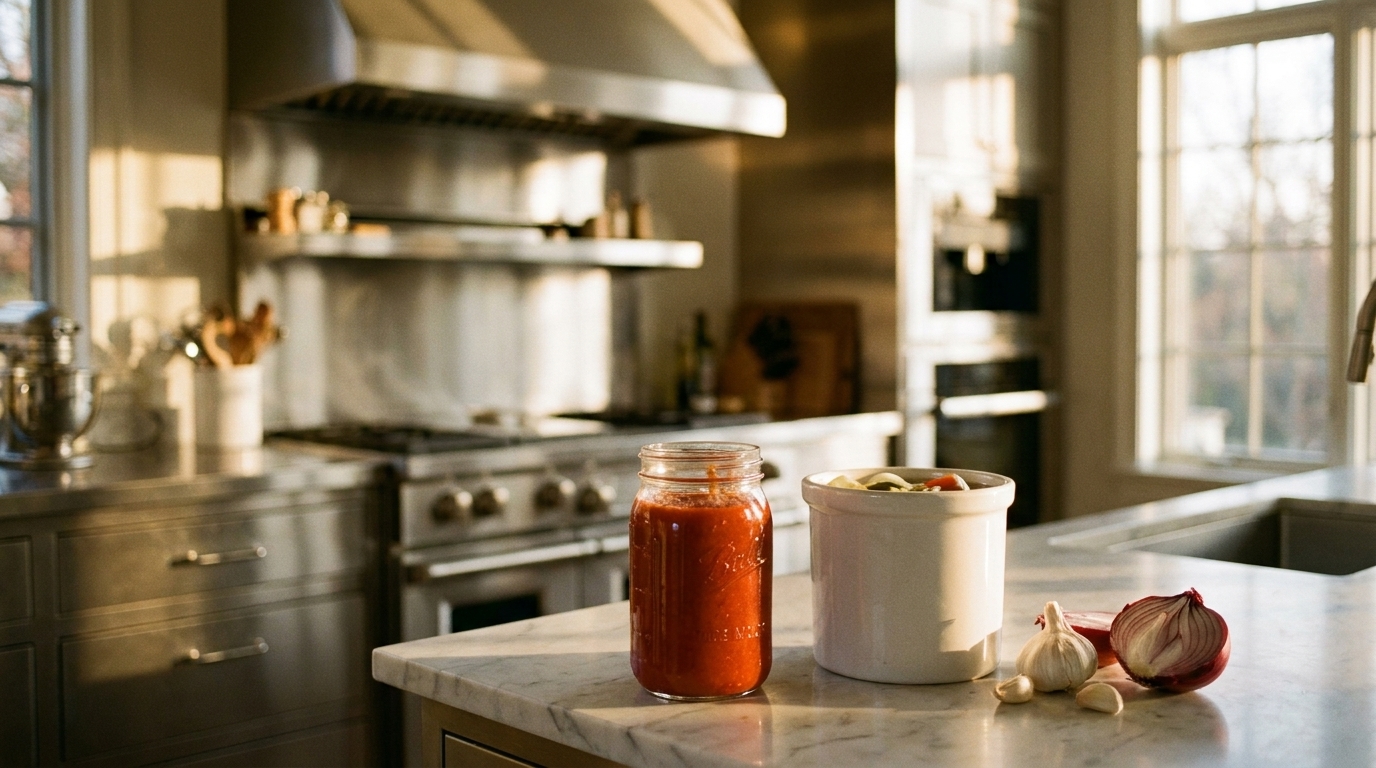
Acidic foods, high-salt items, dairy, and cut alliums can leach metals or absorb odors when stored in stainless steel due to extended contact time. Glass or ceramic containers prevent these reactions and keep your food tasting clean while protecting your cookware's surface.
Why Stainless Steel Storage Matters: Understanding the Science Behind Food Safety
Nickel and chromium leaching from stainless steel into acidic foods increases dramatically with extended contact time, making storage riskier than cooking.
How acidic and salty foods corrode stainless steel containers
The difference between cooking in stainless steel vs. storing food long-term The core difference between cooking and storing food in stainless steel is contact time. Cooking involves high heat and a defined end point -- you finish the recipe and transfer the food to a different vessel.
Storage removes that time limit entirely. Research confirms that nickel and chromium leaching from stainless steel into acidic foods increases substantially with longer exposure: nickel concentrations jumped roughly 34-fold after 20 hours of continuous contact compared to shorter cooking periods.[3] Leaving acidic or high-salt food in the same pan overnight recreates those extended-contact conditions at room temperature -- without any defined stopping point -- making storage the higher-risk scenario for both surface corrosion and metal migration.[3]

The 5 Food Categories You Should Never Store in Stainless Steel
Acidic foods and high-salt items corrode stainless steel by leaching metals and triggering pitting, so transfer them to glass or ceramic instead.
Acidic foods: tomatoes, citrus, vinegar-based dressings, and wine
Acidic foods are the category most likely to damage stainless steel during storage because organic acids -- citric acid in tomatoes, acetic acid in vinegar-based dressings, and the acids in citrus juice -- actively pull chromium and nickel out of the protective oxide layer on the steel's surface. [4] Research using tomato sauce (pH 4.17-4.30) found nickel concentrations jumped up to 26-fold after just six hours of contact with stainless steel, and nearly 34-fold after 20 hours. [3] Vinegar dressings behave the same way: the higher the acetic acid content, the more likely food develops a metallic off-taste during storage. [4] For most people, the amounts involved stay below daily intake thresholds -- but for anyone with a nickel allergy or contact dermatitis, even sub-toxic doses leached during storage can trigger systemic symptoms, making glass or ceramic the cleaner swap for these foods. [4]
High-salt foods: brined vegetables, cured meats, and pickled items
High-salt foods -- brined vegetables, cured meats, olives, capers, and pickled items -- are particularly damaging to stainless steel because their chloride content, derived directly from salt, acts as a catalyst for corrosion rather than a slow degradant. [5] Chloride ions concentrate within the microscopic surface features of the steel, disrupting the passive film and initiating pitting: discrete, deepening cavities that erode the metal from the inside out. [5] Salty liquids that pool in seams or small gaps compound the problem further, since chloride concentrations rise over repeated exposure cycles and accelerate crevice corrosion -- a second failure mode where the metal is progressively undermined from within tight spaces. [5] Anything packed in salt water, cured with salt, or fermented in brine should transfer to glass or ceramic storage promptly; leaving it in a stainless steel pan or bowl overnight creates exactly the chloride-heavy conditions that cut the material's service life short. [6]
Additional Foods and Beverages to Keep Out of Stainless Steel Storage
Dairy and allium vegetables can stain stainless steel and create odors that persist even after washing, so store them in glass or ceramic instead.
Dairy products and their chemical reactions with stainless steel
Dairy products contain lactic acid, and while industrial stainless steel equipment is engineered to resist it in controlled processing environments, the risk profile changes in home storage. [7] Milk, yogurt, buttermilk, and sour cream left in a stainless steel container long-term can stain the surface and create conditions where bacterial growth accelerates without consistent refrigeration -- stainless steel does nothing to prevent spoilage, it only slows it when kept cold. [8] Salt-heavy dairy products like blue cheese, brined feta, and aged cheddar present a compounded problem: the same chloride dynamic that damages stainless steel in the presence of brined vegetables applies here, with dairy proteins adding to bacterial retention on the steel surface. [7] Transfer fresh dairy to glass or ceramic containers within two hours of opening, and check out our care & maintenance tips if your stainless steel has already picked up staining from dairy residue -- it's recoverable with the right approach. [8]
Onions, garlic, and sulfurous vegetables that stain and corrode
Onions, garlic, and other allium family vegetables release organosulfur compounds -- including allicin, allyl methyl disulfide, and diallyl disulfide -- the moment you cut or crush them. [9] Chromium, the element responsible for stainless steel's corrosion resistance, actively binds with these sulfur compounds on contact -- a reaction strong enough that it underpins the entire category of stainless steel odor-removing soap bars. [9] Store cut onions or garlic in a stainless steel container and that same chemistry works against you: sulfur compounds absorb into the surface, producing persistent odors and discoloration that standard washing rarely clears completely. [9] Glass or ceramic containers sidestep the problem entirely, since neither material reacts with organosulfur compounds the way chromium does.


The Right Storage Strategy: What to Use Instead and How to Protect Your Cookware
Proper storage keeps your cookware protected and ready to perform, whether you choose stainless steel or carbon steel.
Choosing glass, ceramic, and food-grade plastic alternatives for different foods


The Right Storage Strategy: What to Use Instead and How to Protect Your Cookware
Glass containers eliminate metallic off-tastes and safely store acidic foods, brined items, and cured meats without absorbing flavors or odors.
Choosing glass, ceramic, and food-grade plastic alternatives for different foods
Glass is the clearest upgrade from stainless steel for high-risk food categories -- it's completely non-reactive with acids, salts, and sulfur compounds, doesn't absorb odors, and lets you inspect food visually for spoilage at a glance. [11] For acidic foods like tomato sauce and vinegar-based dressings, glass jars also eliminate the metallic off-taste that develops during extended stainless steel contact. [10] Ceramic and stoneware crocks are a reliable choice for fermented or salt-heavy items, provided any glaze is confirmed lead-free and food-safe. [11] Food-grade plastic works as a lightweight option for short-term brine storage -- but only containers specifically rated food-safe qualify, since general-purpose buckets or non-food containers introduce their own contamination risks. [11]
Food Storage Container Selector
| Food Type | Risk Level | Best Container | Why | Suggested Max Storage |
|---|---|---|---|---|
| Tomato sauce, citrus juice, vinegar dressings | High | Glass | Non-reactive; no metallic off-taste or staining | Up to 5 days refrigerated |
| Brined vegetables, pickles, olives | High | Glass jars | Non-reactive with acidic brine; easy to seal and inspect | Weeks to months |
| Cured meats, salted items | High | Glass or ceramic | Resists chloride-driven corrosion; no flavor transfer | 3-5 days refrigerated |
| Fresh dairy (milk, yogurt, sour cream) | Moderate | Glass or ceramic | Non-porous; easy to sanitize; no odor absorption | Per label |
| Brined or aged cheeses (feta, blue cheese) | High | Glass | Resists both chloride and lactic acid; no odor retention | 1-2 weeks refrigerated |
| Cut onions and garlic | Moderate | Glass | Won't bind sulfur compounds or hold persistent odors | 3-5 days refrigerated |
| General cooked leftovers | Low | Glass, ceramic, or food-grade plastic | Non-reactive; prevents chemical leaching from heat | 3-4 days refrigerated |
Maintenance tips to restore stainless steel if corrosion occurs
Surface rust on stainless steel is almost always a deposit issue rather than structural damage -- meaning it's fixable without replacing the pan.
A paste of baking soda and distilled white vinegar, scrubbed with the grain using a non-abrasive sponge, removes most minor rust spots without scratching the surface.[13] For heavier buildup, Bar Keepers Friend restores the steel to a clean silver finish with less effort than baking soda alone -- wipe it off within a minute to prevent discoloration.[12] If you're seeing actual pitting rather than surface staining, the passive layer may be compromised; our piece on does stainless steel rust explains the difference, and you can always contact us for guidance on whether the pan is still safe to use.
- Nickel and chromium leach 34-fold more from stainless steel during 20-hour storage versus cooking.
- Acidic foods like tomato sauce and vinegar dressings pull chromium and nickel from steel's protective layer.
- Salt and chloride in brined vegetables cause pitting and crevice corrosion that degrades stainless steel.
- Dairy products, onions, and garlic create staining and persistent odors that standard washing won't remove.
- Glass containers are non-reactive with acids, salts, and sulfur compounds--the safest storage choice.
- Surface rust from food storage is fixable with baking soda paste or Bar Keepers Friend without replacing the pan.
- https://pmc.ncbi.nlm.nih.gov/articles/PMC11012613/
- https://www.outokumpu.com/en/expertise/stainless-basics/corrosion-resistance
- https://pmc.ncbi.nlm.nih.gov/articles/PMC4284091/
- https://www.eatingwell.com/stop-storing-these-foods-in-stainless-steel-containers-11970970
- https://www.foodengineeringmag.com/articles/98614-know-the-causes-of-stainless-steel-corrosion-in-retorts-and-take-practical-steps-to-prevent-corrosion
- https://orapiasia.com/pitting-corrosion-an-in-depth-analysis/
- https://nickelinstitute.org/en/blog/2020%E5%B9%B4/may/food-safety-why-stainless-steel-is-a-vital-ingredient/
- https://destudiohome.com/blogs/news/can-i-put-milk-in-a-stainless-steel-bottle-the-ultimate-guide?srsltid=AfmBOoqFvhkB34FLiBV9V-VI6Sp2QfK-QPJhAmOJCl1c-P4PT9AEKrRz
- https://rusticwise.com/how-does-stainless-steel-soap-work/
- https://www.aol.com/articles/15-popular-foods-never-store-135700000.html
- https://agriculture.institute/food-processing-and-engineering-i/choosing-right-containers-for-pickling/
- https://www.nytimes.com/wirecutter/guides/how-to-clean-stainless-steel-pans/
- https://www.duncanscreativekitchens.com/rust-in-your-stainless-steel-sink/
- Summary
- Why Stainless Steel Storage Matters: Understanding the Science Behind Food Safety
- The 5 Food Categories You Should Never Store in Stainless Steel
- Additional Foods and Beverages to Keep Out of Stainless Steel Storage
- The Right Storage Strategy: What to Use Instead and How to Protect Your Cookware
- The Right Storage Strategy: What to Use Instead and How to Protect Your Cookware
- Key Takeaways
- References