

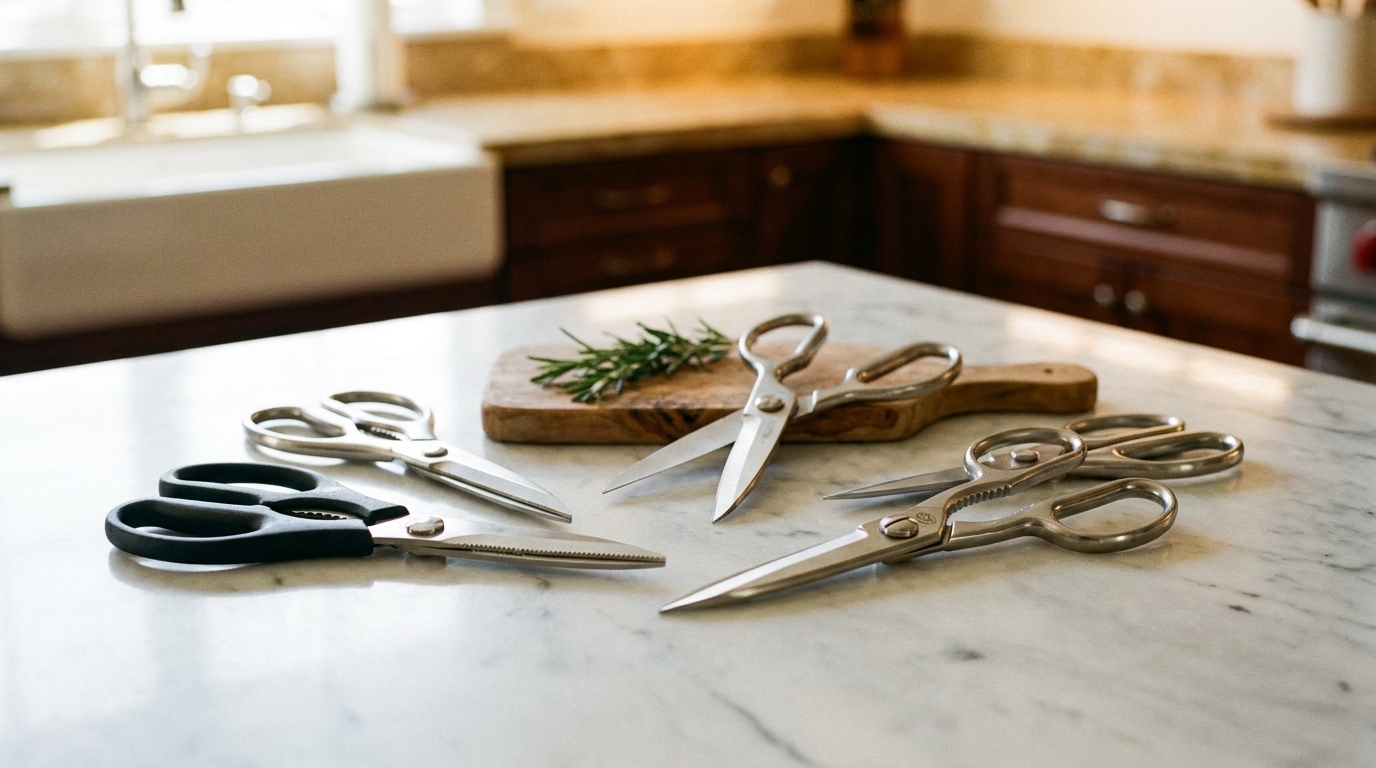
Kitchen shears engineered with stainless steel blades, ergonomic handles, and reinforced pivots outperform standard scissors for food prep tasks from delicate herbs to spatchcocking poultry. Choosing the right pair depends on your cooking habits--prioritize blade alignment and handle comfort for herb work, or compact blades with longer handles for breaking down birds.
Understanding Kitchen Shears
Kitchen shears use thicker blades, larger handles, and reinforced pivot points to cut through bone and raw protein where regular scissors would bend or dull.
Definition and key features of kitchen shears
Kitchen shears are scissors engineered specifically for food prep, built with stainless steel blades, ergonomic handles, and a pivot point set farther from the handles than standard scissors -- giving you more leverage when cutting through tough ingredients like poultry bones.[2] That design difference is what makes them a distinct kitchen tool rather than just a stand-in for whatever's in your junk drawer.[1] Most quality pairs include at least one micro-serrated blade to grip slippery raw proteins, and the blades pull apart completely so you can clean the pivot zone where food debris and bacteria collect.[2] They also tend to include extra features -- bottle openers, shell crackers, herb strippers -- which is why a good pair functions more like a kitchen multitool than a simple cutting instrument.[1]
Differences between kitchen shears and regular scissors
The most visible difference is handle design: shears have one larger finger loop sized for multiple fingers, giving you more leverage and grip pressure when cutting dense ingredients, while scissors use equal-sized handles built for light cuts on flat materials like paper or fabric.[4] Blade thickness follows the same logic -- kitchen shear blades are thicker and reinforced at the pivot to resist bending under load, while scissor blades dull quickly on anything tougher than thin packaging or twine.[4] Using regular scissors on raw meat or bones creates both hygiene concerns and accelerated blade wear.[4] The asymmetry in blade and handle is intentional -- it's what makes kitchen shears a distinct tool rather than an oversized version of what's in your desk drawer.[4]
Essential components of high-quality kitchen shears
Blade alignment is one of the most telling quality markers in the best kitchen shears -- when the two blades don't track straight against each other, delicate items like chives fold instead of shearing cleanly, while a well-aligned pair cuts precisely from pivot to tip.[5] Understanding blade construction basics helps here: just as knife geometry determines cutting performance, the handle-to-blade ratio in shears determines leverage -- shorter blades paired with longer handles generate more mechanical force at the cutting point, which is why the most powerful shears aren't always the ones with the longest blades.[5] Reinforced handle construction is the third factor to evaluate, since flimsy handles flex under load and can't sustain the pressure needed to work through dense joints or thick stems without fatiguing your hand.[6]

Top Kitchen Shears Brands and Models
The Messermeister Take-Apart Kitchen Scissors earned unanimous preference in testing for their sharp blades, comfortable handles, and practical multi-tool features.
Messermeister 8-inch Take-Apart Kitchen Scissors
The Messermeister 8-inch Take-Apart Kitchen Scissors stand out in testing for their balance and handle comfort -- in one informal trial, every person asked to pick a favorite pair from a lineup chose these without hesitation.[6] The pointed stainless steel blades are sharp enough to break down chicken joints cleanly, yet controlled enough for snipping tomatoes or herbs straight from the vine.[6] They come apart for thorough cleaning around the pivot, are dishwasher safe, and include integrated tools: a bottle opener, nut cracker, jar lid gripper, and bone cutter.[7] At 8.72 inches, they're a practical size for both everyday prep and heavier tasks, and they work equally well for left- and right-handed cooks.[6]
Shun Multi-Purpose Kitchen Shears
The Shun Multi-Purpose Kitchen Shears stand out for an unusual blade design: the anvil blade is serrated on the outside rather than the interior, giving it a firm grip on slippery ingredients while the smooth inner edge slides cleanly through parchment without tearing or snagging.[5] At 4.38 inches, they have the longest blades in most tested lineups, enabling longer, smoother strokes with narrow profiles that maneuver well around tight cuts.[8] Medium pivot tension keeps snipping comfortable over multiple repetitions, and the shears separate completely at the hinge for thorough cleaning.[8] The set also includes a bottle opener, nutcracker, bone notch, and two screwdriver tips -- a range of extras that genuinely earns the multi-purpose label.[5]
OXO Multi-Purpose Kitchen and Herb Scissors
The OXO Good Grips Kitchen and Herb Scissors (8.75-inch) earn consistent top marks for handle comfort -- a 2.75-inch opening fits three fingers without cramping, and the slightly cushioned plastic reduces fatigue on repetitive snipping tasks like herbs or bacon strips.[5] One blade is micro-serrated to grip slippery proteins; the other stays smooth for parchment and delicate cuts, with blade alignment precise enough that both edges shear cleanly from pivot to tip rather than folding material between them.[5] Small metal divots above the pivot screw double as an herb stripper, a low-profile detail that earns regular use once you know it's there.[5] The blades pull apart at the hinge for cleaning, though the micro-serrations make hand-washing slower than a smooth-bladed pair -- these are not dishwasher-safe.[5]
Evaluating Kitchen Shears Performance
Sharp blades with proper ergonomics and regular maintenance--especially keeping the pivot dry--determine whether your shears perform reliably for years.
Sharpness and cutting precision
Sharpness in kitchen shears comes down to blade geometry and tip design -- pointed tips give you control at tight cuts and joints, while blunt tips make precision work noticeably harder.[6] Micro-serrated blades grip slippery proteins and resist dulling faster than smooth blades, though they require a professional sharpener when they eventually lose their edge; smooth-edged blades can be restored with a few passes on a sharpening stone at home.[6] Like serrated knife edges, a serrated shear blade grips rather than slides on wet or fatty ingredients, which matters when breaking down raw proteins.[9] A simple field test: if shears fold or drag through chives instead of cutting cleanly, sharpening is overdue.[6]
Comfort and ergonomics
Handle size and material are the two ergonomic factors that matter most during extended use -- finger loops sized for multiple fingers reduce cramping, while soft or silicone-coated handles cushion your grip through repetitive tasks like snipping herbs or breaking down poultry.[10] Weight distribution is equally important: a shear that's blade-heavy transfers fatigue to your cutting hand faster, while a balanced design lets the tool do the work.[11] Shears that are too heavy or bulky can be a problem regardless of sharpness -- if you can't sustain comfortable pressure through the cut, performance suffers no matter how good the blade is.[12]
Durability and maintenance
The most important care & maintenance tip for kitchen shears is also the simplest: dry them completely before storing, since moisture trapped at the pivot causes rust even on stainless steel blades.[6] Hand-washing with hot, soapy water after every use outperforms the dishwasher even when a pair is labeled dishwasher-safe, since repeated heat cycles can warp blade geometry over time.[6] Disassembling the blades before washing lets you scrub the pivot zone where food debris collects, which is also the spot most vulnerable to corrosion if left damp.[6] A drop of food-safe oil applied to the pivot joint periodically keeps it moving smoothly and prevents the gradual stiffness that makes even a sharp pair feel resistant mid-cut.[6]


Versatile Applications of Kitchen Shears
Quality shears handle delicate herb prep, poultry spatchcocking, and even jar lids--making them far more versatile than most cooks realize.
Herb snipping and food preparation
Shears outperform a knife on delicate herbs because they cut without bruising -- chives, basil, and scallions stay fresh and bright instead of releasing oils under blade pressure on a cutting board.[13] For basil chiffonade, stack the leaves, roll them tightly lengthwise, then snip across the roll in 1/8-inch increments -- the same result as cutting chiffonade with a knife but faster and without bruised edges.[13] Snipping directly over a bowl eliminates the cutting board entirely, which makes quick work of canned whole tomatoes, bacon strips cut into lardons, or parsley leaves trimmed from their stems -- three prep tasks where shears are genuinely faster than reaching for a knife.[5]
Poultry and meat trimming techniques
Spatchcocking is the most demanding cut kitchen shears handle well -- place the bird breast-side down, cut along both sides of the backbone from tail to neck, remove it, then flip and press down firmly on the breastbone until it cracks flat.[14] The technique cuts overall cook time by roughly half while keeping breast meat from overcooking before the dark meat finishes -- two problems with whole-bird roasting that flattening solves by exposing more surface area to direct heat.[16] It works equally well on Cornish hens, small turkeys, and quail, making it a dependable approach for any bird where thickness varies significantly from breast to thigh.[15]
Opening packaging and non-culinary uses
Beyond food prep, quality shears handle several tasks that have nothing to do with cooking -- the plier-like grippers built into the inner handles open stubborn jar lids and bottle screw caps, and double as a cracker for shell-on nuts or lobster.[1] Most pairs also include a bottle opener and flathead screwdriver tips on each handle, which are useful for quick kitchen maintenance like tightening loose cabinet knobs.[1] For packaging, shears cut through thick plastic clamshells, food bags, and heavy twine more cleanly than standard scissors -- and at a better angle than a box cutter -- making them the tool you'll reach for before digging through a junk drawer.[17]


Choosing the Right Kitchen Shears
The right pair matches your cooking style--whether you're breaking down poultry, prepping herbs, or doing both--and proper storage keeps blades sharp between uses.
Considering your cooking style and needs
Your cooking habits should drive which pair you choose.
If you regularly break down whole birds or work through tough joints, prioritize a compact blade paired with longer handles -- the mechanical advantage matters more than blade length when cutting through bone.[5] Cooks who focus on herbs, parchment, and lighter daily prep benefit more from precise blade alignment and spacious finger loops that don't cramp your hand through repetitive snipping tasks.[10] If your cooking spans both ends of that range -- poultry one week, herb prep the next -- look for a come-apart pair with a micro-serrated blade that handles both without compromising on either, since the best kitchen shears are simply the ones that match how you actually cook.[18]
Budget-friendly vs. premium options
Price in kitchen shears spans roughly $15 for entry-level pairs to over $80 for premium models, and performance tracks that range -- but not linearly.
Budget options like the KitchenAid All-Purpose Shears deliver micro-serrated blades, come-apart construction, and ambidextrous handles at a fraction of premium pricing -- blade alignment and handle comfort are where precision cuts reveal the difference.[6] Premium models like the Shun are the most expensive in most test lineups, excelling at controlled snipping and parchment work, but testers found them harder to power through heavy cuts like spatchcocking than mid-range competitors at roughly half the cost.[5] For everyday cooking across varied tasks, a solid mid-range pair often delivers the best balance of performance and value.
Care and storage tips for longevity
Storage placement affects how long shears stay sharp -- tossing them loose in a drawer chips blade edges, while a magnetic strip, dedicated sheath, or drawer organizer protects them between uses.[20] Humidity is a real concern: storing shears near sinks exposes the pivot to moisture splashes even when they're not in use, so a dry cabinet shelf or a silica gel packet in the storage area prevents rust before it starts.[19] If rust spots do appear, scrub with a baking soda and water paste, dry thoroughly, then apply a drop of food-safe oil to the affected area before the damage spreads.[19] Using shears only for tasks within their design limits -- not cutting frozen food or hard bones beyond their capacity -- is a straightforward care & maintenance tip that extends blade life considerably.[19]
- Kitchen shears have reinforced blades, ergonomic handles, and a pivot point engineered for leverage--making them distinct from standard scissors.
- Micro-serrated blades grip slippery proteins without bruising delicate herbs, while blade alignment determines whether cuts are clean or fold material.
- Spatchcocking with quality shears cuts poultry cook time roughly in half by flattening the bird and exposing more surface area to heat.
- Handle size, weight distribution, and material matter most during extended use--finger loops for multiple fingers reduce cramping on repetitive tasks.
- Hand-wash and dry completely before storing; disassemble at the hinge to scrub the pivot zone where food debris and rust accumulate.
- Match your shears to your cooking habits: compact blades with longer handles for poultry, precise alignment for herbs, or a versatile micro-serrated pair for both.
- https://www.seriouseats.com/why-you-need-kitchen-shears
- https://www.nytimes.com/wirecutter/reviews/best-scissors-kitchen-shears/
- https://www.gohomeguide.com/kitchen-shears-vs-scissors/
- https://santokuknives.co.uk/blogs/blog/what-is-the-difference-between-scissors-and-shears
- https://www.seriouseats.com/the-best-kitchen-shears
- https://www.foodandwine.com/best-kitchen-shears-7096434
- https://www.desertcart.in/products/477691767-messermeister-8-inch-take-apart-kitchen-scissors-red
- https://www.americastestkitchen.com/equipment_reviews/1877-kitchen-shears
- https://culinaryambition.com/best-kitchen-shears-and-scissors/
- https://www.foodnetwork.com/how-to/packages/shopping/product-reviews/best-kitchen-shears
- https://www.techgearlab.com/topics/kitchen/best-kitchen-shears
- https://www.consumerreports.org/home-garden/best-kitchen-shears-of-the-year-a7032005438/
- https://andrewzimmern.com/11-ways-to-use-your-kitchen-shears/
- https://www.wholefoodsmarket.com/tips-and-ideas/archive/guide-spatchcocking-funny-name-sensible-technique
- https://cutco.com/learn/how-to-quickly-spatchcock-chicken
- https://zestkh.com/guide-to-spatchcocking-poultry/
- https://www.brigii.com/blogs/news/15-genius-ways-to-use-kitchen-shears-beyond-cutting-food
- https://kyokuknives.com/blogs/kyoku-chef-blog/kitchen-shears-guide?srsltid=AfmBOorLmtGHWDkTmhZiiOXzGTcmI13fHzmTl7J5KqoLugXhiE0aClLm
- https://www.insight-kitchenknife.com/what-are-some-common-maintenance-tips-for-kitchen-shears.html
- https://dalstrong.ca/blogs/news/the-ultimate-guide-to-kitchen-shears?srsltid=AfmBOortdIQNVoveHHqS3j7isyBm7mzsiYqAHziD-nJIKgW48PXgDCbR