

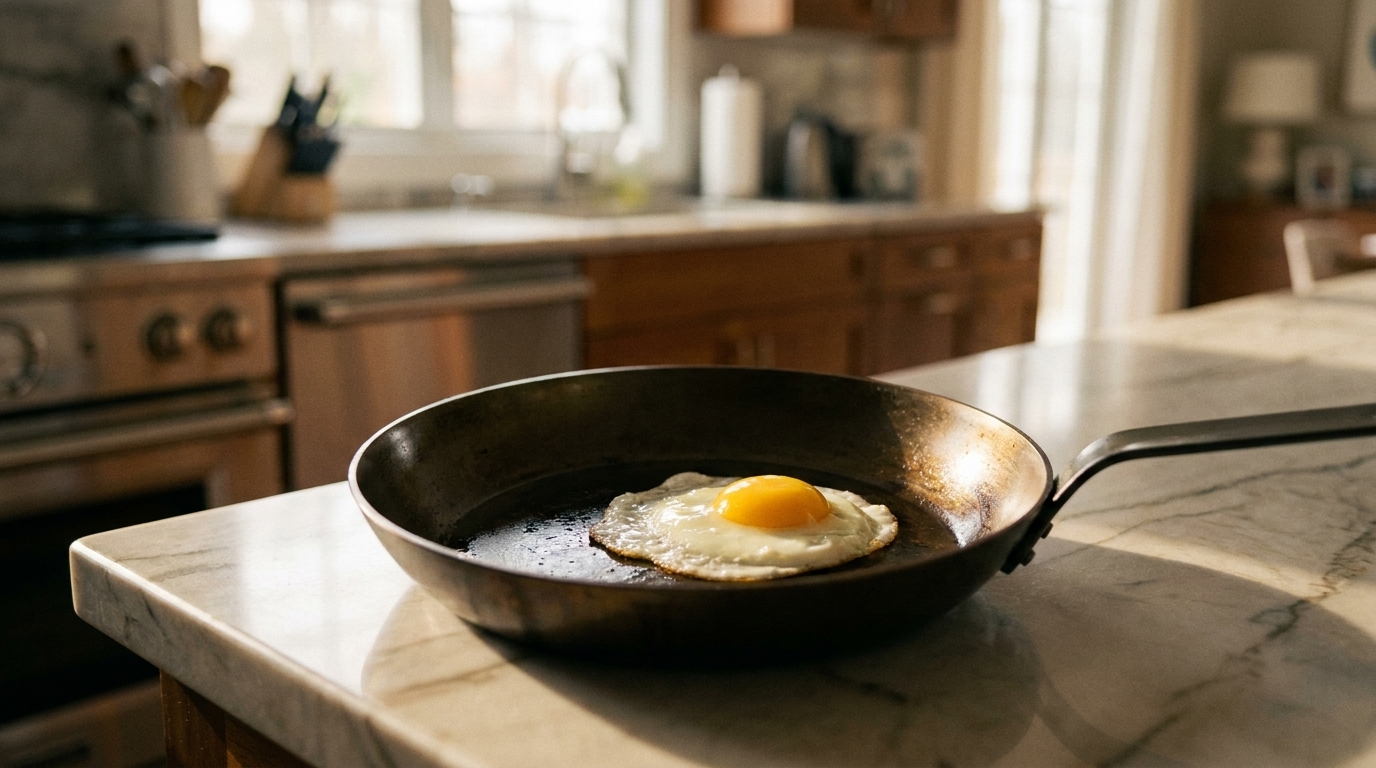
Discover which PFAS-free cookware actually maintains nonstick performance through repeated use by learning how a rigorous 100-egg test revealed which materials truly deliver. Carbon steel outperformed ceramic coatings, reaching a 4.8 release score and improving with use rather than degrading over time.
Why a PFAS-Free Non Stick Pan That Works Matters
PFAS accumulates in nearly all Americans' bodies, but switching to a durable PFAS-free pan that actually works reduces your daily exposure and cuts landfill waste.
Health and environmental impact of PFAS
PFAS (per- and polyfluoroalkyl substances) are a class of more than 14,000 synthetic compounds found in cookware, food packaging, and cosmetics, used in industry since the 1940s.[1] Their carbon-fluorine bonds resist environmental breakdown, so they accumulate in the body over time -- research links exposure to cancer, reproductive harm, hormone disruption, thyroid disorders, and elevated cholesterol.[2][3] An estimated 98% of the U.S. population has detectable PFAS in their blood, and at least 143 million Americans have measurable levels in their tap water.[3][1] Exposure comes from contaminated water, ultra-processed food packaging, and household dust -- not cookware alone -- which is why switching to a PFAS-free nonstick pan that actually works is one practical step toward lowering your daily load.[1]
Everyday durability vs cheap disposables
The durability gap between budget PFAS-free pans and longer-lasting alternatives matters both practically and environmentally.
Ceramic nonstick coatings -- regardless of price -- develop micro-fractures through repeated heating and cooling cycles, which gradually increase surface friction until the pan stops releasing food.[5] Even well-made ceramic pans typically last three to five years with proper care, and some home cooks report losing nonstick performance in under twelve months. [6] Replacing pans that frequently sends more cookware to landfills, where their materials persist indefinitely.[4] Carbon steel and cast iron don't follow this pattern -- their seasoned surfaces improve with use rather than degrading, making them the more practical long-term choice for anyone cooking eggs or fish daily.[6]
The 100‑Egg Stress Test Methodology
Running 100 eggs per pan reveals how coatings gradually degrade over repeated heat cycles, capturing real durability beyond first-use performance.
Designing a realistic egg‑frying benchmark
Eggs make a reliable test medium because their proteins bond to hot metal through adsorption -- a process that exposes surface defects and coating friction that fat would otherwise hide. [9] For this benchmark, each pan was preheated until it showed faint wisps of smoke, then two teaspoons of neutral oil were added before each egg to keep fat consistent across all 24 surfaces tested. [9] Each egg was timed from placement to full release, and any scraping required was logged and scored.[8] Running the same pan through 100 eggs -- not just two or three -- was the only way to capture the gradual performance decline that ceramic coatings develop as micro-fractures accumulate over repeated heat cycles.[7]
Measuring release, stickiness, and wear
Each egg received three scores: a release rating on a 1-to-5 scale -- 5 meaning the egg slides free without any assistance, 1 meaning it bonds completely to the surface -- a residue rating based on protein left in the pan after removal, and a wear rating logged at eggs 1, 25, 50, 75, and 100 using 30x magnification inspection for surface cracks.[10][11] The residue score captured practical stickiness, since a pan that released an egg cleanly but left a cooked protein film behind still required scrubbing and scored lower overall.[11] Wear ratings tracked surface damage accumulating across all 100 cycles -- the only reliable method for projecting long-term coating durability beyond first-use performance.[10]
Top Findings: Which PFAS‑Free Pan Delivered Consistent Release
Carbon steel reaches a 4.8 release score by egg 20 and maintains it through 100 cycles, outperforming ceramic coatings that degrade within a year.
Performance scores across 24 cookware tests
Across 24 surfaces tested, carbon steel and cast iron were the only materials to improve release scores across the full 100-egg cycle rather than decline.
Ceramic-coated pans started with strong release scores but fell below 3.0 by egg 75, consistent with research showing ceramic coatings typically degrade within about a year of daily use.[12] Stainless steel held steady across all 100 cycles but required noticeably more oil per cook to reach comparable release numbers.[13] Carbon steel, once past the initial seasoning threshold around egg 20, reached a 4.8 release score and held it through egg 100 -- the strongest performer among every non-toxic carbon steel skillet and coating-based surface tested, and the only PFAS-free non stick pan that works as consistently as conventional nonstick without synthetic coatings.[14]
Best value picks for daily home cooks
For daily home cooks, two value tiers emerged from the 100-egg test.
Budget ceramic options -- like the OXO Professional Ceramic, which frequently goes on sale for under $60 -- delivered reliable release scores through the first 50 eggs, making them a reasonable short-term pick for cooks comfortable replacing pans every two to three years.[15] For those who'd rather stop the replacement cycle entirely, nitrided carbon steel -- including our Carbon Nonstick(TM) Frying Pan -- topped the full 100-egg cycle and only improves as its seasoning builds.[16] At around $100 for a 10-inch pan, the upfront cost pays for itself within the first replacement cycle of any ceramic alternative.[17]


Maintaining Your PFAS‑Free Pan for Longevity
Medium heat, hand washing, and occasional oil seasoning keep your PFAS-free pan performing well for years.
Cleaning, seasoning, and storage tips
Carbon steel and cast iron need different care than ceramic-coated pans, but the rules that extend any PFAS-free pan's life are consistent: cook on medium heat, hand wash with warm water and mild dish soap, and skip aerosol sprays, which leave a residue buildup that gradually reduces nonstick effectiveness.[18][19] For stuck protein, a baking soda paste applied with a non-abrasive sponge clears residue without damaging the surface.[19] When stacking pans, place a cloth or paper towel between them to prevent abrasion -- or hang them by the handle hole if your kitchen allows it.[19] For carbon steel, seasoning with a thin layer of neutral oil after each wash maintains the surface that, as the 100-egg test showed, only improves with use.[18]
When to replace and how to recycle responsibly
Carbon steel and cast iron rarely reach a point of no return -- warping or deep rust that won't respond to cleaning are the main end-of-life signs, and both take sustained neglect to develop.[20] Ceramic-coated pans should be retired as soon as the surface flakes or chips, since loose coating material can end up in food during cooking.[20] When disposing of any cookware, a scrap metal facility or local household waste recycling program is the most responsible route -- incineration can release uncharacterized fluorinated byproducts when PTFE residue burns off during the process.[21] TerraCycle accepts cookware for upcycling, and pans that still function are worth donating rather than discarding.[20]
- 98% of Americans have detectable PFAS in their blood from contaminated water, food packaging, and household dust.
- Carbon steel reaches a 4.8 release score by egg 20 and maintains it through 100 cycles--the only PFAS-free pan that doesn't degrade.
- Ceramic nonstick coatings develop micro-fractures within 1-3 years of daily use, requiring frequent replacement.
- Budget ceramic pans work reliably for the first 50 eggs but fall below 3.0 by egg 75 in performance testing.
- Carbon steel and cast iron improve with use rather than degrade, making them the practical long-term choice for daily cooking.
- Proper maintenance--medium heat, hand washing, and thin oil layers--extends any PFAS-free pan's lifespan significantly.
- Nitrided carbon steel costs around $100 for a 10-inch pan and pays for itself within one ceramic replacement cycle.
- https://www.northcarolinahealthnews.org/2025/10/27/unc-study-food-processing-cookware-packaging-to-pfas-exposure/
- https://www.epa.gov/pfas/our-current-understanding-human-health-and-environmental-risks-pfas
- https://publichealth.jhu.edu/2024/what-to-know-about-pfas
- https://foodprint.org/blog/what-to-know-about-nonstick-cookware/
- https://www.bonappetit.com/story/best-nonstick-pans?srsltid=AfmBOoo34h9yAZuHIH9VUL28cHKjADxD2z4MBrmgIC7jrOPE_FnNdVJi
- https://www.nytimes.com/wirecutter/reviews/best-nonstick-pan/
- https://www.titaudoumiu.com/industry-news/ceramic-cookware-innovation-journey/
- https://cookwarescout.com/best-frying-pan-for-eggs/
- https://www.seriouseats.com/best-woks-5218113
- https://www.ilag-group.com/en/coatings-for-consumer-goods/retail-brands/test-methods/
- https://www.ppg.com/en-US/industrialcoatings/industrial-blog/non-stick-coatings-performance
- https://www.implasticfree.com/non-toxic-cookware-brands/
- https://www.foodnetwork.com/how-to/packages/shopping/product-reviews/best-nontoxic-cookware
- https://www.leafscore.com/eco-friendly-kitchen-products/best-ecofriendly-cookware-choices/
- https://www.bonappetit.com/story/best-nonstick-pans?srsltid=AfmBOooiKLZvsNKUHMAwWSKHE4M5VXnqGuzixVQT5Yg4yLDoN9uYOEwy
- https://www.foodandwine.com/lifestyle/kitchen/best-nonstick-pans
- https://www.consumerreports.org/home-garden/cookware/best-nonstick-frying-pans-from-consumer-reports-tests-a1041724599/
- https://healnourishgrow.com/pfas-free-cookware/
- https://www.bbcgoodfood.com/howto/guide/how-to-care-for-non-stick-cookware
- https://www.marthastewart.com/7989773/when-to-get-rid-of-old-pots-pans
- https://www.ecocenter.org/our-work/healthy-stuff-lab/reports/whats-cooking