

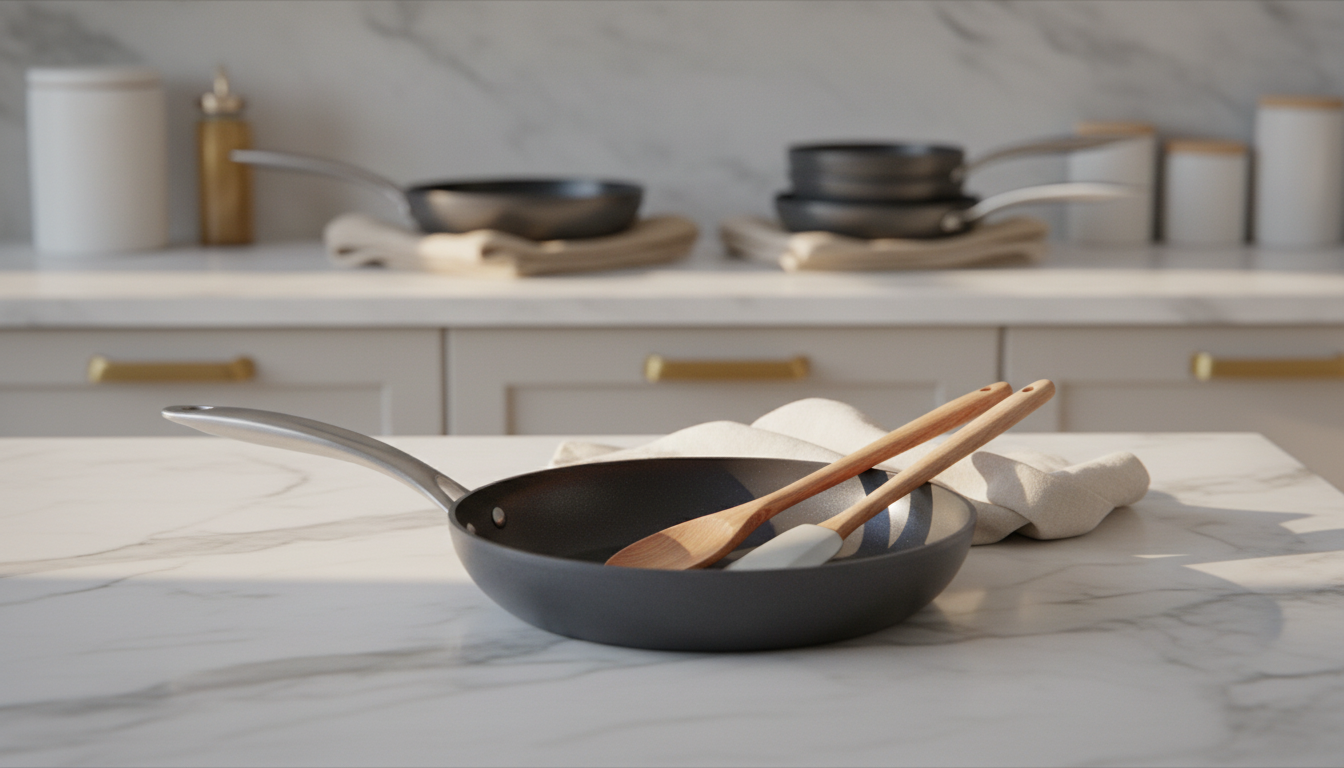
Non-stick coatings fail prematurely from overheating, metal utensils, and harsh cleaning--but simple habit changes prevent most damage. Control your heat, hand-wash, store carefully, and choose a quality pan to reliably double its working life.
Why Non-Stick Frying Pans Fail Before Their Time
Heat cycling, metal utensils, and harsh cleaning each wear down nonstick coatings, but you can prevent all three with simple cooking and care habits.
The three main culprits behind premature non-stick coating breakdown
Nearly every frying pan with a nonstick coating fails for the same three structural reasons, regardless of brand or price. The coating is a thin layer bonded onto a metal base, usually aluminum, and that layer was never built to last as long as the metal underneath it [1]. Understanding these failure points is the first step toward doubling a pan's working life, since each one is preventable with the right habits. Three failure points show up across almost every pan, coated or ceramic:
- Heat cycling: repeated preheating and cooling makes the coating and metal expand at different rates, flexing the bond between them until it separates at a microscopic level [1].
- Metal utensils: a light scrape from a metal spatula can shear through a coating only a few microns thick, which is why wood or silicone tools hold up better [1][2].
- Chemical and abrasive cleaning: dishwasher detergent and scouring pads are formulated to strip fat and residue, and they pull at the coating's surface chemistry with every wash [1][3].
These three stressors compound rather than act alone. One teardown of a used ceramic pan found a persistent brown film and visible pitting from metal utensils well before the coating fully failed, showing how heat, scraping, and cleaning chemistry all leave marks on the same surface over time [3].
How everyday cooking mistakes accelerate wear (and how to stop them)
Beyond the structural failure points, daily habits compound the damage every time you cook. Preheating an empty frying pan lets temperatures spike within minutes, since there's no oil or food to absorb the heat, which accelerates coating breakdown before you've added a single ingredient [4][5]. Overcrowding the pan or flipping food too soon has a similar effect: a flooded cold surface drops the pan's temperature, pushes you to crank the burner higher to compensate, and that extra heat wears on the coating over repeated use [6]. Cooking sprays create their own problem, leaving a sticky residue that builds up invisibly and gradually reduces how well food releases from the surface [4]. Stacking pans in a cabinet adds pressure marks and fine scratches that look harmless at first but weaken the coating with every stack and unstack [4][5].
A few adjustments stop most of this wear before it starts:
- Add oil before turning on the burner, never after [4][5]
- Cook in batches instead of crowding the surface [6]
- Use small amounts of oil or butter instead of spray [4]
- Separate stacked pans with a cloth or liner [4][5]
None of these require buying anything new (our guide on what actually makes non-stick pans last covers how coating quality factors in too), just a shift in sequence and handling that protects the coating you already paid for. Small as they are, these corrections are often enough to double the number of years a pan stays in rotation.
Master the Heat: The Single Biggest Factor in Non-Stick Longevity
Keeping your non-stick pan below medium-high heat and staying under 500 degreesF can double its working life by preventing coating breakdown.
Why high heat destroys non-stick coatings faster than anything else
PTFE, the fluoropolymer behind most non-stick coatings, is prized for being temperature-resistant and chemically tough, but that resistance has a ceiling [7]. Manufacturers design non-stick cookware around medium-heat cooking and delicate foods that tend to stick, not maximum-heat searing, because the coating simply isn't built for that kind of thermal load [7]. An empty pan left on a hot burner heats up fast since there's no oil or food to absorb the energy, and surface temperatures on a high-output burner can climb toward 500 degreesC, a range where even a high-quality coating starts to break down [7][8].
That's a different failure mode than ordinary wear from utensils or cleaning: overheating degrades the coating from the inside, not just the surface, which is why a single bout of severe overheating can do more damage than years of normal cooking [7][8]. Heat exposure also ranks as one of the most common reasons coatings degrade prematurely, especially when a pan gets rushed to temperature with too little oil or is left on the burner empty [9]. The takeaway is practical: how a pan is heated, not just how often it's used, often determines whether the coating makes it to year one or year five [9].
Controlling heat alone can effectively double a pan's working life, since overheating is the single fastest way to cut it short.
The optimal temperature range for your frying pan and what it means for your cooking
The working ceiling for a non-stick frying pan sits at 500 degreesF. Past that point, the coating starts to decompose, and fumes released above roughly 660 degreesF can trigger flu-like symptoms known as polymer fume fever [10]. On a stovetop, that means staying at or below medium-high heat rather than maxing out the burner, since power burners above 12,000 BTU (or 2,400 watts on electric) can push a non-stick surface past its limit in minutes [10].
For oven use, 450 degreesF is the practical cap, since ovens cycle above their set point as they work to maintain temperature, and starting lower keeps the pan from spiking past 500 degreesF during those cycles [12]. In real cooking terms, this range covers nearly everything non-stick is suited for: eggs, pancakes, fish, delicate sauces, and vegetables that need gentle, even heat rather than a hard sear. High-heat tasks like searing steak or blackening are better suited to a stainless steel skillet or a carbon steel pan, which tolerate sustained heat without a chemical coating to protect [11].
Staying inside this window isn't a limitation so much as a match between tool and task: non-stick pans trade high-heat versatility for effortless release and easy cleanup, and respecting that tradeoff is what keeps the coating intact cook after cook. Staying within this range consistently is one of the simplest ways to double how long a coating lasts compared to pans run hot from day one.
Cleaning and Storage: The Maintenance Routine That Extends Pan Life by Years
Hand-washing your pans with warm water and a soft sponge, rather than using the dishwasher, can double your cookware's lifespan by protecting the non-stick coating.
Hand-washing vs. dishwasher: which method actually preserves non-stick coatingsHand-washing comes out ahead for one simple reason: it skips the heat and chemical intensity that dishwashers rely on. Dishwasher cycles use high water temperatures and strong detergents formulated to strip grease, and that same chemistry pulls at a non-stick coating's surface bonds with every run [13]. The sustained heat inside a dishwasher can also warp thinner pan bases over repeated cycles, while jostling against other dishes adds scratches that compound over time [13][14]. PTFE-coated pans fare worst in this environment, since manufacturers generally advise against dishwasher use altogether, and even pans marketed as dishwasher-safe see gradual coating wear from repeated exposure [14]. Hand-washing avoids all three stressors at once: lower water temperature, gentler cleaning agents, and no contact with other cookware. The proper method matters too, since rinsing with warm water and a soft sponge, rather than steel wool or scouring pads, keeps the coating's surface intact [13][14]. A few practices make hand-washing effective without adding real time to cleanup:
- Let the pan cool before washing to avoid thermal shock [13]
- Use warm water and mild dish soap, not harsh degreasers [13]
- Scrub with a soft sponge, never steel wool or abrasive pads [13][14]
- Dry completely before storing to prevent moisture damage [14]
If a dishwasher is unavoidable, a gentle cycle, mild detergent, and separating the pan from other dishes limit the damage, though none of these fully match the control of washing by hand [13][14]. Consistent hand-washing alone can add years to a pan's life, in many cases doubling its lifespan compared to regular dishwasher use.
Proper storage techniques that prevent coating damage between uses
How you store a frying pan matters as much as how you clean it, since stacked cookware creates pressure points that scratch the coating long before the metal shows any wear. Setting pans directly on top of each other lets the rim of one scrape across the cooking surface of the one below, and that friction builds up with every stack and unstack [15][16]. A cloth, paper towel, or silicone mat between pans absorbs that contact and keeps the coating from taking the hit [16][17]. A pot rack or shelving setup that keeps each pan separate removes the problem entirely, which matters most if your kitchen stores several frying pans of different sizes together [17]. Rubbing a small amount of oil into the surface before storing adds a thin protective layer and keeps the coating conditioned between uses [15]. A few habits cover most of what storage requires:
- Separate stacked pans with cloth, paper towel, or a silicone mat [16][17]
- Store pans on a rack when cabinet space allows [17]
- Make sure pans are fully dry before stacking or racking [16]
- Wipe a thin layer of oil on the surface before putting it away [15]
None of these steps take more than a minute, but skipping them is one of the quieter ways a non-stick coating loses years off its working life. Done consistently, these storage habits alone can stretch a pan's usable life to twice what careless stacking would allow.
Choosing a Non-Stick Frying Pan Built to Last: What Separates Durability From Hype
Multi-layer PTFE coatings and particle size during manufacturing determine whether a non-stick pan lasts years or wears quickly under daily use.
Coating quality and construction features that predict real-world lifespan
Coating composition determines how long a frying pan holds its non-stick surface, and PTFE and ceramic are built from different structures entirely. PTFE's carbon backbone, shielded by fluorine atoms, stays flexible and resists cracking under vibration or bending, with stable performance up to roughly 260 degreesC before it starts to break down [18]. Ceramic coatings rely on a denser, inorganic matrix that tolerates heat above 500 degreesC but turns brittle under stress, so a ceramic pan that gets flexed, dropped, or knocked against a stovetop grate is more likely to crack than to wear down gradually [18].
Particle size during manufacturing also predicts how the coating performs once it's on a pan: fine PTFE powder, in the 1 to 10 micron range, produces a dense, pore-free surface that releases food reliably, while coarser particles create micro-texture that boosts abrasion resistance but reduces how cleanly food slides off [18]. Multi-layer PTFE coating systems, built with reinforced layering instead of a single coat, are engineered specifically to outlast traditional single-layer nonstick surfaces in daily use [19]. It's the same logic behind our own nonstick pan, which uses multiple coating layers intended to add durability where the surface takes the most abuse.
None of this shows up in plain language on a box, but it explains why two pans marketed simply as 'non-stick' can wear at very different rates depending on the coating's internal structure and particle makeup, not just the brand printed on the handle. Choosing a well-constructed coating up front is one of the few decisions that can double a pan's realistic lifespan before it ever touches a stove.
How to evaluate non-stick pans before buying to avoid premature failure
Before buying, check three things that predict how long a coating will actually last: independent durability testing, oven-safe temperature ratings, and how clearly the brand discloses coating type. Lab testing that puts nonstick surfaces through thousands of steel wool strokes before re-testing food release shows real differences between pans marketed the same way [20]. Oven-safe ratings vary widely, from 400 degreesF on some PTFE pans to 600 degreesF or higher on certain ceramic models, so matching that number to how you actually cook matters more than the coating type alone [20]. Ceramic coatings have outperformed traditional PTFE nonstick in recent comparative testing, but manufacturers themselves report ceramic typically holds up for two to five years with good care, not indefinitely [20]. A quick water-bead or egg-release test on a pan you already own can also reveal whether a coating is still intact or quietly failing [21]. Visible warning signs -- flaking, discoloration, or food sticking where it used to release easily -- are equally reliable cues that a pan is due for replacement [21]. Because ceramic lifespans can run three years or shorter in everyday use, confirming the coating composition and any PFOA-free or PTFE-free claims before purchase helps set realistic expectations [22]. Our buyer's guide to non-toxic non-stick pans breaks down coating types in more detail if you want to compare before you shop. Getting these checks right before purchase is often what separates a pan that lasts one season from one that doubles that span with the same care routine. A short checklist covers most of what matters at the shelf:
- Ask for published durability test results, not just marketing claims [20]
- Match oven-safe rating to your actual cooking habits [20]
- Confirm PTFE or PFOA-free claims with real disclosure [22]
- Expect ceramic coatings to need replacement sooner than PTFE [20][22]
Putting It Together: How Small Changes Compound Into Double the Lifespan
Each fix above works on its own, but the real doubling effect comes from stacking them rather than relying on any single one. A pan that's already protected from overheating, then washed by hand instead of run through a dishwasher, then stored without pressure or scratching, isn't getting one improvement -- it's getting four or five, each compounding on the last instead of competing with it.
Most non-stick pans fail early from a combination of these stressors hitting at once, not from a single mistake, so layering every fix together is what turns a one-year pan into a two-year pan, or a two-year pan into four. Seen this way, doubling a pan's lifespan isn't a single trick or product upgrade; it's the cumulative result of removing every avoidable source of damage, one habit at a time, until the coating simply has far less working against it.
The Takeaway
Simple habits like medium-high heat, hand washing, and careful storage can double your nonstick pan's lifespan.
Doubling the life of a nonstick pan comes down to a few repeatable habits: keep the heat at or below medium-high, add oil before the burner goes on, wash by hand, and store each pan so nothing scrapes the coating. Pair those habits with a pan built to hold up, and you get years of reliable release instead of months.
For more care & maintenance tips, or if you have a question about keeping your cookware in top shape, contact us--we're always happy to help.
Frequently Asked Questions
-
What's the safe temperature range for cooking on a non-stick frying pan?
The article sets the working ceiling at 500°F on the stovetop, recommending you stay at or below medium-high heat since burners above 12,000 BTU (or 2,400 watts electric) can push the surface past that limit in minutes. For oven use, it caps recommended heat at 450°F, since ovens cycle above their set point and can spike a pan past 500°F if you start higher.
-
What happens if I accidentally overheat my non-stick pan?
According to the article, fumes released above roughly 660°F can trigger flu-like symptoms known as polymer fume fever, and overheating degrades the coating from the inside rather than just the surface. It notes a single bout of severe overheating can do more damage than years of normal cooking, so avoiding empty pans left on a hot burner is key.
-
Is it okay to use metal utensils or the dishwasher on a non-stick pan?
The article advises against both: a light scrape from a metal spatula can shear through a coating only a few microns thick, so wood or silicone tools hold up better. Dishwasher detergent and heat also pull at the coating's surface chemistry with every wash, so hand-washing with warm water, mild soap, and a soft sponge is recommended; if a dishwasher is unavoidable, use a gentle cycle and separate the pan from other dishes.
-
How should I store non-stick pans to avoid scratching them?
The article recommends separating stacked pans with a cloth, paper towel, or silicone mat, since direct contact lets one pan's rim scrape the cooking surface of the one below. A pot rack or shelving that keeps pans separate removes the problem entirely, and wiping a thin layer of oil on the surface before storing adds a protective layer between uses.
-
Can better habits actually double how long a non-stick pan lasts?
The article states that controlling heat, consistent hand-washing, and proper storage can each effectively double a pan's working life compared to careless use, and choosing a well-constructed coating up front can do the same before it ever touches a stove. It points to multi-layer PTFE systems, like the one used in Misen's nonstick pan, as an example of coating construction engineered to outlast single-layer surfaces.
- Non-stick coatings fail from heat cycling, metal utensils, and harsh cleaning, not from one cause alone.
- Preheating an empty pan lets temperatures spike dangerously fast, accelerating coating breakdown before cooking starts.
- Staying at or below medium-high heat and 500 degreesF keeps the coating intact, while overheating does more damage than years of normal use.
- Hand-washing with warm water and a soft sponge extends pan life compared to dishwasher cycles that strip coatings with heat and strong detergent.
- Separating stacked pans with cloth or storing on a rack prevents scratches and pressure marks that weaken the coating over time.
- Multi-layer PTFE coatings and ceramic built to withstand higher temperatures last longer than single-layer alternatives, but ceramic typically needs replacement sooner.
- Stacking several small habits, not relying on one fix, compounds protection and can realistically double a pan's working life.
- https://kaizencookware.com/blogs/news/why-every-forever-nonstick-pan-fails-in-18-months
- https://www.sensarte.com/blogs/all/the-science-behind-nonstick-coatings-and-how-they-work
- https://www.imesh-kitchenware.com/resources/how-ceramic-pans-work-and-how-to-restore-their.html
- https://klonberg.eu/en/blog/how-to-avoid-common-mistakes-that-damage-non-stick-cookware
- https://proware-kitchen.co.uk/explore/how-to-use-and-care-for-non-stick-cookware/
- https://www.lagostina.ca/en/blog/cooking-mistakes-you-are-making
- https://www.pfannenprofis.com/en-cz/pages/antihaftbeschichtungen-ptfe
- https://www.pfannenprofis.com/en-it/pages/antihaftbeschichtungen-ptfe
- https://siraatskitchen.com/blogs/care-use/how-long-do-non-stick-pans-last-lifespan-care-when-to-replace
- https://www.straightupfood.com/blog/2015/09/24/are-nonstick-pans-safe/
- https://www.vikingculinaryproducts.com/blogs/articles/the-best-cookware-for-high-heat-cooking
- https://www.americastestkitchen.com/articles/8686-best-practices-cookware
- https://www.sensarte.com/blogs/all/hand-washing-vs-dishwasher-what-s-better-for-nonstick-cookware
- https://ecolutionhome.com/a/blog/are-non-stick-pans-dishwasher-safe-a-comprehensive-guide
- https://culistack.com/en/blogs/news/non-stick-pan-care
- https://insights.made-in-china.com/Mastering-Non-Stick-Care-The-Complete-Guide-to-Prolonging-Your-Fry-Pan-s-Life_MAzGegFjbJDc.html
- https://leadingcatering.com.au/blog/post/what-are-some-crucial-tips-to-maintain-and-extend-the-life-of-commercial-cookware
- https://fluoropolymers.alfa-chemistry.com/resources/comparing-ptfe-and-ceramic-coating-choosing-the-right-non-stick-surface.html
- https://en.pfluon.com/how-multi-layer-coatings-outperform-traditional-teflon/
- https://www.consumerreports.org/home-garden/cookware/best-nonstick-frying-pans-from-consumer-reports-tests-a1041724599/
- https://alva-cookware.us/blogs/news/know-pan-non-stick
- https://foodprint.org/blog/what-to-know-about-nonstick-cookware/
- Summary
- Why Non-Stick Frying Pans Fail Before Their Time
- Master the Heat: The Single Biggest Factor in Non-Stick Longevity
- Cleaning and Storage: The Maintenance Routine That Extends Pan Life by Years
- Choosing a Non-Stick Frying Pan Built to Last: What Separates Durability From Hype
- The Takeaway
- Key Takeaways
- References