

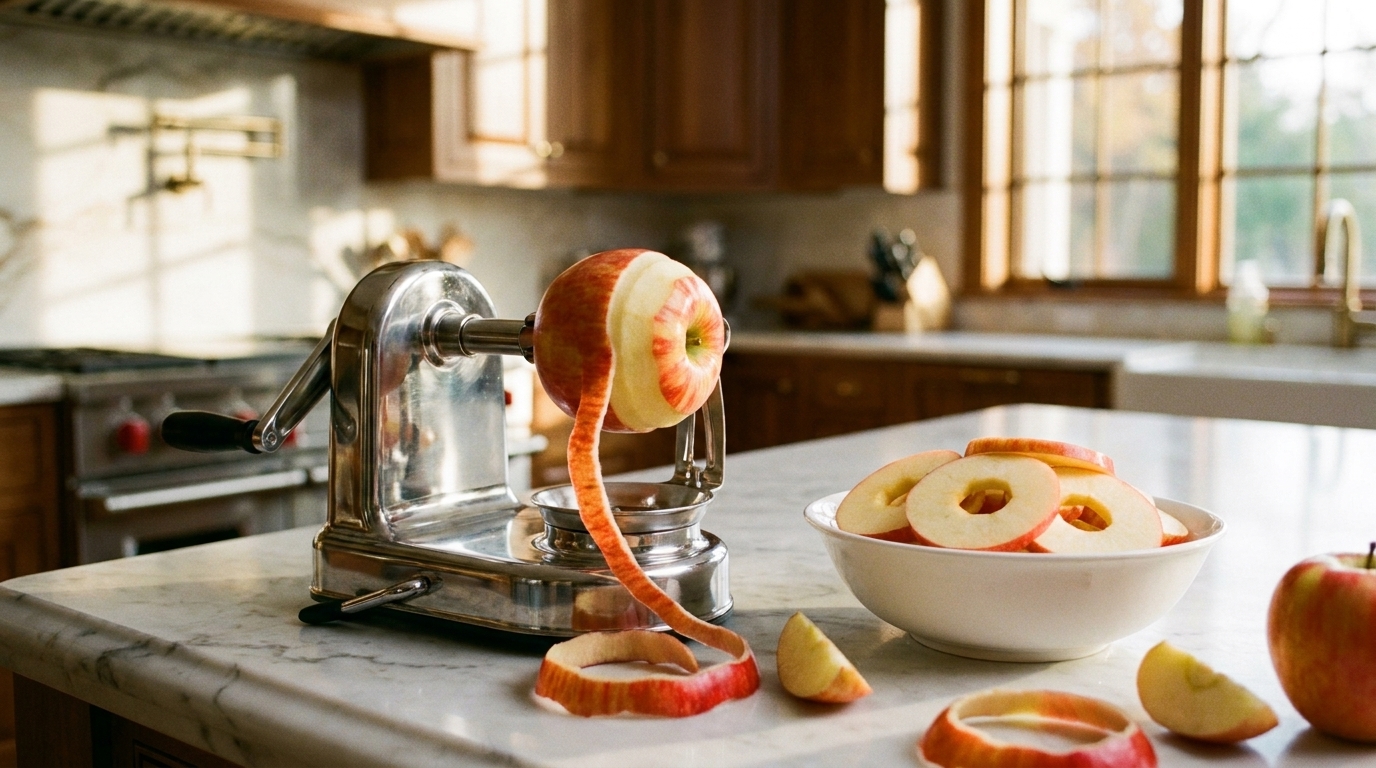
Learn which apple peeler corer slicer design works best for your kitchen, from handheld options to crank-style countertop models. A dedicated tool cuts prep time from 12 minutes to under 4 minutes while producing uniform slices that cook and dehydrate evenly.
Introduction to Apple Preparation Tools
Mechanical apple peelers complete 5 pounds of apples in under 4 minutes while producing uniform slices that bake and dehydrate evenly.
Evolution of apple processing tools
Apple processing tools have a longer history than most home cooks realize.
The first U.S. apple peeler patent was issued to Moses Coates in 1803, and over 325 patents followed as demand grew for faster fruit prep -- early designs were mostly wooden frames with metal blades.[1] A separate coring device appeared in 1810, when Cyrus Gates received the first U.S. patent for a machine that cored and quartered apples simultaneously.[2] The two functions converged by 1883, when Reading Hardware's Champion used a single crank turn to peel, slice, core, and eject an apple -- establishing the multifunctional design that today's apple peeler corer slicer tools still follow.[1]
Benefits of using specialized apple tools
A dedicated apple peeler corer slicer delivers three practical advantages over a standard paring knife: speed, consistency, and reduced physical effort.
Cook's Illustrated testing found a mechanical apple peeler completed 5 pounds of apples in under 4 minutes -- a task that took a skilled cook 12 minutes by hand -- with finished piles weighing within a few ounces of each other, addressing the common concern about excess waste. [4] Crank-style models can peel, core, and slice a single apple in roughly five seconds, producing uniform slices that bake and dehydrate evenly. [5] For anyone processing large quantities -- applesauce, pie filling, or dehydrated snacks -- that combination of speed and consistent slice thickness makes a measurable difference in both prep time and end results. [5]
Types of apple preparation devices
Apple preparation devices fall into three main categories: handheld peelers, crank-style countertop models, and electric machines.
Handheld options -- swivel, Y-style, and serrated blades -- are compact and suited to small batches, though they handle peeling only; the same blade styles in our potato peeler guide apply directly to apples. [6] Crank-style countertop models complete all three functions -- peeling, coring, and slicing -- in a single rotation, making them the most practical choice for high-volume tasks. [2] Electric machines reduce physical effort the most, peeling an apple in under 30 seconds, though most don't include coring or slicing. [6] Stand mixer attachments occupy a middle category, adding spiralizing and slicing to an existing appliance without requiring a dedicated drawer slot. [6]

Peeler Apple Peeler Corer Slicer: Features and Functionality
Multifunctional crank-style models peel, core, and slice apples in one rotation, with spring-loaded arms adapting automatically to different fruit sizes.
Design and components of multifunctional apple tools
A standard apple peeler corer slicer consists of three main components: a frame, a blade assembly, and a stabilizing base.
Frames are most often enamel-coated cast iron, though lighter metals and plastic are common alternatives; blades are almost always stainless steel, sometimes chrome-coated for added corrosion resistance. [7] Multifunctional models separate that blade assembly into distinct cutting elements -- a peeling blade that strips the skin, a hollow coring tube that removes the seed pocket, and a slicing disc that portions the apple into uniform rings -- all engaging in a single crank rotation. [5] Spring-loaded arms then handle size variation automatically, gripping smaller or larger apples without manual reconfiguration between pieces. [7]
Peeling, coring, and slicing mechanisms
The peeling blade maintains continuous contact with the apple's surface throughout the full rotation, removing skin in a single unbroken spiral -- crank-style models typically produce a strip several feet long from one apple. [9] The coring tube follows the same rotational path through the apple's center, extracting the seed pocket cleanly in one pass, while the slicing disc cuts the remaining flesh into uniform rings simultaneously. [9] A single vertical cut through the finished spiral from top to bottom produces two stacks of half-circle slices ready for pie, tarts, or dehydrating. [9] Most crank-style models let you disengage individual blades independently -- peeling only, or coring and slicing without removing the skin -- so the mechanism adapts to the task rather than forcing a fixed output. [8]
Adjustability and versatility for different apple sizes
Crank-style apple peeler corer slicer tools handle size variation well when the fruit is firm -- top-performing models process apples that are perfectly round, lopsided, small, or oversize without requiring manual reconfiguration between pieces. [9] The blade assembly can also be adjusted selectively: you can engage peeling and coring without slicing, or coring and slicing without peeling, depending on what the recipe calls for. [9] The main size constraint is firmness rather than shape -- soft or overripe fruit can't anchor securely on the prongs, so crank models work best with crisp varieties. [9] Push-style models are more forgiving on that front, working reliably on both firm and softer fruit like ripe pears and less-than-crisp supermarket apples. [9]
Comparing Different Styles of Apple Preparation Tools
Y-style peelers outpace swivel models by nearly twice as fast and maneuver more easily around irregular apple curves.
Crank-style rotary peelers
divide into two mounting types -- suction-cup and clamp -- and that choice affects where and how you work more than most buyers expect.
Suction-cup models attach anywhere on a smooth countertop and keep peel accumulation centered on the work surface; clamp models fasten at the counter's edge, which limits placement and pushes the mess exactly where counter space runs short. [4] Cook's Illustrated testing found clamp-style models too narrow for most countertops, giving suction models a clear practical advantage for the majority of kitchens. [4] The one constraint with suction cups is surface texture -- they grip reliably on laminate, stone, or tile but struggle on butcher block and other porous or textured surfaces. [4]
Swivel and Y-style handheld peelers
Swivel and Y-style peelers handle apple prep differently, and the difference is clear under testing.
Taste of Home's Test Kitchen found the swivel-style OXO Good Grips peeler took the longest of any style tested -- suitable for one or two apples, but noticeably slower for larger batches. [10] The Y-style Kuhn Rikon Swiss Peeler outpaced it, using a horizontal blade that removed peel in fewer, wider strokes per apple. [10] Serious Eats testing confirmed this pattern more broadly: Y-peelers completed peeling tasks nearly twice as quickly as swivel models and maneuvered more easily around irregular curves, while swivel blades were more prone to skidding across the fruit's surface. [10]
Electric apple processing machines
Electric apple processors split into two types: dedicated motorized units and stand mixer attachments, each with distinct trade-offs.
Dedicated electric peelers handle peeling automatically once the apple is mounted, making them efficient for bulk prep, though initial setup can be involved and some require additional hand-finishing. [11] Stand mixer attachments cover more ground: the KitchenAid spiralizer attachment peeled, sliced, and cored apples in under 20 seconds on the lowest speed setting, with thin peel removal that minimized waste -- but it only works with a compatible stand mixer. [3] Disassembly and cleanup take longer than crank models, making it a stronger fit for cooks who already own a stand mixer and process apples regularly. [3]
Practical Applications and Uses
Uniform slice thickness ensures even drying and prevents some pieces from spoiling while others remain too moist during storage.
Efficiency in large-scale apple processing
Industrial apple peeler corer slicers operate at a different scale than any countertop model -- commercial machines can process dozens of apples per minute while maintaining consistent slice thickness across the entire batch, a throughput that crank-style or handheld tools simply can't match. [13] Fruit processing plants, commercial bakeries, and juice producers rely on this equipment to reduce manual labor while keeping product quality uniform, which matters when you're prepping hundreds of pounds per shift rather than a single pie. [13] Stainless steel construction is standard at the industrial level, supporting both continuous hygiene requirements and the sustained output that food service operations demand. [12] The broader market signals how widely this need is recognized -- the global fruit processing machinery market is projected to reach $12.4 billion by 2030, growing at a compound annual rate of 6.8%. [14]
Creating uniform apple slices for baking and dehydrating
Uniform slice thickness matters more than most home cooks expect -- pieces of different thicknesses dry at different rates in a dehydrator, leaving some over-dried while others retain enough moisture to mold in storage. [15] Slices between 1/4" and 3/8" thick dried at 135 degreesF take 6-12 hours to reach a pliable, leathery texture; slicing as thin as possible produces crispier apple chips with additional drying time. [16] Slicing into rings creates naturally more uniform thickness, which helps batches dry evenly -- and for anyone processing large quantities, an apple peeler corer slicer speeds that prep considerably while keeping consistent width across every piece. [17]
Time-saving benefits for home cooks and professionals
The cumulative time savings become most apparent when you measure complete prep tasks rather than individual apples -- nine large apples, enough for most apple pie recipes, can be peeled, cored, sliced, and cleaned up in under five minutes using a crank-style apple peeler corer slicer. [18] One Wirecutter staff writer estimated that same batch would have taken five times as long without it -- a difference that matters most when other burners are running and prep competes with active cooking. [18] For home cooks working through a bushel from the orchard or professionals prepping for weekend service, the math is the same: a dedicated tool pays for itself in time well before it wears out. [3]
Maintenance and Care of Apple Preparation Tools
Hand wash your apple peeler to preserve blade sharpness, and replace dull blades or sharpen removable ones with simple tools when they stop cutting cleanly.
Cleaning and storage best practices
Most apple peeler corer slicer tools disassemble for cleaning -- stainless steel blades resist staining and rinse clean easily, while hand washing is recommended over the dishwasher to preserve blade sharpness and the tool's overall condition. [19] Push-style models are generally dishwasher-safe, though the small base that comes with many of them stores separately and is easy to misplace -- keeping it in a designated drawer spot or clipped to the tool solves that. [9] For crank-style models, placing a rimmed baking sheet under the device during use keeps the suction base anchored on textured countertops like granite or marble, and it corrals peels and juice for faster cleanup after prep. [9]
Blade sharpening and replacement
The peeling blade on an apple peeler corer slicer dulls over time -- when it starts skidding across the surface rather than cutting cleanly, it's ready to sharpen or replace. [20] Blades secured with a wing nut can be removed from their housing and sharpened with sandpaper wrapped around a dowel or a small half-round metal file from the jewelry-making section of a craft store. [21] For blades that can't be removed, a cone-shaped hone or emery cloth wrapped around a pencil can reach the curved edge, though results are less predictable. [21] When sharpening isn't worth the effort or the blade has a visible chip, replacement blades are available for many models -- check the manufacturer's parts list before buying a new unit. [20][22]
Troubleshooting common issues
The most common issue with crank-style apple peeler corer slicers is the prong spinning inside the fruit instead of rotating it -- this happens when the apple is too soft for the spike to grip. [23] Firm, crisp varieties solve this directly; an overripe apple can't anchor on the prongs regardless of how the tool is positioned. [23] Assembly is another stumbling block on certain models -- some require a screwdriver to attach the handle arm before first use, which isn't clear from the packaging. [24] If the peeling blade leaves thick strips rather than thin ones, adjust the blade closer to the fruit's surface using the adjustment mechanism before assuming the blade needs replacing. [24]
- Crank-style apple peeler corer slicers complete all three functions in one rotation, processing 5 pounds of apples in under 4 minutes versus 12 minutes by hand.
- Uniform slice thickness (1/4" to 3/8") ensures even drying in dehydrators and consistent baking results across batches.
- Suction-cup models outperform clamp-style versions on most countertops, while Y-style handheld peelers work nearly twice as fast as swivel designs.
- Soft or overripe fruit won't anchor properly on crank-model prongs; firm, crisp apple varieties perform best.
- Nine large apples for a pie can be peeled, cored, sliced, and cleaned up in under five minutes with a crank-style tool.
- Removable blades secured with wing nuts can be sharpened with sandpaper or a half-round metal file; replacement blades are available for many models.
- Stand mixer attachments like the KitchenAid spiralizer complete peeling, slicing, and coring in under 20 seconds but require longer disassembly and cleanup.
- https://www.farmcollector.com/equipment/tools/labor-saving-tools-zm0z15julzhur/
- https://grokipedia.com/page/Apple_corer
- https://www.tasteofhome.com/article/apple-peeler-corer-slicer/
- https://www.healthycanning.com/apple-peelers-home-canning
- https://www.top5dealchoice.com/review/best-5-apple-peelers-of-2025-transform-your-kitchen-prep-from-frustrating-to-effortless/
- https://www.thespruceeats.com/best-apple-peeler-corer-slicer-5076277
- https://bestreviews.com/kitchen/utensils/best-apple-peelers
- https://www.simplycanning.com/apple-slicer/
- https://www.americastestkitchen.com/equipment_reviews/2362-apple-corer-slicers
- https://www.seriouseats.com/best-vegetable-peelers-6892175
- https://www.chicagotribune.com/2020/01/23/the-best-apple-peeler/
- https://www.alibaba.com/product-introduction/Automatic-Industrial-Apple-Peeler-Corer-Slicer_1601156940615.html
- https://www.foodlinemachinery.com/industrial-apple-peeler-corer-slicer/
- https://www.accio.com/plp/apple-peeler-corer-slicer-all-in-one
- https://www.attainable-sustainable.net/dehydrated-apples/
- https://www.freshoffthegrid.com/dehydrating-apples/
- https://alifewellplanted.com/22471/dehydrating-apples-easy-method/?srsltid=AfmBOopkz6R8CbboPAESyGmb8N4PQBFR4-uh90SYO6Z-spCrO1U2_Bhe
- https://www.nytimes.com/wirecutter/reviews/king-arthur-apple-peeler-corer-slicer/
- https://www.chefsuccess.com/threads/is-the-apple-peeler-corer-slicer-worth-it-reviews-and-thoughts.3982/
- https://www.houzz.com/discussions/3198544/dull-apple-peeler-blade-how-to-sharpen
- https://www.hometalk.com/diy/repair/q-sharpen-the-little-curved-blade-on-apple-peeler-corer-44100147
- https://www.chefsuccess.com/threads/should-i-replace-the-blade-on-my-apple-peeler-corer-slicer.1553/
- https://kk.org/cooltools/johnny-apple-peeler/
- https://www.consumerreports.org/home-garden/best-and-worst-single-use-kitchen-tools-a9518186231/