

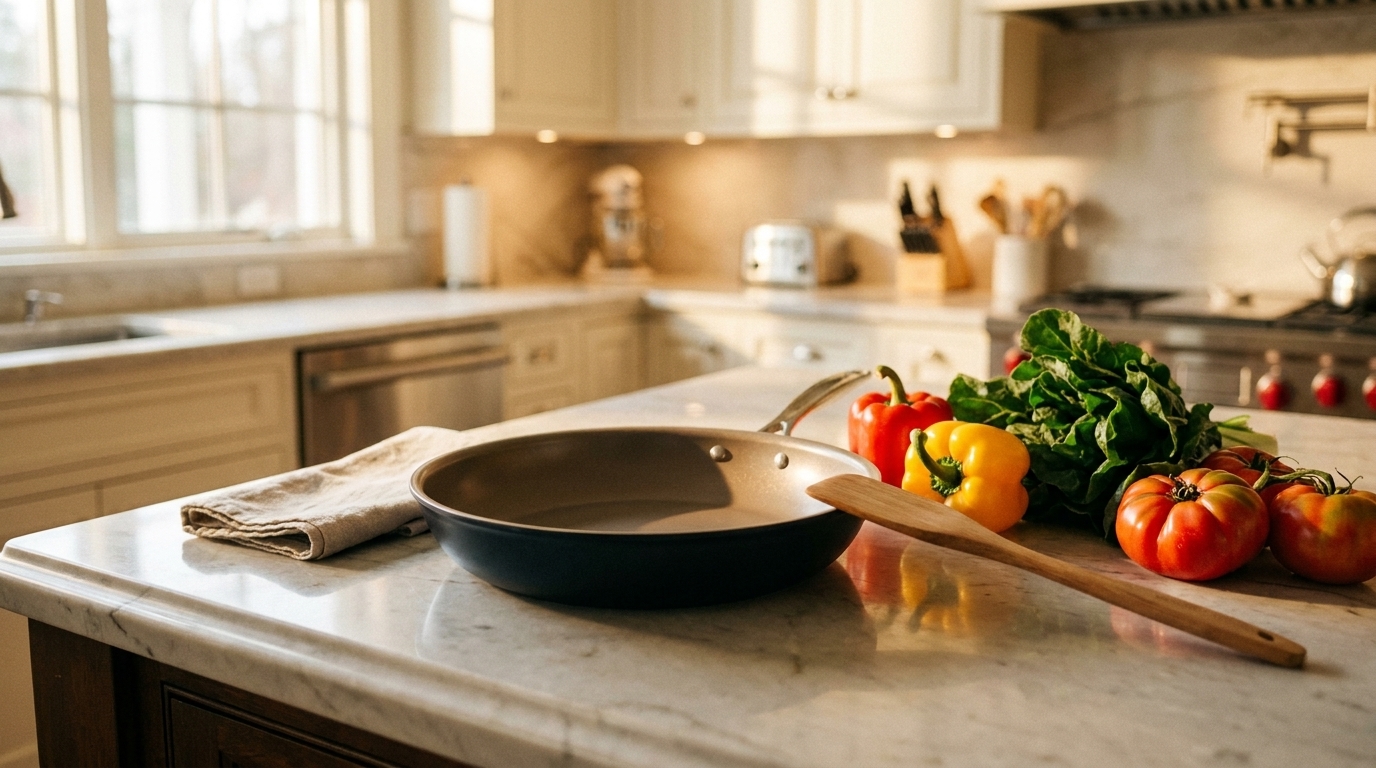
Choosing a non-toxic nonstick sauté pan means understanding the tradeoffs between ceramic coatings for immediate convenience and nitrided carbon steel for lasting durability and heat tolerance. Ceramic delivers quick nonstick performance but degrades within years, while coating-free options like Carbon Nonstick(TM) improve with proper use and reward good technique with lifetime value.
Why Non-Toxic Non-Stick Matters: Health, Performance, and Longevity
Ceramic coatings give you immediate nonstick performance, while coating-free carbon steel pans tolerate extreme heat and improve with use over years.
Understanding PFOA, PTFE, and why these chemicals matter for your kitchen
PFOA and PTFE both belong to the PFAS family (per- and polyfluoroalkyl substances), called "forever chemicals" because they persist in the body and environment for years. [1] PFOA has been linked to liver disease, thyroid disorders, and certain cancers, which led the EPA to eliminate its use in U.S. cookware by 2015. [2] PTFE -- the coating sold as Teflon -- is now produced without PFOA, but Consumer Reports testing found that PTFE-coated pans labeled "PFOA-free" still contained an average of 4 parts per billion of PFOA. [1] When shopping for a non-toxic non-stick saute pan, the PTFE-free label is more reliable than PFOA-free, since ceramic-coated pans carrying that claim tested free of all 96 PFAS in Consumer Reports' panel. [1]
How non-toxic coatings perform differently than traditional Teflon alternatives
Traditional PTFE coatings hold up well across repeated use, but they release fumes when overheated -- a real risk for anyone cooking at high heat without close temperature control. [4] Ceramic-coated pans perform comparably to PTFE when new, with eggs and delicate proteins releasing cleanly, but the nonstick surface degrades faster, especially when exposed to high heat or aerosol cooking sprays. [4] Coating-free options like nitrided carbon steel don't offer instant nonstick performance out of the box -- they require proper preheating and a small amount of fat -- but they tolerate temperatures up to 1,112 degreesF and improve with use rather than declining. [4] That tradeoff matters for a non-toxic non-stick saute pan: ceramic delivers early convenience, while coating-free pans like the Misen Carbon Nonstick(TM) reward good technique with long-term durability.

The Safest Materials for Non-Stick Saute Pans: A Comparison of Coating Technologies
Ceramic coatings lose their nonstick performance within two to five years, while nitrided carbon steel builds durability over time and tolerates metal utensils and extreme heat.
Ceramic vs. mineral-based vs. hybrid coatings: What each offers and what to avoidCeramic coatings are a sol-gel of silica- and titanium-based nanoparticles applied to a metal core -- they test PFAS-free, but the "non-toxic" label isn't regulated, so verify lead-free and cadmium-free certifications on the packaging rather than trusting marketing claims alone. [5] Hybrid coatings layer ceramic nonstick over stainless steel, aiming to combine durability with easy release, but testing finds they don't sear as well as bare stainless or release as cleanly as dedicated nonstick coatings. [6] Mineral-based options like nitrided carbon steel skip coatings entirely -- nitrogen diffused into the metal produces a surface that tolerates metal utensils, handles heat above 1,100 degreesF, and gets more nonstick with each use. [6] Of the three, ceramic coated pans give the most familiar nonstick experience out of the box, while nitrided steel -- like the Misen Carbon Nonstick(TM) -- offers the strongest long-term durability for a non-toxic non-stick saute pan.
Comparison table: Durability, heat tolerance, and safety ratings across coating types
Not all non-toxic coatings perform equally, and the differences matter more than marketing suggests. Ceramic sol-gel coatings are PFAS-free and safe out of the box, but their silica-based structure develops micro-fractures with repeated heating cycles, reducing nonstick performance within two to five years regardless of how carefully you treat them.[7] Nitrided carbon steel tolerates temperatures above 1,100 degreesF, accepts metal utensils, and builds performance over time rather than losing it.[9] The table below consolidates temperature thresholds, expected lifespan, and key certification data across the main coating categories so you can match the right non-toxic non-stick saute pan to how you actually cook.
| Coating Type | Max Rated Oven Temp | Safe Cooking Temp | Expected Lifespan | PFAS Status | Metal Utensil Safe | Key Certifications |
|---|---|---|---|---|---|---|
| Ceramic sol-gel | Up to 600 degreesF | Medium heat (≤400 degreesF) | 2-5 years; up to 7 with care | PFAS-free | No | Lead-free, cadmium-free (verify on label) |
| Nitrided carbon steel | Up to 1,100 degreesF+ | Any -- no coating to degrade | Lifetime (improves with use) | PFAS-free; no coating | Yes | No synthetic chemicals; seasoning-based surface |
| Hybrid (ceramic + stainless) | ~400-500 degreesF | Medium heat (≤400 degreesF) | 2-4 years (ceramic layer degrades) | PFAS-free ceramic layer | No | Lead-free, cadmium-free |
| PTFE (traditional) | Up to 500 degreesF | Low to medium (fume risk above 500 degreesF) | 3-5 years | PTFE present; PFOA-free since 2015 | No | PFOA-free |
Ceramic coatings rated to 600 degreesF still degrade faster when used above 400 degreesF because repeated thermal stress fractures the sol-gel structure at the microscopic level.[7] For a pan rated for lifetime use, nitrided carbon steel is the only coating-free option here that delivers improving nonstick performance alongside high-heat capability and metal utensil compatibility -- making it the strongest long-term value for cooks who use their pans daily.[9] Ceramic remains the better entry point for those who prioritize an easy, low-maintenance nonstick surface from day one, as long as you verify lead-free and cadmium-free certifications on the packaging rather than relying on the 'non-toxic' label alone.[8]
Size, Weight, and Design: Choosing the Right Non-Toxic Saute Pan for Your Cooking Style
A 3-quart sauté pan with sloped sides and a lid rated to match your actual cooking temperatures gives you the control and safety you need for everyday stovetop and oven work.
Why 3-quart capacity and sloped sides matter for everyday sauteing
For everyday use, a 3-quart capacity hits the right balance between cooking surface and manageability -- enough room to sauté vegetables, sear proteins, and build pan sauces without the pan becoming difficult to handle. [11] Testing found that the ideal sauté pan dimensions are 10-11 inches in diameter and 2½-3 inches in height, which maps to that 3-3.5-quart range. [10] Sloped sides -- the defining feature of a sauteuse shape -- allow heat to escape more quickly than straight-sided walls, giving you faster cooking times and better evaporation control when deglazing or reducing. [12] Straight-sided pans hold liquid longer and work better for braises; sloped sides move moisture out efficiently, which is exactly what you want when sautéing proteins or vegetables over higher heat. [12]
Handle design, lid compatibility, and oven-safe limits: What to prioritize
Handle design affects both safety and daily control -- riveted stainless steel handles stay cooler during stovetop use, while cast iron handles often require silicone covers at high heat. [14] Lid compatibility deserves a separate check: on many ceramic non-stick sets, the pan body tolerates higher oven temperatures than the lid -- a common gap puts the pan body at 450 degreesF but the lid at only 350 degreesF, a detail that matters when you're finishing dishes in the oven (our guide on oven-safe pan limits covers this across materials). [14] Ceramic-coated sauté pans are rated as high as 550-600 degreesF by some manufacturers, but regular cooking at those limits accelerates coating degradation faster than medium-heat use. [13][15] For any non-toxic non-stick sauté pan moving regularly from stovetop to oven, match the lid's rated limit to how you actually cook -- not just the pan's stated maximum.


Maintenance and Longevity: How to Keep Your Non-Toxic Pan Performing Like New
Avoid dishwasher washing, thermal shock, and high heat to preserve your ceramic coating, and store pans with soft cloth separators to prevent scratches that degrade performance over time.
Proper seasoning, cleaning, and storage techniques that extend non-stick life
Seasoning before first use sets the nonstick surface correctly -- wash with mild soap, dry thoroughly, apply a thin layer of vegetable oil, heat over medium for 30 seconds, then cool and wipe off any excess oil. [16] After that, the three habits that degrade ceramic coatings fastest are dishwasher washing, plunging a hot pan into cold water (thermal shock stresses the coating), and cooking above medium heat without cause. [16] For storage, place a soft cloth or pan protector between stacked pans -- direct metal contact scratches the coating even when the damage isn't immediately visible. [16] For mineral-based and carbon steel pans like the Misen Carbon Nonstick(TM), oil selection matters more than it does for ceramic, since the seasoning layer is the surface itself rather than a factory-applied coating -- making these care & maintenance tips both simpler and more consequential over the long term.
Warranty coverage and customer support: What separates quality brands from the rest
Warranty terms reveal how much confidence a brand places in its coating, and the gaps are significant.
Some brands promote lifetime warranties on nonstick cookware, though no nonstick coating genuinely lasts a lifetime regardless of the claim -- always read the fine print. [17] More credible are brands offering 10-year warranties on ceramic nonstick, which better reflect the realistic performance window of a well-maintained coating. [18] Beyond warranty length, look for brands that provide clear care documentation and accessible support -- the more thorough the guidance offered upfront, the more likely a brand is building for long-term use rather than repeat purchases.
Misen backs its cookware with a lifetime warranty against defects and publishes detailed care & maintenance tips for every product in the line, so you always know exactly how to get the most out of what you've got.
- PFOA and PTFE are 'forever chemicals' linked to liver disease, thyroid disorders, and certain cancers; the PTFE-free label is more reliable than PFOA-free when shopping.
- Ceramic coatings test PFAS-free but degrade within 2-5 years, while nitrided carbon steel tolerates temperatures above 1,100 degreesF and improves with use over a lifetime.
- A 3-quart sauté pan with 10-11 inch diameter and sloped sides provides the best balance for everyday cooking, searing proteins, and sauce reduction.
- Dishwasher washing, thermal shock from plunging hot pans into cold water, and cooking above medium heat are the three fastest ways to degrade ceramic coatings.
- Verify lead-free and cadmium-free certifications on ceramic pan packaging rather than trusting unregulated 'non-toxic' marketing claims.
- Match your pan lid's temperature rating to your actual cooking habits, not just the pan body's maximum, since lids often have lower limits that restrict oven finishing.
- Riveted stainless steel handles stay cooler during stovetop use compared to cast iron handles, which typically require silicone covers at high heat.
- https://www.consumerreports.org/toxic-chemicals-substances/you-cant-always-trust-claims-on-non-toxic-cookware-a4849321487/
- https://www.webmd.com/food-recipes/is-teflon-coating-safe
- https://www.foodandwine.com/lifestyle/kitchen/best-non-toxic-cookware
- https://healnourishgrow.com/pfas-free-cookware/
- https://www.seriouseats.com/nonstick-vs-ceramic-skillets-7110252
- https://www.bonappetit.com/story/best-nonstick-pans?srsltid=AfmBOoriWdpVTDMU26Xa3PkzHcGnRhsj5geTQ2yoawf0nbqrBIjCxhzM
- https://www.seriouseats.com/best-ceramic-cookware-8723380
- https://alva-cookware.us/blogs/news/is-ceramic-cookware-safe?srsltid=AfmBOoqr1vy9U4ClhuiljPg27Ike-oLX_w0qc-PLz3rzLg2X_5bwzMG2
- https://www.bonappetit.com/story/best-nonstick-pans?srsltid=AfmBOoqiROBc9h6y2Y2bsiP_PIFh8CT5gvKltSQv7h6PZQD_YjmlhlgA
- https://www.bonappetit.com/story/best-saute-pans?srsltid=AfmBOooeC5e90TK5Uz3sypjQN7R-LkYo-MJTNEfUb_2ewXu2GxUvFhGU
- https://www.debuyer-usa.com/blogs/guides/saute-pan-buying-guide?srsltid=AfmBOorqfWdZ141j_aykijzE2nT9icrpSsvpH2UVf5UvCbPBO9B7-M2U
- https://www.ice.edu/blog/sloped-vs-straight-sided-pans
- https://www.thegoodtrade.com/features/nontoxic-cookware/
- https://www.seriouseats.com/best-non-toxic-cookware-sets-11702422
- https://www.leafscore.com/eco-friendly-kitchen-products/best-ecofriendly-cookware-choices/
- https://gourmetkitchenworks.com/blogs/recipes/essential-guide-proper-use-and-storage-of-non-stick-pans-for-longevity?srsltid=AfmBOoo1ut1caXOQ-LW6njYShx14nFy56DWCfcoKg_iKFg-TN6yITGeF
- https://www.cnn.com/cnn-underscored/reviews/best-nonstick-pan
- https://www.organicauthority.com/organic-food-recipes/non-toxic-cookware-brands-to-keep-chemicals-out-of-your-food
- Summary
- Why Non-Toxic Non-Stick Matters: Health, Performance, and Longevity
- The Safest Materials for Non-Stick Saute Pans: A Comparison of Coating Technologies
- Size, Weight, and Design: Choosing the Right Non-Toxic Saute Pan for Your Cooking Style
- Maintenance and Longevity: How to Keep Your Non-Toxic Pan Performing Like New
- Key Takeaways
- References