

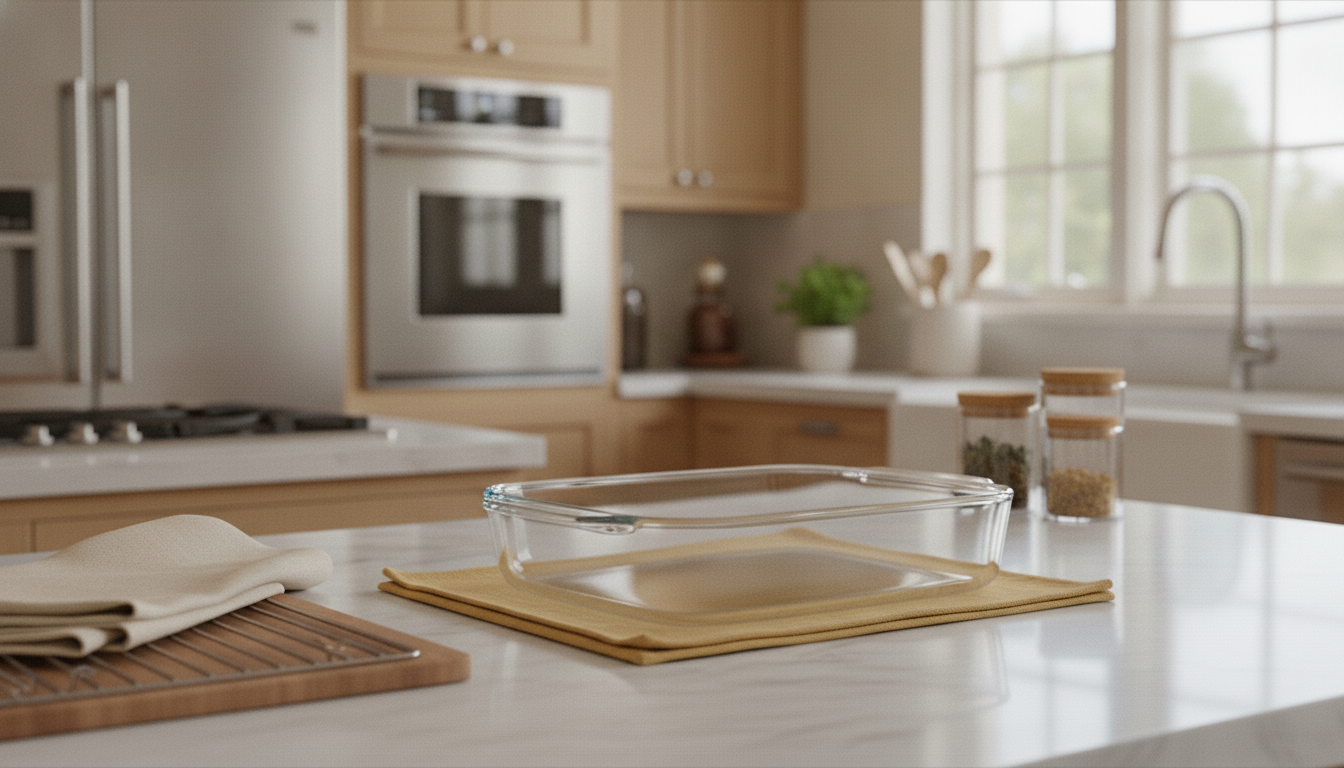
Learn how thermal shock cracks glass and the practical habits that prevent it, from gradual temperature changes to protective surfaces. Borosilicate glass handles wider temperature swings than standard glass, but proper care and handling are what keep your dishes intact for years.
What Is Thermal Shock and Why Borosilicate Glass Cracks
Borosilicate glass resists cracking because boron lowers its thermal expansion coefficient to about one-third that of standard glass.
The Science Behind Thermal Shock: Temperature Swings That Fracture Glass
Thermal shock happens when a glass surface experiences a temperature change that exceeds what its structure can absorb evenly, creating tensile stress that can split the material [1]. The trigger is usually abrupt: pouring hot liquid into a cold dish, or setting a hot dish onto a cold, wet counter, forces one side of the glass to expand or contract faster than the other [1]. That internal stress imbalance, not the temperature itself, is what cracks the glass [1].
How much stress builds up depends on a property called the thermal expansion coefficient, which measures how much a material grows or shrinks as temperature shifts [2]. Glass with a low expansion coefficient resists this stress buildup because it expands and contracts less dramatically across a given temperature swing, which is part of why it holds up better under rapid heating or cooling [2]. Glass with a higher expansion coefficient reacts more severely to the same temperature change, accumulating stress faster and fracturing more easily [2].
This coefficient also shapes how glass behaves over repeated heating and cooling cycles: materials with a poor match between their expansion rate and the temperature swings they regularly face tend to fatigue faster, so the risk of cracking can increase over years of use even when any single temperature change seems minor [2].
Why Borosilicate Glass Is Safer Than Regular Glass--But Still Vulnerable
Borosilicate glass earns its reputation for toughness through one key ingredient: boron trioxide, added to the silica mix during manufacturing [3]. That addition drops the glass's thermal expansion coefficient to roughly 3.3 x 10 to the negative 6 per Kelvin, about one-third that of standard soda-lime glass [4]. In practical terms, borosilicate can handle a temperature swing of about 330 degreesF before fracturing, while soda-lime glass typically fails after a 100 degreesF change, which is why a soda-lime dish can shatter when a boiling pot meets ice but a borosilicate version often survives [4].
This lower expansion rate also means less material stress during repeated heating and cooling cycles, since the glass network does not have to accommodate as much dimensional change [3]. None of this makes borosilicate immune to thermal shock, though. The glass can still crack or shatter when temperature changes happen too fast or too unevenly, especially at the edges of thick or unevenly shaped pieces where heat does not distribute as quickly [3].
So while borosilicate buys you a wider safety margin than ordinary kitchen glass, it still has limits, and treating it as indestructible is the mistake that leads to most cracked dishes.
Is Borosilicate Glass Safe for Cooking and Food Storage?
Borosilicate glass resists thermal shock three times better than standard glass and contains no lead, making it safe for daily cooking and food storage.
Borosilicate Glass vs. Soda-Lime Glass: Which Resists Thermal Shock BetterBorosilicate glass earns its safety reputation largely from how differently it behaves compared to soda-lime glass, the material used in most everyday glassware. Soda-lime glass is made from silica, sodium oxide, and calcium oxide and has a coefficient of thermal expansion around 9-10 x 10⁻⁶/ degreesC, while borosilicate swaps some of that soda and lime for boron trioxide, dropping its expansion rate to roughly 3.3 x 10⁻⁶/ degreesC [5].
That gap shows up directly in real-world performance: soda-lime glass often cracks with temperature changes as small as 50-80 degreesC (90-144 degreesF), while borosilicate can typically survive swings of 150-200 degreesC (270-360 degreesF), with some manufacturers citing a safe differential near 170 degreesC, or about 340 degreesF [5][7]. Borosilicate also beats soda-lime on chemical stability, resisting acids, alkalis, and solvents without leaching sodium ions the way soda-lime can when it meets hot or acidic liquids [5].
This combination, lower expansion plus stronger chemical resistance, is a big part of why people ask whether borosilicate glass is safe for daily cooking and storage: it tolerates heat swings and keeps food from reacting with the container itself [5][7]. The tradeoff is cost, since borosilicate needs higher melting temperatures and pricier raw materials to produce, but for cooks who move glassware between hot and cold often, that extra expense buys a meaningfully wider safety margin against cracking [5][6].
Lead, Toxins, and Microplastics: What the Science Actually Says About Borosilicate Safety
Borosilicate's safety profile also comes up because of what it does not contain: lead oxide, the ingredient used in decorative leaded crystal to add sparkle and weight. Kitchen-grade borosilicate relies on boron trioxide instead, the same compound that lowers its thermal expansion rate, so there is no lead component to leach into food or drink under normal use.
Glass in general is also non-porous and chemically stable, which matters for the microplastics conversation: unlike many plastic containers, glass is far less likely to shed fragments into food when scratched, heated, or washed repeatedly. That inertness is a big part of why cooks lean on borosilicate for both baking and storage, a topic covered in more depth in this breakdown of why borosilicate passes non-toxic testing.
None of this means every glass product on the market meets the same standard, since labeling and manufacturing quality still vary by brand, but the base material itself carries far fewer of the chemical risks associated with lead crystal or degrading plastics.
How to Prevent Thermal Shock: 7 Practical Rules for Your Kitchen
Avoid pouring hot liquid into cold dishes, rinsing hot glass under cold water, and setting hot cookware on cold or wet surfaces to prevent thermal shock cracks.
Avoid the Temperature Mistakes That Shatter Borosilicate Containers
Most borosilicate failures trace back to a handful of predictable habits, not random defects. Consumer Reports' year-long investigation found that moving glass cookware straight from a 450 degreesF oven onto a countertop where moisture was present caused frequent failures in soda-lime glass, while borosilicate samples held up until pulled from a 500 degreesF oven [8]. Lab testing turns up the same pattern: rinsing hot glassware under cold water ranks among the top causes of cracked vessels, and setting a hot dish directly on a cold metal surface, stone counter, or wet towel creates that same uneven stress [9]. Placing a hot dish on a cold, wet surface can start tiny fractures that widen into full breaks over repeated use [10]. The mistakes worth avoiding:
- Pouring hot liquid into a dish straight from the fridge
- Setting a hot dish on a cold or wet countertop
- Rinsing hot glassware under cold tap water
- Concentrating heat in one spot instead of distributing it evenly [9]
Most glass cookware is rated for oven and microwave use but not for stovetop burners, broilers, or open flame, so check the product's care label before applying direct heat that way.
Stepping temperature up or down gradually, rather than jumping between extremes, keeps the stress low enough for the glass to absorb safely [9].
Care and Maintenance Essentials: Keep Your Glass Cookware Crack-Free
Daily habits matter more than any single feature for keeping borosilicate dishes intact. A few care & maintenance tips go a long way here. Dishwasher-safe labeling often applies only to the glass itself, not to lids, silicone seals, or wooden stands, so check whether care instructions cover the whole product or just one part [11]. After washing, inspect for cracks or sharp edges before the next use, since fragile glass can develop damage that is not obvious at a glance [11]. Temperature handling still matters most: never rinse a hot dish under cold water, and set it on a wooden board or folded towel instead of a cold counter or wet surface while it cools [12]. For longer-term storage, dry glass completely before stacking, since trapped moisture can cause problems later, and slip paper towels or soft cloths between pieces to prevent scratches [12]. A few habits cover most of what keeps glass cookware crack-free over the years:
- Skip abrasive scrubbers, which create tiny surface scratches [12]
- Avoid pouring boiling liquid into a cold jug or dish [11]
- Let dishes cool gradually on a towel, not a cold counter [12]
- Store fully dry, with padding between stacked pieces [12]
These routines take little extra time but add years to a dish's working life, and the same logic extends to everyday dinnerware care habits that protect plates and bowls from chips and cracks.
Choosing Glass Cookware That Won't Fail You: What to Look For
Real borosilicate glass is lighter, harder, and more impact-resistant than cheaper soda-lime alternatives, so check material composition and weight before you buy.
How to Identify True Borosilicate Glass and Spot Inferior Alternatives
Manufacturers don't always disclose glass composition clearly, so spotting genuine borosilicate takes checking a few physical traits rather than trusting a label alone. True borosilicate contains boron oxide (B2O3) blended with silica, while cheaper imitations are often standard soda-lime glass made from silicon, sodium, and calcium oxide with no boron added at all [13]. Since soda-lime remains the most common type of manufactured glass, a suspiciously low price on something marketed as borosilicate is worth questioning [13]. Weight offers a physical clue: soda-lime is denser and feels heavier, while real borosilicate tends to be lighter and can be made with thinner walls while still holding its strength [14]. Borosilicate also ranks high on the Mohs hardness scale, just behind diamond, which gives it a scratch and impact resistance soda-lime can't match [13].
A few quick checks before buying:
- Look for boron oxide listed in the material description [13]
- Compare weight against a similar-sized soda-lime item [14]
- Question bargain pricing on claimed borosilicate pieces [13]
- Favor brands that disclose full composition, not just marketing terms [15]
Pairing Glass Cookware with Other Kitchen Tools for Safer, Smarter Cooking
Glass cookware performs best when paired with tools that buffer temperature extremes and reduce impact risk, not just used on its own. Setting a hot glass dish on a trivet, folded towel, or cooling rack instead of a bare countertop lets heat dissipate gradually while protecting the surface below, a version of the "use protective barriers" habit recommended for safe glass handling. Grabbing dishes with oven mitts or textured pot holders instead of bare hands lowers the odds of a sudden drop, since even sound glass can crack on impact [16]. Before pairing glass with metal utensils or serving tools, inspect the dish for chips, scratches, or hairline cracks, because a smooth-edged tool can still catch on existing damage and widen it [16]. Cleaning calls for the same caution: pair glass with soft sponges rather than abrasive scrubbers, and avoid stacking it directly against metal bakeware that can scratch the surface over time [16]. Microwave pairing deserves its own check, since not every lid or cover sold alongside glass cookware is actually built for that heat cycle, so confirming compatibility before combining pieces matters [16]. Treating glass as part of a system -- trivet, mitts, inspection habit, and compatible lids -- rather than a standalone item is the practical takeaway for avoiding most pairing-related breakage [16].
The same care mindset that keeps borosilicate crack-free carries over to the rest of your kitchen. Handle each material for what it is, step temperatures up or down gradually, and store pieces with a little padding, and your cookware will keep performing for years. Borosilicate gives you a wide safety margin, but it rewards good habits -- the same way a stainless steel pan or a carbon steel pan does. If you ever have a question about caring for a specific piece, contact us and we'll help you sort it out.
Frequently Asked Questions
-
How much of a temperature swing can borosilicate glass actually handle before it cracks?
Borosilicate glass can typically survive a temperature swing of about 150-200°C (270-360°F), with some manufacturers citing a safe differential near 170°C (about 340°F). Soda-lime glass, by comparison, often cracks with changes as small as 50-80°C (90-144°F). These are general ranges, so check your specific product's care label for exact limits.
-
Is borosilicate glass cookware dishwasher-safe and reusable?
The article notes that dishwasher-safe labeling often applies only to the glass itself, not to lids, silicone seals, or wooden stands, so you need to check whether the care instructions cover the whole product or just one part. It also recommends inspecting for cracks or sharp edges after each wash since damage isn't always obvious.
-
Is it safe to use borosilicate glass on the stovetop or under a broiler?
Most glass cookware, including borosilicate, is rated for oven and microwave use but not for stovetop burners, broilers, or open flame, according to the article. Always check the product's care label before applying direct heat that way, since even borosilicate's wider safety margin has limits at thick or unevenly shaped edges.
-
How can I tell if glassware marketed as 'borosilicate' is the real thing?
Look for boron oxide (B2O3) listed in the material description, since cheaper imitations are often soda-lime glass with no boron added. Real borosilicate tends to be lighter than soda-lime of a similar size, and a suspiciously low price on a claimed borosilicate piece is worth questioning. Favor brands that disclose full composition rather than relying on marketing terms alone.
-
Is borosilicate glass worth the extra cost compared to regular soda-lime glassware?
The article notes borosilicate costs more to produce because it needs higher melting temperatures and pricier raw materials, but for cooks who move glassware between hot and cold often, that expense buys a meaningfully wider margin against cracking. It doesn't provide fixed prices for comparison, so compare the actual composition and cost of a specific product against soda-lime alternatives before deciding.
- Thermal shock occurs when temperature changes exceed what glass can absorb evenly, creating internal stress that causes cracking.
- Borosilicate glass resists thermal shock three times better than soda-lime glass due to its lower thermal expansion coefficient of 3.3 x 10⁻⁶ per Kelvin.
- Borosilicate can typically survive temperature swings of 150-200 degrees Celsius, while soda-lime glass often fails at 50-80 degrees Celsius.
- Avoid pouring hot liquid into cold dishes, rinsing hot glassware under cold water, and setting hot dishes on cold or wet surfaces.
- Borosilicate glass resists acids and alkalis without leaching sodium ions, and contains no lead oxide, making it safer for cooking and food storage.
- Real borosilicate is lighter than soda-lime glass and lists boron oxide in its material description, not just marketing claims.
- Pairing glass with trivets, cooling racks, soft sponges, and oven mitts reduces cracking risk from temperature extremes and impact damage.
- https://www.ddpsinc.com/en/knowledge/what-are-the-different-types
- http://panchaoglass.com/news/1125.html
- https://www.google.com/goto?url=CAESawHrOzAVbxOsc7WPxYUvIMfp7xoB149QopksIJIO8JbAab0fjnxEzHM0S5wa1_hH2DBEtGG_kGMElaKRLJzqDYhIpNoIDQX-q1Ja7aSdaa03XUp3_cQEK8gadJ57luUPr_iKChkfEiy8SUPj
- https://www.google.com/goto?url=CAES1gEB6zswFSU32On5xEcg5pc5BBMNWYs31YTTMtz-Z8PvqqRFgp_UO2YKK4J6fwylmEWKxGf7oYu68W5f-dVHQC5DNuhbZYOjHgAKo0Lcxu6wQTl65eXy_D8dmzTsM5Q5Y9n7A0QZu1V7-ZCoqTMWDm8KTm4_EG9IJpENLCbopKEeBMJcRb0m-cZ_VpE3Mo6wArOogsdhO1JKCmQmq6H0LY6kO2iSV4a7vKxxtPJfNFV8W-wkoxPEHS7NjvNPi7Q5hMkjD6OHttJtUir_7WXTFItw49KiHaWK
- https://www.cn-glassware.com/info/how-to-choose-borosilicate-glass-or-soda-glass-103166781.html
- https://reihey.com/glass-melting-point/
- https://www.jiatengglass.com/what-is-borosilicate-glass/
- https://ceramics.org/ceramic-tech-today/hells-kitchen-thermal-stress-and-glass-cookware-that-shatters/
- https://labchoiceaustralia.com.au/thermal-shock-explained-simple-rules-to-prevent-glass-breakage-in-daily-lab-work/
- https://gosciencecrazy.com/blogs/gsc-blog/breaking-myths-is-borosilicate-glassware-really-unbreakable
- https://m.joybuy.nl/blog/glass-kitchenware-tips/LZdRJoax
- https://www.stripesandwillows.com/lifestyle/ceramic-vs-glass-bakeware
- https://www.ecobudusa.com/our-story/news-blog/product-news/the-better-glass-borosilicate-vs-soda-lime
- https://www.zgs-glass.com/info/difference-soda-lime-glass-and-borosilicate-93629866.html
- https://borohouse.com/blogs/journal/borosilicate-glass-vs-soda-lime-glass-material-comparison-safety-guide
- https://diyhomegarden.blog/pyrex/