

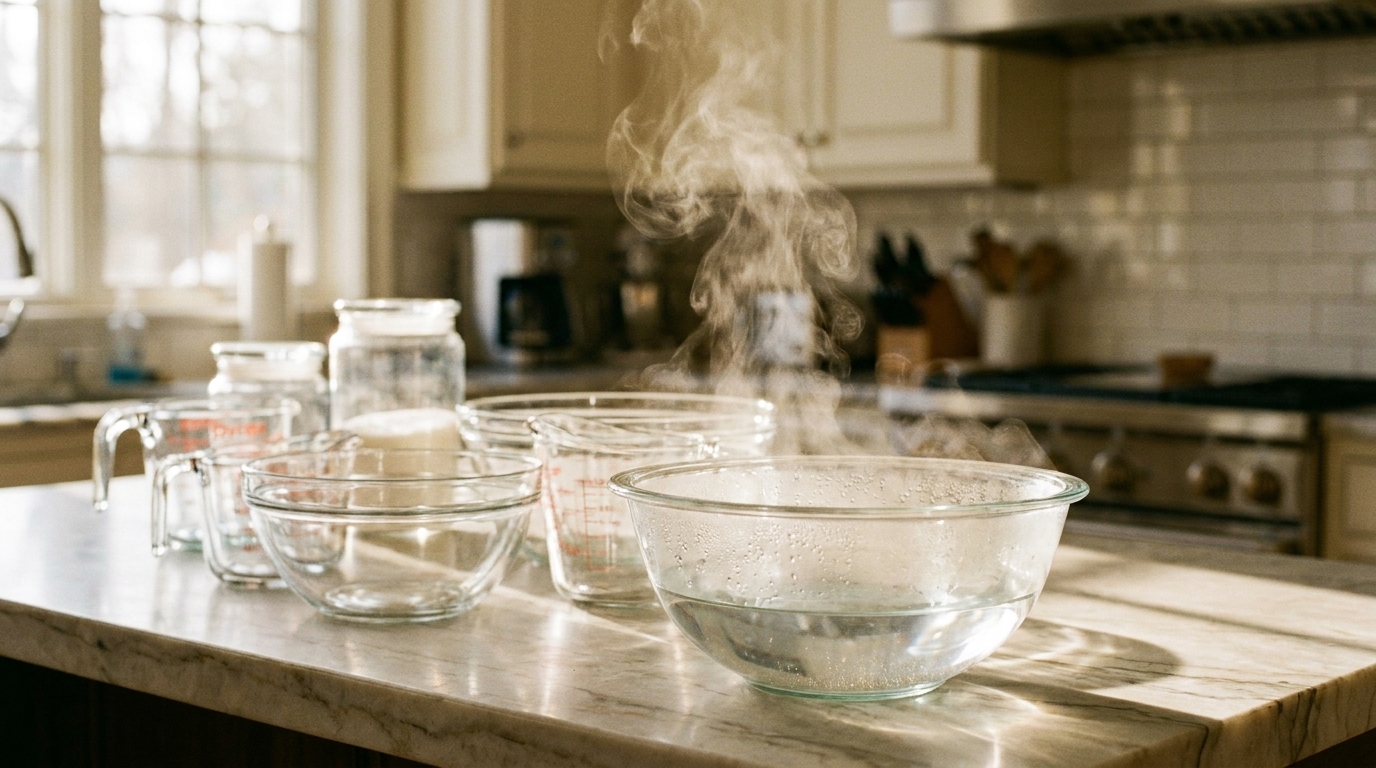
Borosilicate glass safely handles hot steam and rapid temperature changes because its molecular structure expands far less than ordinary glass, preventing thermal shock and cracking. Its silica-and-boron composition is chemically inert, so it never leaches harmful chemicals like BPA or lead into food, even under extreme heat.
The Direct Answer: Yes, Borosilicate Glass Is Safe for Hot Steam--Here's Why
Borosilicate glass resists thermal shock because its molecular structure expands one-third as much as ordinary glass when exposed to rapid temperature changes.
What Makes Borosilicate Glass Thermally Superior to Regular Glass
Borosilicate glass contains at least 5% boric oxide alongside a higher share of silicon dioxide (80.6%) compared to soda-lime glass (69%), and that combination binds the molecular structure more tightly. [3] The resulting coefficient of thermal expansion is roughly one-third that of ordinary glass, meaning borosilicate expands and contracts far less when temperatures shift quickly. [1] That structural stability is what makes borosilicate glass safe around hot steam and kitchen heat that would stress or fracture standard glass. [2] For a deeper look at how this material is formulated, our guide to what is borosilicate glass breaks it down further.
How Boron Compounds Create Heat Resistance Without Toxins
The boron trioxide in the glass reacts with silica during manufacturing to form a tightly bonded molecular matrix that resists breaking down under heat rather than leaching compounds into food. [5] That chemical stability distinguishes borosilicate from plastic or lower-grade glass: it contains no lead, BPA, or phthalates, and won't transfer harmful substances into food when exposed to steam or high heat. [2] The structure also resists chemical attack from acidic foods and liquids, keeping it inert across a wide range of cooking applications -- for more detail on those safety properties, our guide on borosilicate glass toxicity covers the full picture. [4]
Understanding Thermal Shock: Why Some Glass Breaks and Borosilicate Doesn't
Borosilicate's low thermal expansion and efficient heat distribution prevent the internal stress that cracks ordinary glass during sudden temperature swings.
The Physics of Thermal Expansion and Why Temperature Swings Matter
Thermal shock occurs when one section of a glass piece heats faster than adjacent areas, creating uneven expansion that stresses the material internally.
In soda-lime glass, those stress differences build quickly enough during a rapid temperature swing -- steam contact, or a cold rinse on a hot surface -- to cause cracking or fracture.
Borosilicate resists this through three properties: a low coefficient of thermal expansion, efficient heat distribution throughout the material, and a high softening temperature that keeps the structure stable under sudden heat spikes. [6] Those properties collectively keep internal stress below the fracture threshold, which is why borosilicate withstands temperature extremes that crack ordinary glass in everyday kitchen use. [1]
Real-World Steam Test: How Borosilicate Handles Kitchen Heat Stress
Controlled steam testing puts borosilicate's thermal properties into measurable terms.
A 2023-2024 validation study of 52 commercial cookware pieces subjected borosilicate glass to steam-bath immersion at 95 degreesC with 100% relative humidity -- conditions that match or exceed typical kitchen steam -- and the material passed without structural failure. [7] The same study ran a freezer-to-oven protocol, placing frozen borosilicate pieces directly into a 160 degreesC convection oven; its coefficient of thermal expansion (3.3 x 10⁻⁶/K) prevented cracking and produced 98% reheating consistency, compared to 62% with ceramic. [7] That performance gap confirms what the physics predicts: even under stress well beyond everyday steam exposure, borosilicate stays within its structural limits.
Safety Across Every Kitchen Scenario: Microwave, Freezer, Stovetop, and Steam
Borosilicate glass moves safely between fridge, microwave, and oven without releasing chemicals or deforming, unlike plastic or lower-grade glass.
Borosilicate Glass in Hot Water, Steam, and Direct Heat--Temperature Limits Explained
Borosilicate glass handles sustained temperatures up to 500 degreesC-600 degreesC and can absorb temperature swings of roughly 150 degreesC without structural failure -- a range that covers every standard kitchen scenario from steam and boiling water to microwave reheating. [9] Unlike lower-grade glass or plastic, it won't release chemicals or deform under microwave heat, so it moves safely between fridge, microwave, and oven without needing a material switch. [10] Direct stovetop or broiler heat is the practical exception -- flames and electric burners create localized hotspots that even borosilicate can't reliably absorb, which is why borosilicate glass pans aren't rated for stovetop use. [8]
Common Myths Debunked: Why Borosilicate Is Not Plastic and Not Toxic
A persistent myth treats borosilicate glass as simply a safer version of plastic -- as if both materials sit on the same spectrum with glass being the "BPA-free" option.
That comparison doesn't hold: plastic relies on synthetic polymer chains that shed microplastics and endocrine-disrupting compounds like BPA, BPS, and phthalates -- chemicals that glass never contained and cannot produce. [11] Borosilicate's silica-and-boron matrix is chemically inert, so it won't react with food, steam, or acidic liquids, and it doesn't leach, stain, or absorb odors at any standard kitchen temperature. [12] Physicians and material scientists consistently classify glass as "inert and nontoxic" for precisely this reason -- that stability isn't a coating or an additive but a fixed property of the base material itself. [13]
Choosing and Caring for Borosilicate Glass: A Maintenance Essentials for Long-Term Safety
Inspect borosilicate glass under bright light before heat exposure to catch hidden damage that could cause failure during cooking.
How to Inspect Borosilicate Glass for Damage Before Exposing It to Heat
Before exposing any borosilicate piece to steam or oven heat, inspect the full surface for chips, cracks, scratches, and bubbles -- any mark in the uniform surface is a potential breaking point under thermal stress. [14] Run the inspection under uniform light at a minimum of 1,000 lux (roughly the brightness of an overcast day) against a black-and-white backdrop, which provides enough contrast to catch fine flaws that flat or uneven lighting can miss. [15] Give extra attention to pieces that have been dropped or knocked, even if they appear intact -- impact can introduce internal weak points that don't show clearly on the surface but may cause failure when heat is applied. [15] If you're uncertain about the severity of any damage, the right move is to discard the piece rather than risk it failing mid-use. [15]
Best Practices for Cleaning, Storage, and Extending Glass Lifespan
Borosilicate glass is dishwasher-safe, but hand washing with a soft sponge and mild detergent reduces the micro-abrasion that repeated dishwasher cycles introduce over time. [17] For water spots or cloudiness, soak the piece in equal parts warm water and white vinegar for 15-30 minutes, then dry with a lint-free cloth to restore clarity. [17] Store pieces upright with adequate spacing between them -- overcrowding is a leading cause of rim chips -- in a cool, dry environment that prevents warping or mildew buildup. [17] If your borosilicate containers include silicone gaskets, remove and clean them separately after storing aromatic foods like garlic or curry; residue left in the seal degrades the material and compromises the airtight fit over time. [16]
- Borosilicate glass expands one-third as much as ordinary glass when heated, preventing thermal shock cracks.
- A 2023-2024 validation study confirmed borosilicate withstands 95 degreesC steam immersion and 160 degreesC oven heat without failure.
- Borosilicate contains no lead, BPA, or phthalates and won't leach chemicals into food under steam or high heat.
- Direct stovetop and broiler flames create localized hotspots that borosilicate cannot reliably handle--use it in microwave, oven, and freezer only.
- Inspect borosilicate pieces under bright light for chips and cracks before steam exposure, as damage creates breaking points under thermal stress.
- Hand wash with soft sponges to reduce micro-abrasion; soak cloudy pieces in equal parts warm water and vinegar for 15-30 minutes.
- https://www.westlab.com/blog/what-is-the-difference-between-soda-lime-glass-and-borosilicate-glass
- https://www.chemscience.com/blog/borosilicate-glass-vs-soda-lime-glass-understanding-the-differences
- https://advancedtechnicalprod.com/soda-lime-glass-vs-borosilicate-glass-whats-the-difference/
- https://advancedtechnicalprod.com/is-borosilicate-glass-safe/
- https://slyprc.com/borosilicate-glass-healthy-use/
- https://www.vaia.com/en-us/textbooks/physics/materials-science-and-engineering-an-introduction-7-edition/chapter-13/problem-16-borosilicate-glasses-and-fused-silica-are-resista/
- https://lifetips.alibaba.com/kitchen-hacks/best-ramekins
- https://www.onegoodthingbyjillee.com/is-pyrex-oven-safe/
- https://www.huideglass.com/news/what-kind-of-glass-has-better-heat-resistance.html
- https://www.sumkoka.com/what-plates-are-microwave-safe.html
- https://nontoxiclab.com/best-non-toxic-food-storage/
- https://destudiohome.com/blogs/news/is-stainless-steel-or-glass-less-toxic-find-out-now?srsltid=AfmBOopgu5AuWpQP0ylUxsIZUt7CMz3GOTZ3cqczPF28Dice7U8h5Nkx
- https://www.everydayhealth.com/healthy-living/are-your-pots-and-pans-safe-how-to-choose-non-toxic-cookware/
- https://oehs.ecu.edu/chemical-hygiene/lab-safety/lab-safety-resource-index/glassware/
- https://www.camlab.co.uk/blog/dwk-safety-blog-inspecting-laboratory-glassware
- https://www.messbrands.com/inspiration/rubbermaid-brilliance-glass-2/
- https://www.glasswareonly.com.au/blog/expert-tips-on-glassware-maintenance-a-comprehensive-guide.htm
- Summary
- The Direct Answer: Yes, Borosilicate Glass Is Safe for Hot Steam--Here's Why
- Understanding Thermal Shock: Why Some Glass Breaks and Borosilicate Doesn't
- Safety Across Every Kitchen Scenario: Microwave, Freezer, Stovetop, and Steam
- Choosing and Caring for Borosilicate Glass: A Maintenance Essentials for Long-Term Safety
- Key Takeaways
- References