

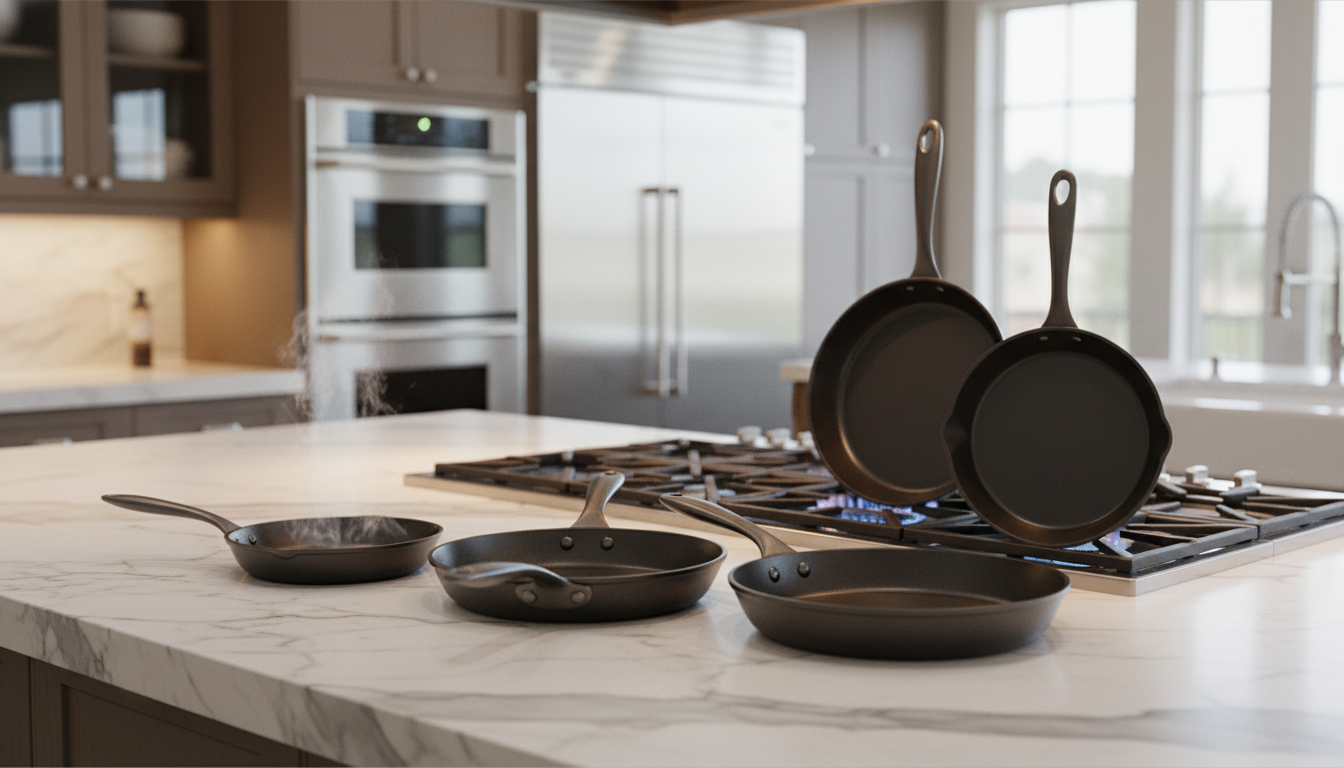
Nitriding treatment hardens metal surfaces by diffusing nitrogen at controlled temperatures, creating wear-resistant layers that maintain flexibility underneath. This process delivers exceptional durability for cookware and kitchen tools, offering rust resistance and natural non-stick properties without chemical coatings.
How Nitriding Treatment Works
Nitrogen atoms penetrate steel surfaces at 500-550 degreesC to form hard metallic nitrides, creating protective layers that reach 200-300 micrometers deep depending on your application needs.
Diffusion Fundamentals
Nitriding relies on the controlled diffusion of nitrogen into metal surfaces. During treatment, nitrogen atoms penetrate the metal surface and combine with iron and alloying elements to form hard metallic nitrides [1]. This diffusion occurs at temperatures between 500-550 degreesC (930-1022 degreesF), well below steel's austenitization temperature of 727 degreesC, enabling treatment while the material remains in its ferrite condition [1][3].
The process creates two distinct zones: an outer compound layer (white layer) and an underlying diffusion zone containing absorbed nitrogen and nitride precipitates [1][3]. Nitrogen exhibits partial solubility in iron, initially forming a solid solution with ferrite. At approximately 6% concentration, it develops gamma prime (γ') compound (Fe4N), while concentrations exceeding 8% form epsilon (ε) compound (Fe3N) [3].
The diffusion depth typically ranges from 200-300 μm but can reach up to 2 mm depending on application requirements [1]. Alloying elements significantly affect nitriding effectiveness, with aluminum forming the strongest nitrides, followed by chromium, molybdenum, and titanium [2][3].
Typical Temperature and Time Ranges
Nitriding treatments operate within specific temperature and time parameters to achieve optimal results. Process temperatures typically range between 500-550 degreesC (930-1022 degreesF), well below steel's austenitization temperature of 727 degreesC, with maximum temperatures reaching 620 degreesC (1150 degreesF) in some applications [4][1]. The practical lower temperature limit is 350 degreesC, below which nitrogen diffusion becomes technologically and economically unfeasible [4].
Treatment duration varies significantly based on application requirements--from as brief as 1.5-2.5 hours for aluminum extrusion dies to 60-80 hours for wind power plant gears requiring thick nitrided layers (0.6-0.8mm) [5]. Most commercial applications remain under 100 hours, as diffusion rates diminish dramatically beyond this point, making longer treatments impractical [1]. Higher temperatures accelerate nitrogen penetration but potentially reduce maximum compressive residual stress and may cause unwanted structural changes [5].
For precise control, many applications employ multi-stage treatments with varied temperatures--like the two-stage process used for glass bulb casting plates (490 degreesC for 2 hours followed by 550 degreesC for 24 hours) [5]. The temperature-time relationship directly affects case depth, with depth typically ranging from 200-300μm but reaching up to 2mm in specialized applications [4][1].
Key Metallurgical Changes
Nitriding creates two distinct microstructural zones in metal surfaces. The outer compound layer (white layer) consists of epsilon (ε) and gamma prime (γ') iron nitrides. The ε phase forms at nitrogen concentrations above 8% and appears closest to the surface, while γ' phase (Fe4N) develops at approximately 6% concentration near the diffusion zone [4].
This diffusion zone contains dispersed nitride precipitates that contribute to hardening without changing the metal's core structure [4]. Unlike carburizing, nitriding doesn't require phase transformation from ferrite to austenite--the steel remains in ferrite phase throughout treatment, preventing dimensional changes beyond slight volumetric expansion from nitrogen diffusion [4]. The process begins with nitrides forming at grain boundaries and nodes where grains meet, eventually growing laterally until creating a complete surface layer [4].
Alloying elements significantly influence case formation, with aluminum forming exceptionally strong nitrides (up to 1% concentration), followed by chromium, molybdenum, and vanadium [4]. These elements not only increase surface hardness but also generate compressive residual stresses that enhance fatigue resistance [4]. The compound layer typically exhibits some porosity due to nitrogen recombination at grain boundaries, which can cause brittleness in some applications [4].
Primary Types of Nitriding Treatment
Gas nitriding uses ammonia to diffuse nitrogen into metal surfaces at moderate temperatures, typically 495-565 degreesC, while maintaining steel stability and minimizing warping.
Gas Nitriding
uses ammonia or ammonia-hydrogen atmospheres to diffuse nitrogen into metal surfaces. During the process, ammonia (NH₃) breaks down into nitrogen and hydrogen, with the nitrogen atoms penetrating the metal surface [6]. This method works at moderate temperatures--typically 495-565 degreesC--which keeps the steel stable and minimizes warping [6][7].
Modern systems use smart controls to manage how much nitrogen enters the metal, allowing operators to fine-tune the process [7]. A two-stage approach works particularly well: starting with more nitrogen to build up the surface, then dialing it back to let it spread deeper without creating too thick of a hard outer shell [7]. This approach allows manipulation of the compound layer thickness, potentially eliminating it or reducing it below 0.007mm to minimize post-treatment machining [7].
Gas nitriding typically requires longer processing times than other methods--from several hours for standard applications to 80+ hours for specialized components like wind power plant gears [6][1]. While more time-consuming, the method offers economic advantages through lower equipment costs and suitability for mass production, with batch sizes limited only by gas flow and furnace dimensions [1].
Salt‑Bath (liquid) Nitriding
Salt-bath nitriding, also called ferritic nitrocarburizing (FNC), uses molten salt baths to add both nitrogen and carbon to metal surfaces at temperatures between 550-570 degreesC [8]. This process creates a thin but exceptionally hard outer layer while keeping the metal's core flexible and strong [8]. The moderate temperature prevents the warping that can plague other hardening methods [9].
Surface preparation critically affects quality--parts require thorough cleaning and degreasing to prevent uneven layer formation that can lead to cracking and flaking [8]. Post-treatment cleaning is necessary to remove residual salts from components [9]. Despite its faster processing time and operational simplicity compared to gas nitriding, salt bath methods have declined in popularity due to significant drawbacks [8].
The process uses highly toxic chemicals (typically cyanide salts), creates substantial environmental concerns, and incurs higher operational costs since salt pots must remain continuously heated [8][9]. Additionally, the expensive disposal requirements for spent salts further increase total processing costs [9]. Modern facilities increasingly favor alternative nitriding methods that achieve equivalent metallurgical results without the hazards associated with salt baths [9].
Plasma (ion) Nitriding
Plasma nitriding (also called ion nitriding) takes a high-tech approach, using electrically charged gas to infuse nitrogen into metal surfaces. Picture a controlled lightning storm in miniature--voltage creates a glowing plasma cloud around your parts in a special chamber [10][11]. Working at lower temperatures than other methods (350-600 degreesC), this plasma delivers nitrogen ions directly to the surface [12].
This approach offers precise layer control: operators can create either compound-free diffusion layers or thicker compound layers by adjusting gas mixtures and electrical parameters [11][12]. The process works exceptionally well for high-alloy and stainless steels that resist conventional nitriding, maintaining much of their corrosion resistance when treated at lower temperatures [10][11]. Beyond standard steels, plasma nitriding works beautifully on cast iron, nickel alloys, titanium, and aluminum [11][12].
The benefits stack up quickly: it's environmentally clean (no toxic chemicals), allows you to treat specific areas while masking others, cuts processing time, barely warps parts, and gives you precise control over hardness depth [10][12]. For precision cookware like These benefits make plasma nitriding particularly valuable for precision components in automotive, aerospace and medical industries, where it can achieve surface hardness exceeding 1000 HV on properly alloyed steels [10][11].
Choosing the Right Method for Your Needs
Picking the right nitriding method comes down to matching your needs with each process's strengths. Gas nitriding shines for everyday steels and cast iron, especially when you're treating lots of parts at once [1][14]. The process requires longer times--up to 80 hours for some applications--but needs lower initial investment than plasma systems [1][14]. Salt bath nitriding enables faster nitrogen diffusion than gas methods and works efficiently for crankshafts, gears, and dies [1].
However, environmental concerns around toxic chemicals have reduced its popularity despite operational simplicity [1]. Plasma nitriding provides precise control at lower temperatures (as low as 260 degreesC) and proves particularly valuable for stainless steels, low-density powder metallurgy parts, and components requiring selective treatment through masking [1][13][14]. While plasma systems require significant upfront investment, they excel with medical instruments, automotive components, and precision parts [1][14]. Start by looking at what you're treating--steels with aluminum, molybdenum, or chromium take to nitriding like a seasoned pan takes to oil [1].
If your parts can't handle any warping, plasma's gentler temperatures make it the smart choice [13]. But for cranking out large batches of similar parts, gas nitriding's simplicity often wins on cost [14]. The best method balances what you need with what you can spend.
Practical Benefits for Everyday Tools
Nitrided tools develop a surface hardness exceeding HV1200 while maintaining ductile cores, giving you longer service life through repeated use cycles and sustained performance under continuous wear.
Surface Hardness and Wear Resistance
Nitrided surfaces achieve exceptional hardness--up to 76 HRC (90 HRA)--creating wear-resistant exteriors while maintaining ductile cores [1]. This unique combination allows tools to withstand continuous friction without sudden failure under impact loads [1]. The hardness layer typically extends 200-300 μm beneath the surface but can reach 2 mm in specialized applications [1].
On the Vickers scale, nitrided surfaces exceed HV1200, significantly enhancing abrasion resistance for automotive components, industrial machinery, and precision tooling [16]. Different nitriding methods produce distinct hardness profiles: gas nitriding reaches HV1000 at 0.1mm depth, salt bath nitriding exceeds HV1000 on tool steels like SKD61, while plasma nitriding achieves HV1000+ at shallower 20μm depths [16]. Notably, nitrided components resist softening at high temperatures better than carburized parts, making them ideal for heat-generating applications [1].
The shallow but intensely hard layer proves particularly valuable for cutting tools, dies, and wear surfaces where edge retention matters more than deep hardness [16]. For everyday tools, this translates to longer service life under repeated use and sustained performance even after extensive wear cycles [15].
Corrosion and Fatigue Performance
Nitriding significantly enhances both corrosion and fatigue resistance in treated components. The process creates a protective surface layer that prevents pitting corrosion in many steels--the deposited hard nitride compounds block formation of corrosion pits that would otherwise penetrate untreated surfaces [1]. For maximum corrosion protection, the white layer formed during nitriding must remain intact [1].
Results vary by material: plasma nitriding improves 410 stainless steel's corrosion resistance through formation of protective iron nitride layers, while paradoxically decreasing corrosion protection in martensitic X17CrNi16-2 stainless steel due to chromium nitride formation that reduces chromium's effectiveness in solid solution [1]. Beyond corrosion benefits, nitriding dramatically improves fatigue performance, increasing fatigue strength by 30-100% across various applications [1]. This improvement stems from the compressive stress layer created on component surfaces--compressive stresses counteract tensile loads that typically initiate fatigue cracks [15].
The compressive layer effectively blocks crack propagation, allowing components to withstand higher cyclic loads without failure [17]. These properties make nitrided parts particularly valuable in applications combining high mechanical stresses with corrosive environments, such as automotive components, industrial machinery, and aerospace systems [15].
Low Distortion Keeps Dimensions Stable
Nitriding offers exceptional dimensional stability--a critical advantage for precision parts. The process operates at relatively low temperatures (500-550 degreesC), well below transformation temperatures of other hardening methods, preventing phase changes that cause warping [18][19]. This stability allows manufacturers to perform nitriding as the final manufacturing step on fully machined components, eliminating post-treatment refinishing [18][15].
For parts with tight tolerances or complex geometries, this preservation of exact specifications and intricate features proves invaluable [18][19]. The minimal expansion during nitriding (typically <0.0005 inches) means components retain their original dimensions while gaining substantial surface hardness [18]. This dimensional predictability particularly benefits aerospace, automotive and medical device manufacturing, where components must maintain precise specifications while withstanding extreme operational conditions [19].
Unlike carburizing or case-hardening methods requiring austenitization and quenching, nitriding eliminates the volume changes and internal stresses that would otherwise necessitate straightening or final grinding operations [15].
Applying Nitriding Treatment to Cookware and Kitchen Tools
Nitrided cookware resists rust in humid kitchens, withstands metal utensils without scratching, and eliminates PFAS chemicals while delivering professional durability that lasts years.
Why Hard‑Facing Matters for Pans and Knives
Nitriding transforms ordinary cookware into high-performance kitchen tools by diffusing nitrogen into metal surfaces at high temperatures. This process creates an extremely hard surface layer with hardness comparable to quenched steel, fundamentally improving performance and longevity [20]. For cast iron pans, nitriding addresses traditional weaknesses while preserving strengths--the treatment creates exceptional rust and corrosion resistance even in humid environments, significantly reducing maintenance needs [20].
The treated surface develops a denser, smoother microstructure with natural non-stick properties that require minimal oil for cooking [20]. Unlike temporary coatings that wear away, nitrided surfaces achieve surface hardness up to 76 HRC (90 HRA), creating wear resistance that withstands metal utensils, frequent scrubbing, and daily kitchen abuse without degrading [1][20]. This durability matters particularly for premium kitchen tools facing intense use.
The nitrided layer's scratch and wear resistance makes cooking more enjoyable while maintaining safety--since it's not a coating but an integrated surface modification, it won't flake off into food [20]. Additionally, nitrided surfaces display anti-galling properties (resistance to metal-on-metal adhesive wear) and maintain their hardness even at high cooking temperatures, where other treatments might soften [1][15]. For health-conscious cooks, nitrided cookware offers a compelling alternative to conventional non-stick coatings, providing a food-safe surface without PFAS chemicals while delivering professional-grade performance [20].
Cost‑Effective Longevity for Home Cooks
Nitrided cookware offers exceptional value despite a higher initial cost. Unlike traditional cast iron that requires frequent maintenance and reseasoning, nitrided surfaces resist rust even in humid environments, dramatically reducing upkeep and extending usable lifespan [20]. The integrated surface modification creates wear resistance that withstands metal utensils, frequent scrubbing, and daily kitchen abuse without degrading--unlike temporary coatings that require careful handling and eventual replacement [20]. This durability translates to fewer replacement purchases over time.
Nitrided cookware maintains its performance advantages through thousands of cooking cycles, with surface hardness up to 76 HRC that doesn't diminish with use [20]. Most nitrided cookware options combine multiple functional benefits: the heat retention of cast iron, the natural non-stick properties of a well-seasoned surface, and the ease of maintenance typically associated with modern coated pans [20]. For health-conscious consumers, nitrided surfaces eliminate concerns about PFAS chemicals in conventional non-stick coatings while still offering excellent food release properties [20]. The anti-galling properties (resistance to metal-on-metal adhesive wear) further enhance longevity in daily use [21].
Regulatory approvals from the U.S. Department of Health & Human Services and European testing organizations confirm these surfaces don't leach harmful substances when properly manufactured, providing peace of mind along with performance [21]. This combination of durability, functionality, and safety makes nitrided cookware an economical long-term investment for serious home cooks.
Maintaining Nitrided Surfaces for Daily Use
Nitrided surfaces require minimal maintenance compared to traditional carbon steel or cast iron. Daily care starts with proper cleaning--rinse with water immediately after use and dry thoroughly to prevent rust formation [22]. Unlike conventional surfaces, nitrided tools don't need extensive seasoning regimens, as they develop a natural non-stick layer through regular use [22]. To accelerate this self-seasoning, apply a dime-sized amount of high-heat oil (algae, canola, grapeseed, or avocado) to the clean, slightly warmed surface and wipe until invisible [22].
This microscopic layer significantly enhances performance without making the surface sticky or tacky. For nitrided knives, avoid dishwashers and honing steels--the latter can damage the hardened surface structure, particularly on single-bevel Japanese knives [23]. Instead, maintain edges with whetstones or professional sharpening. When troubleshooting common issues, address sticky spots by heating the pan gently, sprinkling with salt, and scrubbing with an abrasive sponge [22].
For rust spots, confirm by checking for orange residue, then remove using steel wool and salt before conditioning the surface [22]. During initial use (first 30 days), limit cooking acidic foods like tomatoes, lemons, and vinegar to allow proper seasoning development [22]. With proper care, nitrided surfaces develop a distinctive dark patina with a glossy sheen, signaling optimal performance has been achieved [22]. For long-term storage of nitrided knives, consider applying a light coat of camellia oil or similar protective oil [23].
Conclusion
Nitriding treatment transforms ordinary metal surfaces into high-performance tools through a remarkable process of nitrogen diffusion. Whether applied through gas, plasma, or salt bath methods, this heat treatment creates surfaces with exceptional hardness--up to 76 HRC--while maintaining the toughness and flexibility of the underlying metal.
For kitchen applications, nitrided surfaces deliver a powerful combination of benefits that traditional coatings can't match. The integrated modification resists rust, withstands metal utensils, and develops natural non-stick properties through use--all without the risk of flaking or chemical concerns. Unlike temporary coatings that require careful handling and eventual replacement, a properly nitrided surface maintains its performance through thousands of cooking cycles.
The minimal distortion during nitriding makes it particularly valuable for precision tools and cookware where exact dimensions matter. Combined with enhanced fatigue resistance and corrosion protection, these properties explain why nitriding has become essential in industries from aerospace to professional kitchens.
Understanding nitriding helps you make informed choices about your kitchen tools. Whether selecting a pre-seasoned carbon steel pan or evaluating knife durability, knowing how surface treatments affect performance empowers better purchasing decisions. With proper care, nitrided tools deliver professional-grade results while simplifying maintenance--proving that advanced metallurgy can make everyday cooking more enjoyable.
- Nitriding diffuses nitrogen into metal surfaces at 500-550 degreesC, creating a hard outer layer while keeping the core flexible, without the warping caused by other hardening methods.
- Nitrided surfaces achieve hardness up to 76 HRC with compressive stress layers that increase fatigue strength by 30-100%, making them resistant to both wear and crack propagation.
- The treatment depth typically ranges from 200-300 micrometers but can reach 2mm depending on application, with processing times from 1.5 hours for dies to 80 hours for large gears.
- Aluminum, chromium, molybdenum, and titanium alloying elements significantly strengthen nitride formation, with aluminum producing the hardest nitrides suitable for demanding industrial applications.
- https://fractory.com/nitriding-explained/
- https://en.wikipedia.org/wiki/Nitriding
- https://www.totalmateria.com/en-us/articles/nitriding/
- https://www.ispatguru.com/nitriding-process-and-nitriding-steels/
- https://www.sciencedirect.com/topics/engineering/nitriding-time
- https://www.sciencedirect.com/topics/engineering/gas-nitriding
- https://thermalprocessing.com/quality-counts-gas-nitriding/
- https://www.totalmateria.com/en-us/articles/liquid-salt-bath-nitriding/
- https://www.paulo.com/resources/salt-bath-nitriding-process-safer-alternative/
- https://www.aalberts-st.com/processes/plasma-ion-nitriding/
- https://www.bodycote.com/services/heat-treatment/case-hardening-without-subsequent-hardening-operation/plasma-nitridingion-nitriding/
- https://bortec-group.com/glossary/plasma-nitriding/
- https://www.ionheat.com/plasma-nitriding-fundamentals-1/what-is-the-best-nitriding-method%3F
- https://www.nitrex.com/en/ion-plasma-nitriding-versus-gas-nitriding/
- https://www.umbragroup.com/media/news/4003/nitriding-heat-treatment-advantages-and-disadvantages
- https://sunfa.co.jp/en/resources/column/column-2595/
- https://www.batchforce.com/en/service/heat-treatments/nitrate/
- https://www.nitrera.com/articles/35-benefits-of-nitriding
- https://wallworkht.co.uk/gas-nitriding-enhance-durability-performance-and-reliability/
- https://www.sarchicookware.com/news/is-nitriding-cookware-safe-to-use.html
- https://www.nitrera.com/articles/nitriding-for-food-safe-applications
- https://misen.com/pages/carbon-nonstick-care?srsltid=AfmBOoq1zZdrLw8Z62ndMP1OovCTyU0yBysGKQgH2UUtG-2vZgRW17v5
- https://www.reddit.com/r/carbonsteel/comments/18fukwu/caring_for_carbon_steel_knives/