

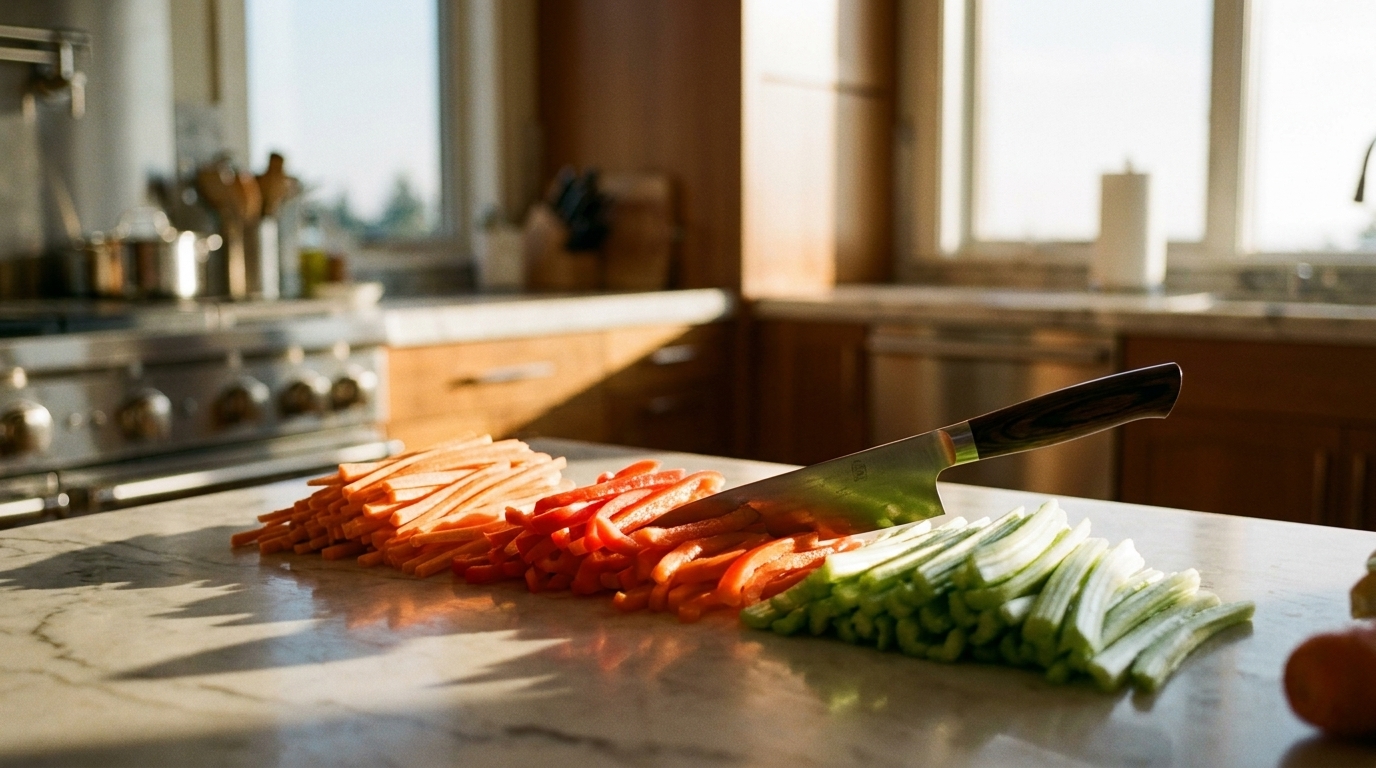
Master the julienne cut to prep weeknight vegetables faster and more evenly, ensuring consistent cooking and better flavor absorption. Thin, uniform strips cook through simultaneously and absorb dressings better than thicker cuts, making your meals taste more seasoned and polished.
What Is a Julienne Cut and Why Home Cooks Should Master It
Uniform julienne strips cook evenly and absorb marinades faster, ensuring consistent texture and flavor in every bite.
The exact dimensions: 1/8-inch thick, 2-3 inches long matchsticks
The julienne cut -- also called the matchstick cut -- produces thin, uniform planks measuring 1/8 inch x 1/8 inch x 2½ inches. [1] A fine julienne reduces those cross-section dimensions to 1/16 inch at the same length, typically reserved for garnishes rather than main-dish prep. [2] These specific dimensions matter practically: strips at this thickness cook through in seconds over high heat and absorb marinades or dressings faster than thicker cuts. [3] The standard julienne works best on firm produce like carrots, celery, and apples, where the knife moves cleanly through without the vegetable compressing -- our guide to knife cuts covers how this cut connects to related techniques like brunoise. [1]
Why julienne transforms ordinary vegetables into restaurant-quality sides
The practical payoff of julienne goes beyond speed -- it's about consistency in the pan and on the plate. [5] Thin, uniform strips in a stir-fry reach the same internal temperature at the same moment, so nothing ends up overdone while the rest catches up. [5] The same logic applies to raw preparations: julienned carrots in a slaw or bell peppers layered into spring rolls hold their texture under dressings rather than going soft. [4] For cooks who also work with leafy herbs, the chiffonade technique applies the same principle -- consistent cut size produces consistent texture and flavor release. [5]

How to Do a Julienne Cut: The Step-by-Step Method That Works Every Time
A sharp knife and a stable flat base are the two foundations that separate clean, uniform matchsticks from crushed, uneven strips.
The five-step process from vegetable prep to finished matchsticks
Start by washing and peeling the vegetable, then trim it into 2-3-inch segments -- this length sets your final strip length, so keep each cut consistent. [6] Slice a thin section off one rounded side to create a flat, stable base so the piece doesn't rock as you work. [7] Place the trimmed piece flat-side down and cut it into 1/8-inch-thick planks; this is the step where a sharp chef's knife matters most, since a dull blade compresses the vegetable rather than slicing cleanly through it. [6] Stack two or three planks at a time and cut again at 1/8-inch intervals to produce finished matchsticks. [7] The rounded edge pieces you trimmed in step two are still the right thickness -- cut them into strips rather than discarding them. [7]
Common mistakes that compromise consistency and safety
The most common issue is a dull blade -- it compresses vegetables rather than slicing through them, producing uneven, crushed strips instead of clean matchsticks. [6] Skipping the flat-base step is the second problem: a rounded piece rocks during cutting, which shifts knife angle mid-stroke and creates strips of uneven thickness. [6] Finger positioning is where safety breaks down -- without a proper claw grip, the guiding hand drifts toward the blade's path as strips get thinner and the piece becomes harder to hold. [6] Inconsistent downward pressure across cuts is what separates passable julienne from tight, uniform strips that actually cook evenly. [8] The Best Tools for Julienne: Knife vs. Mandoline vs. Peeler (Comparison Guide)
Hand knife method: control, safety, and why it's the professional standard
Mandoline, julienne peeler, and food processor alternatives: speed vs. precision trade-offs A mandoline beats knife speed for thin, uniform slices -- down to roughly 1mm -- but requires careful handling since the exposed blade is the leading cause of kitchen lacerations requiring emergency care. [12] Among mandoline types, models with continuously adjustable dials give more control than fixed-notch designs; the Benriner's variable dial and removable blades are why it remains a professional kitchen standard. [9] Julienne peelers strip produce quickly with no setup time, though they work best on medium-firm vegetables and produce less consistent results than a mandoline or knife. [12] Food processors handle the most volume in the least time but trade precision for speed, making them better suited for cooked applications where exact strip dimensions matter less. [11]


Five Weeknight Recipes Where Julienne Cuts Shine (Beyond Fries)
Thin julienne strips expose more surface area to heat and seasoning, so your vegetables absorb flavor faster and cook more evenly than thicker cuts.
Quick-cooking stir-fries, slaws, and noodle bowls that benefit from thin, uniform cuts
Julienne cuts pay off most clearly in three weeknight formats: stir-fries, slaws, and cold noodle bowls.
In a high-heat cabbage stir-fry, thinly sliced vegetables reach the table in under 15 minutes, with uniform thickness preventing any one piece from overcooking while others finish. [13] In cold noodle salads, finely sliced cabbage and carrots absorb dressing evenly and stay easy to chew -- thicker pieces sit on top of the sauce rather than integrating with it. [14] For mayo-free slaws with an acidic dressing, thin cuts hold their crispness longer than thicker pieces, which release water and turn soft quickly. [15]
Why consistent julienne matters for even cooking and better flavor absorption
Cut size directly affects how well vegetables absorb flavor during cooking.
Research on diced zucchini found that smaller pieces -- with roughly twice the surface-to-volume ratio of larger cuts -- lost moisture faster and allowed cooking fat to penetrate more deeply into the tissue. [16] This same surface geometry applies to julienne strips: the thin 1/8-inch cross-section exposes more cell surface to marinades, dressings, and high-heat oil, which is why julienned vegetables taste more seasoned than thicker-cut equivalents dressed with the same amount of sauce. [16] In controlled sensory testing, smaller cut sizes scored higher for texture and overall preference, suggesting that cut dimension affects not just cooking speed but perceived flavor integration -- a practical reason to keep your julienne consistent rather than approximate. [16]
- Julienne cuts (1/8 inch x 1/8 inch strips) cook evenly and absorb marinades faster than thicker cuts.
- Uniform strip thickness prevents overcooking--all pieces reach the same temperature simultaneously in high-heat cooking.
- A sharp chef's knife is critical; dull blades compress vegetables instead of slicing cleanly through them.
- Create a flat base on rounded vegetables before slicing to prevent rocking and ensure consistent thickness.
- Smaller cuts expose more surface area, allowing vegetables to absorb dressing and seasonings more effectively.
- Julienne works best for stir-fries, slaws, and cold noodle bowls where thin, crisp texture matters most.
- https://www.webstaurantstore.com/article/796/types-of-knife-cuts.html?srsltid=AfmBOopxEMyD42rz3w4ZTKbLavFY5hat4ZSzpPDsYJ9vkEeljSdfDM0f
- https://www.thespruceeats.com/culinary-arts-knife-cuts-photo-gallery-4121795
- https://www.escoffier.edu/blog/culinary-arts/8-knife-cuts-every-professional-cook-should-know/
- https://www.foodnetwork.com/how-to/packages/food-network-essentials/how-to-julienne-cut
- https://hospitality.institute/bha102/mastering-vegetable-cuts-julienne-brunoise-more/
- https://santokuknives.co.uk/blogs/blog/how-to-julienne
- https://www.evolvingtable.com/julienne-cut/
- https://reluctantgourmet.com/knife-cuts/
- https://www.seriouseats.com/best-mandolines-7098514
- https://www.epicurious.com/expert-advice/best-mandoline-slicer-article
- https://www.foodandwine.com/best-mandolines-6944616
- https://lovegreatfinds.com/blogs/news/food-chopper-vs-mandoline-comparison?srsltid=AfmBOooU5SlufzmTtqCZRYsjahKmSnaQAZowFhxlxlsSOEzekxZqZ8jy
- https://www.thefoodblog.net/cabbage-stir-fry-recipe/
- https://rainbowplantlife.com/noodle-salad-with-rainbow-veggies/
- https://www.africanbites.com/caribbean-cole-slaw/
- https://pmc.ncbi.nlm.nih.gov/articles/PMC12469137/