

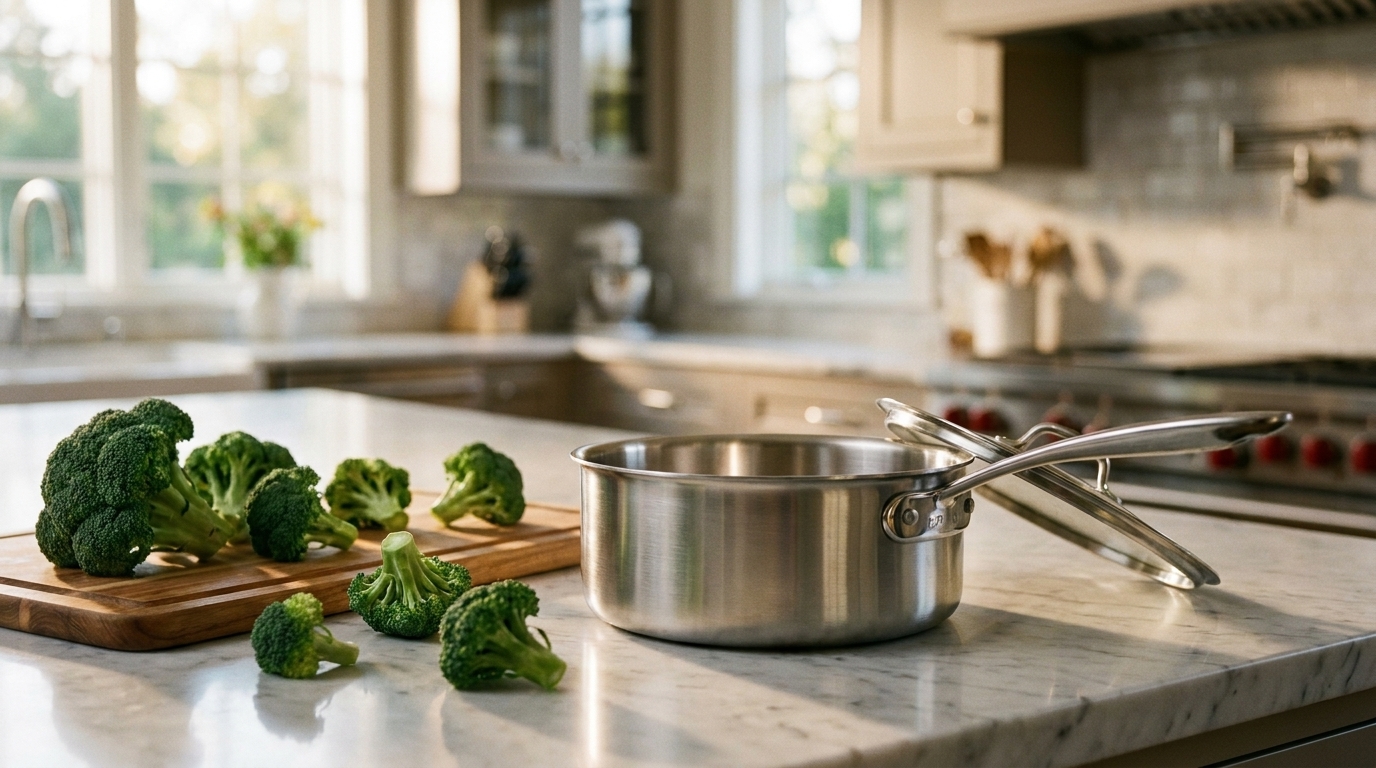
Choosing the right saucepan size ensures steam circulates evenly around broccoli florets, preventing overcrowding and uneven cooking. A 3-quart stainless steel saucepan offers the versatility most home cooks need for steaming vegetables without hot spots or moisture loss.
Why Saucepan Size Matters When Steaming Vegetables
Larger saucepans maintain steadier steam and even heat distribution across your vegetables, preventing the hot spots and uneven cooking that plague crowded pans.
How crowding affects steam circulation and cooking time
Packing broccoli florets too tightly into a saucepan blocks steam from moving between them, so the florets on the bottom overcook while those on top stay underdone. [1] The vegetables release moisture as they heat, raising humidity inside the pan and pulling temperatures down -- which extends cook time beyond what most recipes anticipate. [1] A crowded pan creates an uneven cooking environment where some florets turn soft and others stay firm, and the trapped moisture can cause broccoli to lose its color. [1] Giving florets enough clearance for steam to circulate freely is the practical fix -- and that starts with choosing the right saucepan size for your batch.
The science behind even heat distribution in different saucepan volumes
The volume of a saucepan directly affects how stable the steam environment stays during cooking.
Smaller pans heat water faster but hold less thermal mass, meaning steam generation can fluctuate when burner temperature shifts or moisture escapes around the lid.
Steam transfers heat through condensation -- when vapor contacts a cooler broccoli floret, it releases latent heat directly onto the vegetable's surface, cooking it from all sides rather than just from the bottom up. [2] Larger volumes sustain this process more consistently, providing enough water mass to maintain steady vapor output across a full batch and reducing the hot spots that cause uneven results. [2]

Saucepan Sizes Explained: 1-Quart Through 4-Quart Options
A 3-quart saucepan handles two to four servings without crowding and gives vegetables room to steam evenly, making it the most versatile size for daily cooking.
Small saucepans (1 to 2 quarts): Best uses and broccoli capacity limits
A 1-quart saucepan fits roughly 1 cup of broccoli florets without crowding -- enough for a single portion, but not much more.
A 2-quart expands that to about 2 cups, covering one to two servings comfortably for solo cooks or couples.
Both sizes have straight sides and lids that trap steam, but their compact footprint means capacity runs out fast when cooking for more than two people. [3] For a broader look at what small saucepans handle best day to day, tasks like warming sauces or reheating soup are where they consistently outperform larger pans -- broccoli for a crowd is not their strength.
Medium and large saucepans (3 to 4 quarts): When to choose each for steaming
A 3-quart saucepan -- typically 8 to 9 inches in diameter -- is the size most testers identify as versatile for steaming vegetables, cooking grains, and making sauces, covering two to four servings without crowding. [5] [6] The wider base gives florets lateral room for steam to circulate evenly, which the smaller 1- and 2-quart sizes can't match when batch sizes grow. [4] A 4-quart makes practical sense when you're consistently cooking for four or more, giving you enough room to steam a full batch of broccoli without florets pressing against each other or the lid. [4] At this size, a helper handle becomes worth prioritizing -- a full 4-quart saucepan with steaming water is noticeably heavier to maneuver safely. [5]
The Broccoli Steaming Capacity Chart: Find Your Perfect Saucepan Size
Stainless steel tri-ply saucepans heat evenly for consistent steam and resist moisture damage far better than nonstick coatings.
Sizing guide: Broccoli portions matched to saucepan volumes
Material comparison: Stainless steel vs. nonstick performance for steaming For steaming broccoli, stainless steel outperforms nonstick in every practical way.
Nonstick coatings are designed for low-to-medium heat and delicate foods -- sustained steam generation accelerates their wear over time.[8] Saucepans used for liquid-based tasks don't need nonstick surfaces to begin with, since food rarely contacts the pan surface directly during steaming.[9] Fully clad tri-ply stainless -- aluminum sandwiched between two stainless layers -- heats evenly across the base and walls, maintaining stable steam output without hot spots.[5] Stainless also handles the moisture and mineral deposits from regular steaming far better, and care & maintenance tips are considerably simpler than managing a degrading nonstick coating.[9]
Choosing the Right Saucepan for Your Kitchen and Cooking Style
A 3-quart saucepan handles most household cooking needs, while proper care--cleaning after use, adding salt to boiling water, and using medium heat--keeps stainless steel looking new.
Questions to ask before buying: Frequency, household size, and storage space
Buying the right saucepan starts with three practical questions: how often you cook, how many people you feed, and how much storage you have.
If you cook four or more nights per week, prioritize durable tri-ply stainless construction over lighter-gauge options that can warp under repeated heat cycles. [10] A single 3-quart covers the broadest range of household sizes and takes up less cabinet space than owning separate pans for different tasks -- a good starting point before building out a full cookware set. [10] Households of five or more are the clearest case for moving up to a 4-quart; everyone else generally manages well with a 3-quart plus a smaller pan for sauces. [10]
Maintenance and care tips to extend your saucepan's steaming performance
Regular steaming leaves mineral deposits on saucepan interior walls -- white spots from calcium in tap water -- which a paste of baking soda and hot water, worked in with a non-abrasive sponge, removes without scratching the stainless surface. [11] Pitting develops when undissolved salt sits on the base, so always add salt only to already-boiling liquid and stir immediately to dissolve. [11] Cleaning the pan after every use prevents food residue from burning onto the steel during the next heat cycle, which creates staining that takes significantly more effort to remove than fresh deposits. [11] Keeping heat at medium or lower while building steam also reduces the interior discoloration that accumulates through repeated overheating -- a straightforward care & maintenance tip that protects both appearance and long-term performance. [11]
- Crowded broccoli florets block steam circulation, causing uneven cooking and color loss.
- A 3-quart saucepan is the most versatile size for steaming vegetables for 2-4 servings.
- Tri-ply stainless steel maintains steady steam output better than nonstick for vegetable steaming.
- Larger saucepans sustain consistent steam generation across full batches without temperature fluctuations.
- Salt should dissolve in boiling water before adding to prevent pitting on the pan base.
- A 4-quart saucepan is practical for households of five or more cooking regularly.
- https://brainly.com/question/35554986
- https://lifetips.alibaba.com/kitchen-hacks/how-to-steam-vegetables
- https://www.foodnetwork.com/how-to/packages/shopping/product-reviews/best-saucepans
- https://www.seriouseats.com/best-saucepans-7229377
- https://www.nytimes.com/wirecutter/reviews/the-best-small-saucepan/
- https://www.katom.com/learning-center/saucepan-sizes.html?srsltid=AfmBOoohmiTspgpnUIjRDSlhLaD0RRtYp4-7XjH7Fotrr4IMfhEpuMEf
- https://alohadreams.com/serving-quantity-for-a-large-group/
- https://www.foodnetwork.com/how-to/packages/help-around-the-kitchen/when-to-use-nonstick-or-stainless-steel-pans
- https://www.thespruceeats.com/nonstick-vs-stainless-steel-cookware-908922
- https://www.solamexhome.com/how-many-pots-and-pans-do-you-need-kitchen-cookware-guide-for-every-lifestyle.html
- https://www.360cookware.com/pages/use-care-guide?srsltid=AfmBOoojoY7P8KJDDeKBRXR_a1b1T_aFl8lW1JY74phwriPX5lC-sGHv