

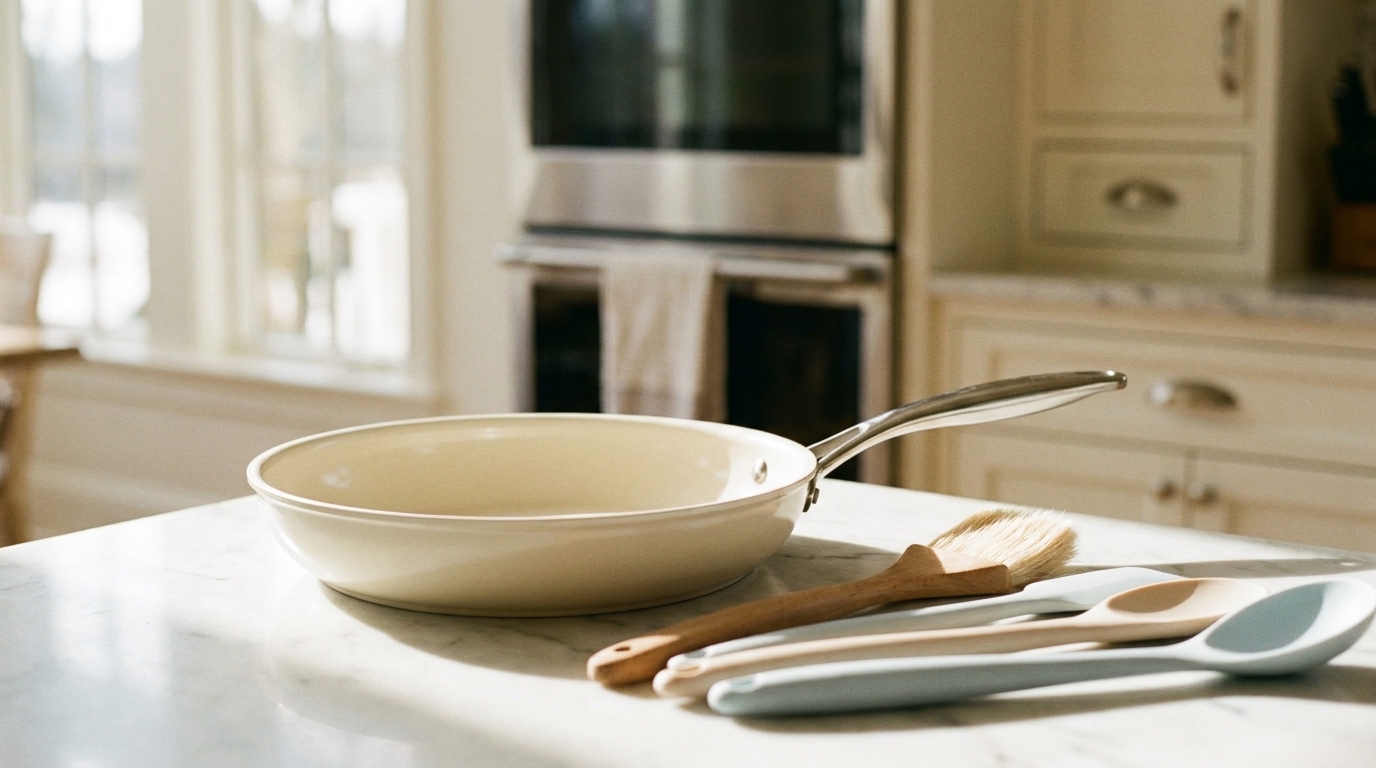
Ceramic non-stick pans are PFAS-free and safer than traditional coated cookware, but their coating degrades within 1-3 years with normal use--making proper maintenance and realistic replacement costs essential. Focus on what labels actually reveal: confirmed PTFE-free designation and published third-party test results matter far more than vague "nontoxic" claims.
The Direct Answer: Yes, Ceramic Non-Stick Is Safe--But There's a Catch
Ceramic pans contain zero PFAS chemicals, but their brittle coating chips easily and rarely lasts more than a few years even with careful use.
Why ceramic non-stick is safer than older PFOA-based coatings
The safety case for ceramic non-stick pans is largely about what they don't contain.
PFOA--one of thousands of per- and polyfluoroalkyl substances (PFAS)--has been linked to liver damage, lowered immunity in children, and other health concerns, and many of these compounds persist in the body for months or years. [1] When Consumer Reports tested three pans for 96 different PFAS chemicals, the two ceramic-coated pans showed zero detectable PFAS, while the PTFE-coated pan contained measurable PFOA and 15 other PFAS compounds. [1] Ceramic coatings are made from silicon- and titanium-based nanoparticles rather than PFAS, so those chemicals aren't required to create the nonstick surface--which makes a PTFE-free claim on a ceramic pan far more reliable than a generic "PFOA-free" label on a PTFE pan. [2]
The hidden durability factor that manufacturers downplay
Ceramic coatings are more brittle than PTFE--prone to chipping and scratching even with careful use--and that rarely appears on packaging. [2] One study found ceramic is slightly more heat-resistant than PTFE, but both degrade at high temperatures, and even with proper care (no metal utensils, low-to-medium heat, hand-washing only), neither type lasts more than a few years. [2] That degradation matters beyond sticking performance: a compromised coating changes how the pan behaves and when it should be replaced--our ceramic coating chip analysis covers what that breakdown looks like.
Factoring in replacement costs upfront, rather than assuming ceramic's health benefits translate to longer lifespan, will save both money and frustration. [2]

What Makes Ceramic Non-Stick Different From Teflon and Other Coatings
Ceramic releases food easily at low to medium heat with minimal fat, while stainless steel demands proper technique but lasts decades without coating degradation.
Ceramic vs. stainless steel: Safety, performance, and longevity compared Stainless steel and ceramic are both PFAS-free, but they diverge significantly on performance and lifespan.
Stainless steel has no coating to degrade--it handles metal utensils, high heat, and searing without issue, and lasts decades where ceramic coatings typically lose their nonstick performance within one to three years. [4] The practical gap shows up in cooking technique: ceramic releases food easily at low to medium heat with minimal fat, making it the simpler choice for eggs or fish, while stainless steel demands proper preheating and sufficient fat to prevent sticking--a technique that comes with a learning curve worth building. [5] One tradeoff specific to stainless steel is minor nickel leaching when cooking acidic foods--worth considering for anyone with nickel sensitivity, and not a factor with ceramic coatings. [5]
The Real Safety Risks: Coating Degradation, Lead, and Scratched Pans
Coating degradation--not lead--is the real safety concern for ceramic pans from mainstream brands, and early signs appear before visible damage.
What happens when ceramic coating wears off--and why it matters sooner than you think
Ceramic coatings lose their nonstick properties when the methyl groups (Si-CH3) on the surface layer are abraded away or when thin, nearly invisible burned-on deposits accumulate--often before any visible damage appears. [7] A 2022 study published in *Science of the Total Environment* found that surface cracks in a damaged nonstick pan can release over 9,000 microplastic and nanoplastic particles, while a fully broken coating may shed roughly 2.3 million. [6] Food starting to stick is the most common early signal, but the underlying degradation typically begins before that point--our chipped ceramic pan analysis covers what the breakdown looks like at each stage. [6] Once the surface layer is structurally compromised, there's no reliable way to restore it. [7]
Heavy metals in ceramic cookware: Separating regulatory fact from marketing fear
The FDA's active lead warnings target a specific category of cookware--uncoated aluminum, hindalium, and brass pots imported from South Asia and Afghanistan--not the ceramic-coated pans sold by mainstream Western brands. [8] A peer-reviewed study found that some hindalium and brass cookware leached lead at levels exceeding children's daily safety limits by more than 1,000-fold, while stainless steel cookware tested in the same study leached lead well below those thresholds. [10] The FDA's regulatory position is unambiguous: any detectable lead leaching from cookware is prohibited, and ceramic coatings--which rely on silicon dioxide and titanium dioxide rather than metal alloys--don't carry the material composition that makes uncoated aluminum and brass pots a lead risk. [9] For ceramic-coated pans purchased from established mainstream retailers, coating degradation is the practical issue worth tracking, not heavy metal contamination.


How to Choose and Maintain Ceramic Non-Stick for Long-Term Safety
Avoid high heat, metal utensils, and the dishwasher to keep ceramic coating intact; hand-wash with soft sponges and let pans cool gradually to prevent damage.
The maintenance Essentials that extends ceramic coating life by years
The biggest threats to ceramic coating longevity are high heat, metal utensils, and dishwasher exposure -- all three avoidable.
Keep burners at low to medium heat, never preheat an empty pan, and use silicone or wooden utensils; metal contact removes the surface groups responsible for nonstick release, accelerating breakdown. [12] Hand-wash with a soft sponge and mild soap after each use, then let the pan cool before it contacts cold water -- thermal shock causes micro-cracks that accumulate over time. [13] Pans with three or more ceramic layers handle daily wear better than single-coat options, and our care & maintenance tips on extending PFAS-free pan life cover the daily habits that add years to coating performance. [11]
Red flags on pan labels: What to avoid when buying ceramic non-stick
"PFAS-free" on a label doesn't mean the pan has been tested for all PFAS -- most third-party tests screen fewer than 100 of the roughly 15,000 known PFAS compounds, leaving room for less-regulated substitutes to go undetected. [14] Brands that don't publish their coating ingredients or third-party test results provide no chemical basis to evaluate the claims on their packaging. [15] "Nontoxic" has no regulatory definition in cookware and carries no legal obligation to prove. [14] For a comparison of coated vs. bare ceramic construction, look for a confirmed PTFE-free designation and published test data -- those are the two label signals worth trusting. [1]
- Ceramic pans contain zero PFAS chemicals, while PTFE pans tested positive for PFOA and 15 other PFAS compounds.
- Ceramic coatings degrade within 1-3 years even with proper care; stainless steel lasts decades without a coating to break down.
- Damaged ceramic coatings shed millions of microplastic particles; food sticking signals degradation has already begun.
- Low-to-medium heat, wooden utensils, and hand-washing only are non-negotiable to extend ceramic pan life.
- "PFAS-free" labels don't guarantee safety--only brands publishing coating ingredients and third-party test results provide verifiable claims.
- Lead leaching risks apply to uncoated aluminum and brass imports, not ceramic-coated pans from mainstream retailers.
- https://www.consumerreports.org/toxic-chemicals-substances/you-cant-always-trust-claims-on-non-toxic-cookware-a4849321487/
- https://www.seriouseats.com/nonstick-vs-ceramic-skillets-7110252
- https://cen.acs.org/environment/persistent-pollutants/does-nonstick-cookware-work-should/103/web/2025/04
- https://www.organicauthority.com/guide/stainless-steel-vs-ceramic-cookware
- https://www.zendaguide.com/post/ceramic-vs-nonstick-vs-stainless
- https://health.yahoo.com/wellness/nutrition/articles/5-warning-signs-nonstick-cookware-132322546.html
- https://economistwritingeveryday.com/2023/06/06/how-ceramic-pans-work-and-how-to-restore-their-non-stick-coating/
- https://www.fda.gov/food/alerts-advisories-safety-information/fda-issues-warning-about-imported-cookware-may-leach-lead-august-2025
- https://blogs.edf.org/health/2023/08/15/fda-says-cookware-that-exhibits-any-level-of-leachable-lead-upon-testing-is-prohibited/
- https://www.nature.com/articles/s41370-024-00686-7
- https://www.leafscore.com/eco-friendly-kitchen-products/cookware/most-non-stick-pans-dont-last-very-long-heres-what-to-do-about-it/
- https://www.sensarte.com/blogs/all/prolonging-the-longevity-of-your-nonstick-cookware-best-practices-for-care
- https://siraatskitchen.com/blogs/care-use/how-long-do-non-stick-pans-last-lifespan-care-when-to-replace?srsltid=AfmBOoovgcEdMfZr8AChAheKkYhh9ByItSJ2GzhGObz8tV_yNwykuyDi
- https://foodprint.org/blog/what-to-know-about-nonstick-cookware/
- https://www.pureandsimplenourishment.com/is-ceramic-cookware-safe/
- Summary
- The Direct Answer: Yes, Ceramic Non-Stick Is Safe--But There's a Catch
- What Makes Ceramic Non-Stick Different From Teflon and Other Coatings
- The Real Safety Risks: Coating Degradation, Lead, and Scratched Pans
- How to Choose and Maintain Ceramic Non-Stick for Long-Term Safety
- Key Takeaways
- References